
Sharks (continued)

Not all sharks are listed on this page. See the list below for the order in which shark entries are listed
Previous Page
This page
Ground sharks (Carchariniformes)

Cat Sharks, Hound Sharks
Carcharhiniform sharks are an order of sharks commonly known as the ground sharks. This group represents the most diverse order of living sharks and includes tiger sharks, bull sharks and hammerheads. Like many types of true sharks, these animals have five gill slits, an anal fin, two dorsal fins lacking spines and a nictitating membrane that protects their eyes while biting into their prey. The members of this group have highly variable tooth shapes depending on their ecological niche, ranging from long thin teeth for catching small fish to the blade-like teeth of the tiger shark. Fossils of carchariniform shark teeth are less common in rock layers from the Western Interior Sea than the remains of their lamniform cousins. Many of the roles occupied by today’s requiem sharks and larger ground sharks were filled by these extinct mackerel shark genera, and most remains of Cretaceous ground sharks seem to be those of smaller animals. Nevertheless, a few genera known from fairly complete skeletal remains dating back to the Cretaceous still have living members found in the world’s oceans today.
Archaeotriakis
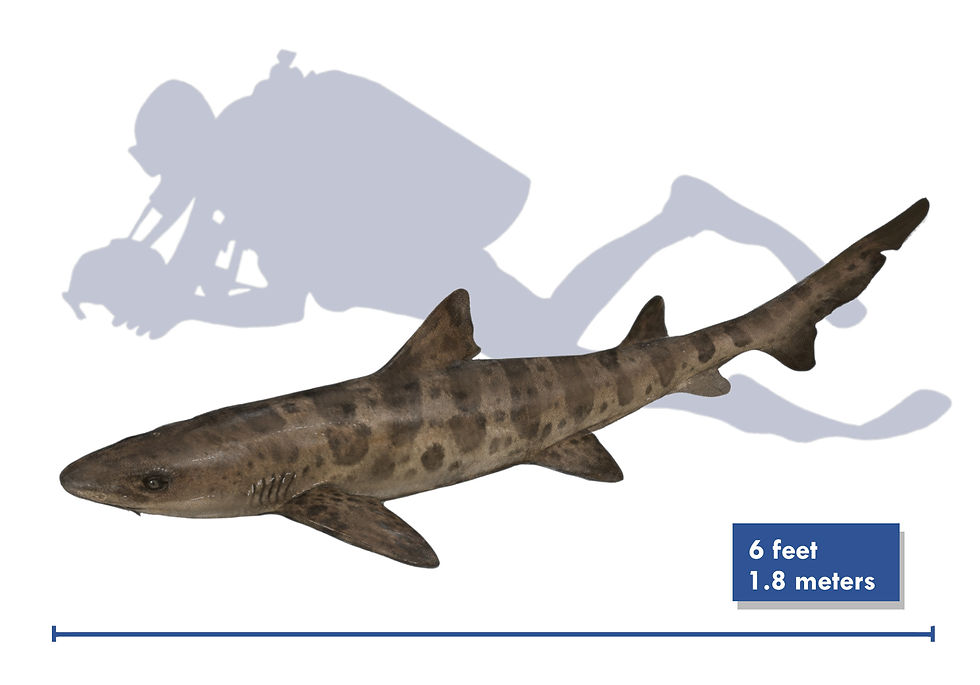
Temporal Range: 75 million years ago
Geographic Range: Wyoming, Canada, Montana
Species: A. rochelleae, A. ornatus
Diet: Carnivorous, fish, small invertebrates
Archaeotriakis was a small prehistoric carcharhiniform shark which is considered a member of the false catshark family Pseudotriakidae. Its teeth were tiny but strongly built, with large central cusps with two smaller cusps on each side. The largest of these side cusplets are still about half the size of the main cusp of the tooth. These teeth also had distinct ridges running vertically along the lower margins of their cusps. The main cusps of these teeth are shorter than those found in many other types of sharks. Some features of its teeth look a lot like those of early ancestral ground sharks, while others, such as the unusually large side cusps and curved cutting edges, are rarely seen in related species. This may be a sign that Archaeotriakis would have occupied a unique role in the marine ecosystem and possibly fed on different types of prey than other carcharhiniform sharks. Its fossils are found in areas which would have been near the coastline in shallow waters and possibly in estuarine or nearshore river environments.

Galeorhinus

Temporal Range: 97 million years ago - present
Geographic Range: Worldwide distribution
Species: G. cuvieri, G. duchaussoisi, G. girardoti, G. glickmani, G. louisi, G. muelleri,
G. tenius, G. galeus
Diet: Carnivorous, fish, cephalopods
Galeorhinus is an extant genus of hound shark whose fossil remains are also known from the Cretaceous period. They are also known as school sharks. These animals have very long, narrow snouts. Their mouths are broad and curved, and the teeth in both jaws are very similar in size and shape. These teeth are small, triangular and flat when viewed from the side. The distal edge of each tooth is covered in a row of prominent serrations. These teeth seem to be suited both for catching and cutting through soft-bodied prey. The bodies of these sharks are long and narrow and the first dorsal fin is located just behind the pectoral fins, while the second dorsal fin is nearly equal in size to the anal fin and positioned directly above it. These sharks are known from many different species found from the middle Cretaceous period onwards but only one species is found today, Galeorhinus galeus.
Palaeogaleus

Temporal Range: Late Cretaceous, parts of the Paleogene
Geographic Range: Parts of North America, Europe, Africa
Species: P. navarroensis, P. larachei
Diet: Carnivorous, fish, cephalopods
Palaeogaleus was an extinct hound shark. Its teeth were generally small and narrow, roughly similar to those of animals like Galeorhinus, with a sharp central cusp and smaller cusps on either side. Compared with the larger, broader cutting teeth found in many larger carcharhiniform sharks, the teeth of Palaeogaleus appear to have been better suited for catching and holding smaller prey. These animals are some of the first members of the houndshark family Triakidae to appear during the late Cretaceous period. The genus has no living members.
Squatigaleus

Temporal Range: 75 million years ago - 66 million years ago
Geographic Range: Central North America, parts of Europe and Africa
Species: S. sulphurensis
Diet: Carnivorous, fish, sharks, marine reptiles
Squatigaleus was a rare extinct carcharhiniform shark that is known mainly from fossil teeth found in Late Cretaceous rocks. The best-known species is Squatigaleus sulphurensis which has been identified from fossil deposits in Texas and is classified within the hound shark family, Triakidae. Its teeth are quite different from those of other types of hound sharks. These teeth have much more prominent main cusps which are very wide and slightly curved when viewed from the side. Based on the size of their teeth and the appearances of their living relatives, Squatigaleus was probably a smaller shark with a long, thin body.
Synechodontiformes
Synechodontiformes is an order of cartilaginous fishes which has its origins in the Permian period and which managed to survive past the end-Cretaceous mass extinction event all the way up until the middle of the Paleogene period. Their exact classification within the cartilaginous fish family tree remains a subject of debate. They are sometimes considered to be true members of the shark division Selachii as an early line branching off from the Galean sharks. Other studies consider them to fall outside of the true shark group and instead recover them as a separate group which spilt off from the common ancestors of sharks and rays.
Synechodus

Temporal Range: Triassic to the early Paleogene, possible Permian record
Geographic Range: North America, parts of Europe and eastern Russia
Species: S. dubrisiensis, S. antiquus?
Diet: Carnivorous, fish, cephalopods
Synechodus is a very old genus of sharks, with the first members of this genus dating back to the early Triassic and possibly parts of the Permian period. In addition to fossils of its teeth, some Synechodus fossils preserve the shape of the animal’s entire body. Synechodus teeth had a thin central cusp flanked by three to five smaller cusps on each side. These teeth were better suited for grasping and holding prey than for cutting large pieces of flesh. The roots of the teeth were very wide but very thin with a gentle curve positioned beneath the area supporting the main cusp of each tooth. Fossil skeletons show that Synechodus had a broad head, a rounded snout, and large pectoral fins attached to a relatively compact body. It had a single dorsal fin positioned further along the animal’s back which did not feature the defensive fin spines seen in some ancient shark groups.
Paraorthacodus

Temporal Range: 200 million years ago - 37 million years ago
Geographic Range: Worldwide distribution
Species: P. andersoni, P. antarcticus, P. clarkii, P. conicus, P. eocaenus, P. jurensis,
P. nerviensis, P. patagonicus, P. recurvus, P. sulcatus, P. validus, P. helveticus
Diet: Carnivorous, fish, cephalopods
Paraorthacodus was a genus of shark very similar to the related genus Synechodus. Some fossils are known from this genus which preserve the entire shape of the animal's body which show us that, like many of its relatives, these animals would have had blunt, rounded snouts, short fins and a dorsal fin located further along the animal’s back. Their teeth were similar to those of Synechodus but can be distinguished by the order of the sizes of their lateral cusplets, which decrease in size more slowly than those of their relatives as they move further away from the main tooth cusp.
Angelsharks (Squatiniformes)
Angelsharks are a very unique group of sharks who are adapted to spend their lives as ambush hunters, partially burying themselves on the seafloor. Their bodies are roughly similar to those of electric rays or guitarfishes, although the arrangement of their teeth and positions of the gill slits indicate that they are, in fact, members of the true shark group. Their pectoral fins are quite large and they join up with the body just below the base of the head. The rest of their bodies are extremely flat and dorso-ventrally compressed.
Squatina

Temporal Range: 118 million years ago - Present
Geographic Range: Worldwide distribution
Species: S. cranei, S. prima, S. crassa, S. minor, S. baumbergensis
Diet: Carnivorous, fish, benthic invertebrates
The genus Squatina is a type of angel shark. This group of sharks is rather strange since its members resemble rays more than they look like typical sharks. Instead of having the streamlined body shape seen in most sharks, angel sharks have broad, flattened bodies and large, wing-like pectoral and pelvic fins. This body design allows them to rest comfortably on the seafloor and remain well camouflaged in sandy or muddy habitats. Even though they look similar to rays they still have many important features found in other sharks, including a muscular tail, two dorsal fins, and gill slits positioned along the sides of their heads. There are several species of Squatina angelsharks found in today’s oceans but their fossil record dates all the way back to the early Cretaceous. Although they are rare in the central US, their fossils are occasionally found in deposits formed by the Western Interior Sea. Angel sharks are ambush predators. Rather than swimming actively in search of prey angel sharks spend much of their time lying motionless on the seabed. They often cover themselves in a thin layer of sediment to add to their disguises. With only their eyes and spiracles visible they can remain hidden until a fish or other prey item comes within range.
Bullhead sharks (Heterodontiformes)
Bullhead sharks are a group of cartilaginous fishes whose first fossil remains date back to the Jurassic period. These tend to be rather small sharks who specialize in feeding on benthic invertebrates near the seafloor. They have eyes which are positioned above their bodies and dorsal fins which are equipped with sharp protective spines.
Heterodontus

Temporal Range: ~155 million years ago - Present
Geographic Range: Worldwide distribution
Species: H. rugosus
Diet: Carnivorous, fish, marine invertebrates
The genus Heterodontus is a group of sharks commonly known as bullhead sharks. These animals are used for their very unique teeth and mouthparts which are quite different from those of large macropredatory sharks. The teeth at the front of their jaws are sharp and pointed so that the shark can hold on to its prey while the teeth at the back of the mouth are more broad and flattened for crushing hard-shelled animals such as sea urchins, crabs, and mollusks. This combination of different tooth types is uncommon among sharks and is the reason for the name Heterodontus, which means “different teeth.” These animals are also easily identifiable thanks to the shape of their heads. They have a short, blunt snout and prominent ridges above their eyes that look like small horns. They also have two dorsal fins, each supported by a strong spine. These dorsal fin spines are a feature that is rare among modern sharks but is found in many types of extinct sharks and shark relatives. They likely provide protection from predators.
Dogfish (Squaliformes)
Dogfishes as a group of relatively small sharks which show up at the start of the Cretaceous period. They are easily distinguished from other types of sharks by their lack of an anal fin in between their pelvic fins and caudal fluke. Living dogfish sharks are known to travel extremely long distances, in some cases for thousands of miles, as part of migrations or in search of food. They usually feed on soft-bodied prey animals
Squalus

Temporal Range: 89 million years ago - Present
Geographic Range: Worldwide distribution
Species: S. ballingsloevensis
Diet: Carnivorous, fish, cephalopods
Squalus is a genus of dogfish sharks. These are a smaller variety of sharks which have long, thin bodies. Members of this genus also have a sharp spine located in front of each of their two dorsal fins. These spines give them some extra protection from predators and are one of the defining traits of the genus. These animals also do not have an anal fin. Squalus sharks also have a slender body, a pointed snout, and relatively uniform teeth in both the upper and lower jaws. Unlike sharks with highly specialized teeth for cutting or crushing, dogfish sharks have sharp, blade-like teeth that are well suited for capturing and eating small fishes and invertebrates.
Sixgill sharks (Hexanchiformes)
Sixgill sharks, which are still found in the world's oceans today, first appear in the fossil record during the early Cretaceous period. Their tooth fossils are fairly rare in Cretaceous deposits from the Western Interior Sea but they may have spent their lives hunting at the bottom of deeper areas in the sea, much like their living descendants.
Hexanchus

Temporal Range: 110 million years ago - Present
Geographic Range: Worldwide distribution
Species: H. agassizi, H. andersoni, H. casieri, H. gracilis, H. microdon
Diet: Carnivorous, fish, sharks, marine reptiles
The genus Hexanchus is a group often known as the sixgill sharks. As their name suggests, Hexanchus had six gill slits on each side of its body. Most modern sharks have only five gill slits, making this extra pair a key feature that separates sixgill sharks from nearly all other shark groups. Hexanchus species have only one dorsal fin instead of the two found in most other extant sharks. This genus is particularly old among extant true sharks and their strange anatomical features hint at their separation from most other branches on the shark family tree. Their tooth shape and arrangement is also rather odd. The lower jaw contains large, comb-shaped teeth with multiple sharp cusps, while the upper jaw is lined with smaller, narrower teeth. This arrangement makes it easier for sixgill sharks to grip and tear apart a variety of prey. Unlike most shark species that are commonly found in shallow coastal waters, Hexanchus sharks are primarily deep-water animals. Their fossil teeth occasionally show up in Cretaceous rocks linked to the presence of the Interior Sea.
Unclear affinities
Aquilolamna

Temporal Range: 93 million years ago
Geographic Range: Central Mexico
Species: A. milarcae
Diet: Filter feeder, plankton, copepods, algae
Aquilolamna is a very strange type of shark whose body shape was only recently revealed. Fossils showing the anatomy of the animal’s entire body have been recovered from the Agua Nueva Formation in Mexico, which sat just below the southern edge of the Western Interior Sea during the Late Cretaceous. These animals had a body design unlike that of any shark living today. Although it had the streamlined body and tail typical of sharks, its most striking feature was its enormous wing-like pectoral fins. These fins were so large that the animal's wingspan exceeded its body length which gave it an appearance more similar to that of a manta ray than a traditional shark. This combination of shark and ray-like characteristics makes Aquilolamna unique among known elasmobranchs. These animals also seem to have a diet similar to that of today’s manta rays, with its small teeth and relatively wide mouth possibly suggesting that it was a filter feeder that fed on plankton in open water.
Media Gallery


Suggested References: Sharks
Case,G. R.;H. Cappetta. (1997). “A new Selachian Fauna from the Late Maastrichtian of Texas” (Upper Cretaceous/Navarroan; Kemp Formation) . Münchner Geowiss. Abh. (A)(34):131–189
Cook, T.D.; Newbrey, M.G.; Murray, A.M.; Wilson, M.V.H.; Shimada, K.; Takeuchi, G.T.; Stewart, J.D. (2011). "A partial skeleton of the Late Cretaceous lamniform shark, Archaeolamna kopingensis, from the Pierre Shale of western Kansas, U.S.A.". Journal of Vertebrate Paleontology. 31 (1): 8–21
Everhart, M. J. (2004). “Late Cretaceous interaction between predators and prey. Evidence of feeding by two species of shark on a mosasaur”. PalArch, vertebrate palaeontology series 1(1):1-7.
Everhart, M.J. (2017). “Oceans of Kansas - A Natural History of the Western Interior Sea”, Second Edition. Indiana University Press, 460 pp.
Everhart, M. J. (2005). “Bite marks on an elasmosaur (Sauropterygia; Plesiosauria) paddle from the Niobrara Chalk (Upper Cretaceous) as probable evidence of feeding by the lamniform shark, Cretoxyrhina mantelli”. PalArch, Vertebrate paleontology 2(2): 14-24.
Everhart, M. J. and K. Ewell. (2006). “Shark-bitten dinosaur (Hadrosauridae) vertebrae from the Niobrara Chalk (Upper Coniacian) of western Kansas”. Kansas Academy of Science, Transactions, 109 (1-2):27-35.
Jambura, P.L.; Stumpf, S.; Kriwet, J. (2021). "Skeletal remains of the oldest known pseudocoracid shark Pseudocorax kindlimanni sp. nov. (Chondrichthyes, Lamniformes) from the Late Cretaceous of Lebanon". Cretaceous Research. 125
Lucas, S. G.; Sullivan, R. M. (2006). “Late Cretaceous Vertebrates from the Western Interior: Bulletin 35.” New Mexico Museum of Natural History and Science.
Maisey, J. G., (1996). Discovering Fossil Fishes. Henry Holt and Company, New York.
McAllister, J. A. (1985). “Reevaluation of the formation of spiral coprolites” - University Kansas Paleontology Contributions, Paper 114, 12 p.
McIntosh, A. P.; Shimada, K.; Everhart, M. J. (2016). "Late Cretaceous marine vertebrate fauna from the Fairport Chalk Member of the Carlile Shale in southern Ellis County, Kansas, U.S.A." Transactions of the Kansas Academy of Science.
Schwimmer, D. R., J.D. Stewart, and G. D. Williams. (1997). “Scavenging by sharks of the genus Squalicorax in the late Cretaceous of North America”. PALAIOS, 12:71-83.
Shimada, K. (2007). "Skeletal and dental anatomy of lamniform shark, Cretalamna appendiculata from Upper Cretaceous Niobrara Chalk of Kansas". Journal of Vertebrate Paleontology, 27(3):584–602.
Shimada, K. (2008). “Ontogenetic parameters and life history strategies of the Late Cretaceous lamniform shark, Cretoxyrhina mantelli, based on vertebral growth increments”. Journal of Vertebrate Paleontology 28(1):21-33.
Shimada, K. and Cicimurri, D.J. (2005). “Skeletal anatomy of the Late Cretaceous shark, Squalicorax (Neoselachii: Anacoracidae).” Paläontologische Zeitschrift 79(2): 241-261.
Shimada, K and M. J. Everhart. (2003). “Ptychodus mammillaris (Elasmobranchii) and Enchodus cf. E. schumardi (Teleostei) from the Fort Hays Limestone Member of the Niobrara Chalk (Upper Cretaceous) in Ellis County, Kansas”. Kansas Academy of Science, Transactions 106(3-4):171-176.
Shimada, K. and M. J. Everhart. (2004). “Shark-bitten Xiphactinus audax (Teleostei: Ichthyodectiformes) from the Niobrara Chalk (Upper Cretaceous) of Kansas”. The Mosasaur 7, p. 35-39.
Shimada, K. and D. J. Martin. (1993). “Upper Cretaceous selachians from the basal Greenhorn Limestone in Russell Co., Kansas”. Kansas Academy of Science Abstracts, 12(78).
Shimada, K. (1993). Upper Cretaceous selachians from the Fort Hays Limestone Member of the Niobrara Formation in Ellis County, Kansas. Kansas Academy of Science Abstracts, 12(78).
Shimada, Kenshu; Ewell, Keith; Everhart, Michael J. (2004). "The First Record of the Lamniform Shark Genus, Johnlongia, from the Niobrara Chalk (Upper Cretaceous), Western Kansas". Transactions of the Kansas Academy of Science. 107 (3/4): 131–135.
Shimada, Kenshu; Popov, Evgeny V.; Siversson, Mikael; Welton, Bruce J.; Long, Douglas J. (2015). "A new clade of putative plankton-feeding sharks from the Upper Cretaceous of Russia and the United States". Journal of Vertebrate Paleontology. 35 (5)
Shimada, Kenshu; Everhart, M.J. (2019). "A new large Late Cretaceous lamniform shark from North America, with comments on the taxonomy, paleoecology, and evolution of the genus Cretodus". Journal of Vertebrate Paleontology. 39 (4)
Siverson, M. and J. Lindgren. (2005). “Late Cretaceous sharks Cretoxyrhina and Cardabiodon from Montana, USA”. Acta Palaeontol. Pol. 50(2) 301-314.
Underwood, C.J.; Cumbaa, S.L. (2010). "Chondrichthyans from a Cenomanian (Late Cretaceous) bonebed, Saskatchewan, Canada". Palaeontology. 53 (4): 903–944.
Welton, B. J., and R. F. Farish (1993). "The Collector's Guide to Fossil Sharks and Rays from the Cretaceous of Texas." Before Time, Lewisville, Texas, 204 pp.
Williamson, T. E., J. I. Kirkland and S. G. Lucas. (1993). “Selachians from the Greenhorn cyclothem ("Middle" Cretaceous: Cenomanian-Turonian), Black Mesa, Arizona, and the paleogeographic distribution of Late Cretaceous selachians”. J. Paleon. 67(3):447-474.