
Sharks

Sharks of the Cretaceous Seas
Sharks are a specialized group of cartilaginous fishes that can be distinguished from rays, skates, chimaeras and other related animals by a suite of unique characteristics; namely their torpedo-shaped bodies, multiple visible gill slits, and strong fluke-shaped tails. Sharks are covered with dermal denticles, tiny tooth-like scales that reduce water resistance. They also have advanced senses which let them detect vibrations and electrical signals in the water. Unlike many fishes, sharks do not have swim bladders and instead maintain their buoyancy with the help of large, oil-filled livers. The Western Interior Sea supported a wide variety of shark species, including large macropredatory carnivores, durophagous shell-crushers and benthic ambush hunters.
Anatomy
External Anatomy
The external anatomies of sharks vary widely between different groups but some characteristic features are shared by most sharks. Most types of sharks have five external gill slits on each side of their heads, situated in front of their pectoral fins. They tend to have two dorsal fins, two pectoral fins, two pelvic fins and an anal fin. Their caudal fin is divided into a ventral and a dorsal lobe and is often separated from the rest of the body of the animal by a keel and a small indendation called a precaudal pit. Many types of sharks also have a small opening behind each of their eyes called a spiracle. These spiracles are used to take in water which is then fed over their gills so that the shark can breathe while standing still. These animals also have external openings for their nares and some orders of sharks have distinctive whisker-like barbs used to detect prey. Most sharks have mouths with multiple rows of replacement teeth in reserve behind their main set of functional teeth.

(BELOW) General external antatomical features of a a shark, Cardabiodon. Not all of these features are present in every type of shark. Dogfish sharks lack an anal fin, angelsharks have large pectoral fins and flattened bodies. Most sharks have torpedo-shaped bodies which taper off gradually between the dorsal fin and the caudal fin.
Skeletal Anatomy

The skeletons of sharks are not ossified like those of tetrapods or ray-finned fishes. Instead, most parts of their skeletons are composed of a more flexible material called cartilage. Key structures such as the muscles of the fins, the arches of the gills, the jaws and pectoral arches are supported by cartilaginous rays and arcing structures. The skulls of sharks are formed from a larger set of cartilaginous structures which together form the chondocranium. The cartilages of the jaws are composed of the cartilage of the upper jaws and the Meckel's cartilage of the lower jaws. Along the length of the body of the shark runs the vertebral column, formed of flexible bundles of cartilage which encase the spinal cord.
(BELOW) Skeletal anatomy of a shark showing the positions of key cartilaginous structures. In some Cretaceous sharks older individuals have tougher material infusing their skeletons with age. As a result, more complete remains of these animals sometimes make it into the fossil record. Complete remains of Squalicorax, for instance, turn up in Cretaceous marine strata.
Teeth and Jaws
The jaws of sharks are composed of several cartilaginous structures. The upper jaws form a distinct arc supported by the palatoquadrate cartilages. The lower jaws are formed from the Meckel's cartilage. The cartilages of the jaws are joined along the middle at a point called the symphysis. Different areas across the jaws of sharks support different tooth shapes.
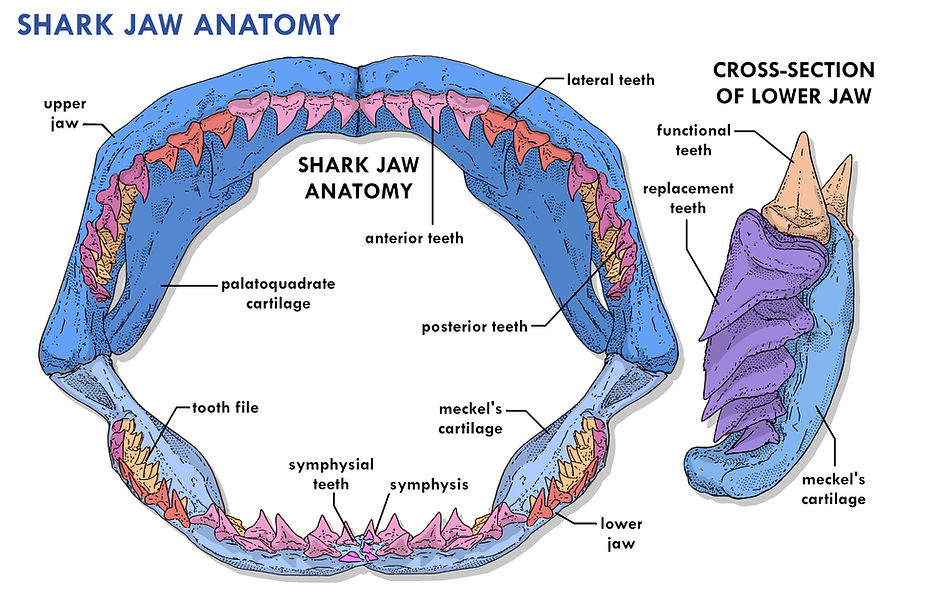
(BELOW) The anatomy of the jaws of a shark. The foremost teeth face outwards as a set of functional teeth while a series of replacement tooth rows sit in the rear. As a tooth falls out of the functional row the replacement teeth move up to fill their places. By looking at the particular shape of a shark tooth it is possible to tell where in the shark's mouth it would have originated. The largest teeth are in the anterior and lateral sections of the mouth while very small symphysial teeth are positioned along the symphysis of the Meckel's cartilages.

(BELOW) General structure of a shark tooth. The upper part of the shark tooth is composed of the tooth root, positioned at the point where the tooth joins with the jaw cartilages and the gum tissue. The transverse groove seen on the roots of some of these teeth are positioned on the inward-facing (lingual) side of the tooth.

(BELOW) A selection of shark tooth types found in deposits from the Western Interior Sea. These teeth came from a wide variety of different types of sharks occupying a range of niches, including shell crushers, fish-eating soft prey specialists and macropredatory animals who fed primarily on large vertebrate prey.
Not all sharks are listed on this page. See the list below for the order in which shark entries are listed
Next page
This page
Carpet sharks (Orectolobiformes)

Nurse Sharks, Bamboo Sharks, Wobbegongs
Orectolobiform sharks, often referred to as carpet sharks, are a group of sharks which can be recognized by the presence of a set of barbels located near their nostrils, which help them with finding prey on the seafloor, and the particular position of their mouths which are located toward the front of the head.
Unlike most types of open-water sharks, orectolobiforms are typically adapted to life near the bottom in near-benthic environments where camouflage plays an important role in avoiding predators and ambushing prey. Living members of this group include nurse sharks, whale sharks, zebra sharks, and wobbegongs. The rocks left behind by the Western Interior Sea preserve the fossil remains of members of the families Ginglymostomatidae and Orectolobidae. Fossils assigned to genera such as Cretorectolobus are fairly rare but their presence serves as a hint that these animals already occupied bottom-dwelling niches and would have fed on small benthic marine animals just as their relatives do to this day.
Cantioscyllium

Temporal Range: ~123 - 66 million years ago
Geographic Range: North America, Europe, western Asia
Species: C. decipiens, C. meyeri, C. brachyplicatum, C. hashimiaensis
Diet: Ambush predator, benthic invertebrates
Cantioscyllium is an extinct genus of Cretaceous nurse sharks. Among Cretaceous carpet sharks it is somewhat notable since it seems to be known from fairly complete fossils of its chondocranium, in addition to the more common fossils of its teeth. Skeletal fossils of Cantioscyllium show that these were small-medium sized sharks with fairly similar proportions to their living relatives. Their teeth are small, triangular, fairly blunt and seem to be well adapted for crushing the shells of benthic invertebrates, such as decapods. It likely hunted near the ocean floor in life, using its sensory barbels to search for food hiding beneath the marine substrate of the ocean floor.

Chiloscyllium

Temporal Range: 95 million years ago - Present
Geographic Range: Worldwide distribution
Species: C. broenirnani (extinct) , C. arabicum, C. burmensis, C. caeruleopunctatum, C. griseum, C. hasselti, C. indicum, C. plagiosum, C. punctatum
Diet: Carnivorous, small fish, invertebrates
Chiloscyllium is a genus of bamboo sharks that is known from fossils found in the Cretaceous but which still has living species found in the world’s oceans today. These animals are adapted for spending their lives near the seafloor. Unlike their wobbegong relatives, bamboo sharks have fairly narrow bodies for carpet sharks. Their dorsal fins are positioned far towards the back of their bodies. Many living genera have skin with splotchy or striped patterns to help keep these animals hidden. Remains of Chiloscyllium from deposits originating in the Western Interior Sea mostly come in the form of fossilized teeth. Their teeth are very small and triangular with large central cusps. Their fossils are found in layers of chalk and shale deposited throughout the Great Plains and eastern North America.

(BELOW) A Chiloscyllium tooth. The teeth of these animals are particularly small with a large middle cusp. Original photo taken by Dylan Falkner/Prehistoric Alabama
(BELOW) A living example of an extant Chiloscyllium species; C. punctuatum. These animals tend to stay near the seafloor and take shelter in reefs or in the cracks between large rocks. Image by Zul M Rosle, distributed via Wikimedia commons under a CC BY 2.0 license.

Cretorectolobus

Temporal Range: 129 - 66 million years ago
Geographic Range: Central North America, parts of the UK
Species: C. olsoni, C. gracilis, C. robustus
Diet: Ambush predator, small fish and invertebrates
Cretorectolobus was an extinct member of the carpet shark family orectolobidae. These animals had teeth that were relatively narrow and specialized for grasping prey, whereas some other carpet sharks had broader tooth forms adapted to a wider variety of feeding strategies such as cutting or shell-crushing. Although modern wobbegongs are often characterized by elaborate skin flaps and highly developed camouflage styled after clumps of seaweed or kelp, the appearance of Cretorectolobus is known mainly from its teeth which makes it difficult to determine whether it shared all of those adaptations for hiding on the sea floor. Its fossils are found on both sides of the Atlantic in Europe and North America in places which were covered by warm shallow seas during the Late Cretaceous.
Orectoloboides

Temporal Range: 97 - 94 million years ago
Geographic Range: Central North America, parts of Europe
Species: O. parvulus, O. multistriatus, O. reyndersi, O. angulatus, O. gijseni
Diet: Ambush predator, small fish and invertebrates
Orectoloboides was an extinct genus of carpet shark that belonged to the same broad group as modern wobbegongs. Like its living kin, it likely depended on camouflaged patterning to hide from its prey before lunging out in an ambush attack. Its relatively small teeth suggest that it fed on smaller animals rather than the large prey targeted by the more famous large Cretaceous mackerel sharks. Fossils of Orectoloboides from rocks deposited by the Western Interior sea consist primarily of isolated teeth.
Plicatoscyllium

Temporal Range: 76 - 66 million years ago
Geographic Range: Central North America, parts of Europe and western Asia
Species: P. derameei, P. gharbii, P. globidens, P. lehneri, P. minutum, P. youssoufiaense
Diet: Suction feeder, small fish, molluscs, echinoids
Plicatoscyllium is an extinct genus of nurse sharks and a member of the family Ginglymostomatidae, a group which still has many living members to this day. Its remains were originally assigned to the genus Ginglymostoma, the same genus as living nurse sharks, but later studies showed that their dental features were unique enough to justify placing them in a separate genus. The teeth of these sharks had characteristic crown and root shapes with many pairs of lateral cusplets and a broad main cusp. Their teeth are very small, usually less than a centimeter long. This genus also had a widespread fossil distribution and fossil teeth attributed to this genus have been recovered from Late Cretaceous deposits across North America, Europe, North Africa, and the Middle East. It seems to have been mostly confined to the northern hemisphere.
Mackerel sharks (Lamniformes)

Mackerel Sharks of the Interior Sea
Lamniform sharks, often referred to as mackerel sharks, are a group of fishes which includes today’s great white sharks, mako sharks, threshers, and goblin sharks. This group includes the largest known macropredatory shark species and the members of this order tend to have streamlined bodies, powerful tails, large jaws, and sharp teeth designed for capturing and slicing prey. Many lamniforms also use a reproductive strategy in which developing embryos grow inside the mother and may feed on unfertilized eggs before birth. Lamniform sharks reached the peak of their diversity during the Late Cretaceous with hundreds of species found all across the world and occupying ecological niches all across the ocean food web, from giant macropredators to smaller soft prey specialists.
Archaeolamna

Temporal Range: 100 - 66 million years ago
Geographic Range: Central North America, parts of Europe and Australia
Species: A. kopingensis, A. striata, A. haigi
Diet: Carnivorous, fish, soft-bodied cephalopods
Archaeolamna was a medium-sized genus of shark which is estimated to have measured around 12 feet long. Evidence from its fossil distribution suggests that Archaeolamna was associated with temperate marine environments and some researchers have suggested that it exhibited an antitropical distribution preferring colder habitats similar to the ranges of the modern porbeagle shark. Its teeth have sometimes been found associated with the skeletons of large marine reptiles from the Western Interior Sea. These may have been leftover traces of scavenging behavior from Achaeolamna feeding on carcasses on the seafloor.

"Carcharias"

Temporal Range: 99 million years ago - Present
Geographic Range: Worldwide distribution
Extinct Species: C. amonensis, C. tenuiplicatus, C. holmdelenesis
Diet: Carnivorous, fish, squid, belemnites
Carcharias amonensis was a mid-sized species of sand tiger shark. It had slender pointed teeth which were ideally suited for seizing and holding soft-bodied, fast-moving prey such as fish, squid and belemnites. It seems to have filled the ecological niche of a mid-sized carnivore living in rudist and oyster reef ecosystems. Fossil teeth belonging to Carcharias amonensis have been recovered from numerous rock units in Kansas, South Dakota, and Colorado in areas which were once covered by shallow sunlit seas. The shape of the bodies of Carcharias amonensis are difficult to determine from the fossil record but they were probably similar to living members of the Carcharias genus, with long thick dorsal caudal fin lobes, wide heads and small eyes.
Cardabiodon

Temporal Range: 95 - 91 million years ago
Geographic Range: Worldwide distribution away from the equator
Species: C. ricki, C. venator
Diet: Carnivorous, fish, smaller sharks, marine reptiles
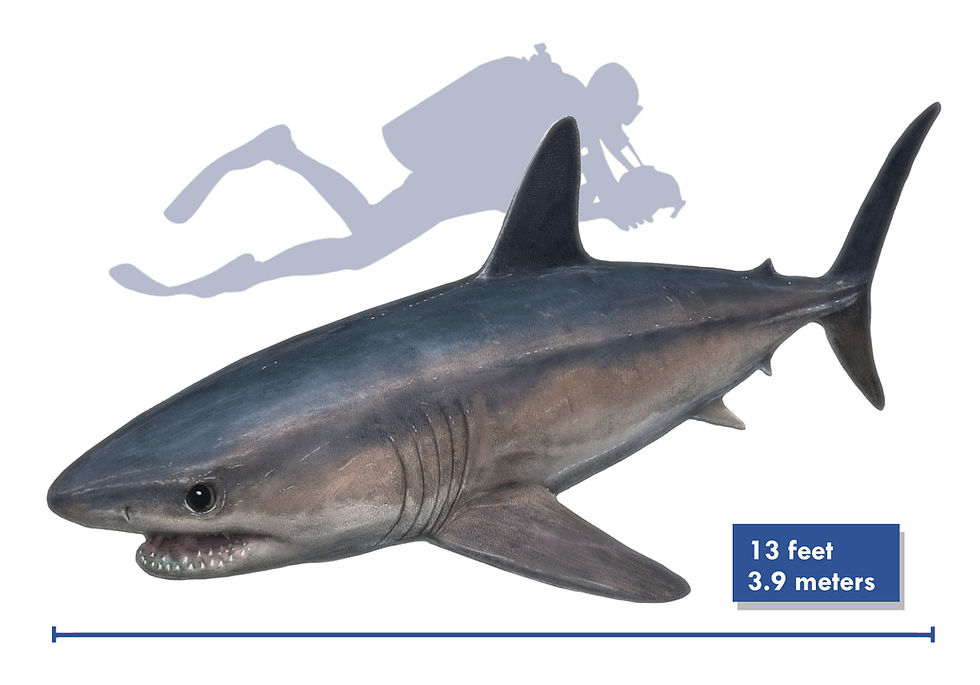
Cardabiodon was a large Cretaceous lamniform shark known from some decent skeletal fossil material which suggests that it was an animal with a deep, heavily built body and a unique dentition that was sufficiently different from other lamniform sharks to place it within its own family, Cardabiodontidae. Its teeth were large, sturdy, and adapted for firmly grasping sizable prey. Its fossils were first found in parts of Australia but it has since been found in environments across the world, including in areas once covered by the Western Interior Sea. It seems to have preferred cooler, temperate marine environments. Fossils have been recovered from regions that were once temperate coastal and offshore seas, and evidence suggests that the genus may have lived in non-tropical environments on either side of the equator, similar to the antitropical distribution of the range of the extant porbeagle shark.
(BELOW) A Cardabiodon tooth from the lower middle Turonian, Eagle Ford Formation of Texas. Fossil collected and original image taken by Jared Cooke/ jcookepaleo

Cretolamna/Cretalamna
Temporal Range: 115 - 46.25 million years ago
Geographic Range: Worldwide distribution
Species: C. appendiculata, C. lata, C. borealis, C. biauriculata, C. maroccana,
C. deschutteri, C. hattini, C. bryanti, C. sarcoporthea
Diet: Carnivorous, fish, smaller sharks, marine reptiles
Cretalamna/Cretolamna was a generalist lamniform shark which seems to be an early member of the megatoothed sharks. Cretalamna is considered to be an early representative of the evolutionary lineage that eventually gave rise to the giant otodontid sharks, including Otodus megalodon. Its classification within this group is usually based on the wideness of the main cusps of their teeth and their wide tooth roots with shallow root notches. Based on fossils of their skeletal material, it seems as though these animals would have been built similarly to living porbeagle or salmon sharks. They would have had large eyes, fairly deep bodies and pointed slightly recurved dorsal and pectoral fins. Their fossils have been discovered in marine deposits across the globe including those of the Western Interior Sea. Most species likely preyed on fishes and other marine vertebrates, and larger individuals may have been capable of hunting larger marine reptiles.
(BELOW) A Cretolamna tooth. The teeth of this genus usually have very large and pointed lateral cusplets. Original photo taken by Dylan Falkner/Prehistoric Alabama

(BELOW) A Cretolamna tooth from the Campanian Ozan Formation of Texas. Fossil collected and original image taken by Jared Cooke/ jcookepaleo

Cretodus

Temporal Range: 100 - 89 million years ago
Geographic Range: Central North America, parts of Europe and Africa
Species: C. crassidens, C. semiplicatus, C. longiplicatus, C. gigantea, C.houghtonorum
Diet: Carnivorous, fish, marine reptiles
Cretodus was a large lamniform which is known from some pretty complete fossil skeletons. These animals would have had broad heads, expansive jaws, and heavily built bodies that more closely resembled those of modern tiger sharks than the sleek profile of high-speed predators such as Cretoxyrhina. Evidence from the shapes of its vertebrae and skin denticles tell us that it was a strong but moderately paced swimmer, not necessarily built for quick bursts of speed. They would have been some of the largest carnivores in their habitats capable of hunting large marine vertebrates. Some moderately-sized species grew to be more than 15 feet long, while the largest known individuals may have approached lengths of around 25 feet. This would make Cretodus one of the largest predatory sharks of its time. Its teeth have a very large, wide dominant central cusp flanked by much smaller lateral cusplets. These cusplets were separated from the main cusp but remained connected by a band of enamel. Some of their large main cusps have some slight groove-like banding along their bases.
(BELOW) A Cretodus tooth from the early Coniacian of Texas. Fossil collected and original image taken by Jared Cooke, jcookepaleo

Cretoxyrhina

Temporal Range: 107 - 73 million years ago
Geographic Range: Worldwide distribution
Species: C. mantelli
Diet: Carnivorous, fish, sharks, marine reptiles
Cretoxyrhina, also known as the “Ginsu shark,” is probably of the most famous of all Late Cretaceous sharks. It is well known for the fossils of its large, blade-like teeth with thick enamel that were highly effective for piercing, immobilizing, slicing, and dismembering large animals. Its postcranial body shape was comparable to that of modern lamnid sharks and it seems to have been adapted for reaching very high swimming speeds. These animals could grow to be larger than a great white shark, although the proportions of their skulls were rather unique, with large eye sockets and short faces. Cretoxyrhina occupied the role of a top marine predator and likely hunted large fishes, marine reptiles, and other large vertebrates living in the Cretaceous seas. Although the species was initially recognized from isolated teeth found in Europe and eastern North America, later discoveries in formations such as those made in the Smoky Hill Chalk of Kansas yielded exceptionally preserved material, including partial skeletons, vertebrae, jaws, cranial cartilage, and associated tooth sets. As these animals grew older, parts of their cartilaginous skeletons became infused with tougher bone-like material which made their skeletons more likely to fully fossilize.
(BELOW) A skeleton of Cretoxyrhina on display at the KU Natural History Museum. The remains of this shark were found in association with the remains of a Xiphactinus fish. See details below.

(BELOW) IMAGE A, Preserved chondocranium of Cretoxyrhina showing preserved rows of teeth and the positions of the jaw cartilages. The snout of the animal would be positioned towards the right of the image

(BELOW) IMAGE B, Remains of ribs, teeth and jawbones of a Xiphactinus found in association with the Cretoxyrhina skeleton. This Xiphactinus may have been preyed upon by the shark. Round elements are Cretoxyrhina vertebrae.

(BELOW) A Cretoxyrhina mantelli tooth from the Late Cretaceous of Kansas, labial view. These teeth have virtually no lateral cusplets. Photo by Mason Hintermeister, N.Pearson via Wikimedia Commons under a CC BY-SA 4.0 license

Dallasiella

Temporal Range: 95 - 83 million years ago
Geographic Range: Central North America, parts of Europe
Species: D. willistoni, D. brachyodon
Diet: Carnivorous, fish, squid, small marine reptiles
Dallasiella was an unusual genus of Cretaceous lamniform shark. Its teeth were generally more lightly built than those of large apex predators such as Cretoxyrhina and lacked the highly serrated cutting adaptations associated with sharks that specialized in attacking large vertebrate prey. At the same time, the teeth of these animals differed from the more generalized dental morphology of animals like Cretalamna. The teeth of Dallasiella have large main cusps which are often thinner and more strongly curved than other types of large macropredatory lamniform genera. It has been considered at various times a close relative of either Cretoxyrhina and Archaeolamna but it is now considered to be a shark of uncertain familial affinity within the Lamniformes.
Johnlongia

Temporal Range: 110 - 85 million years ago
Geographic Range: Central North America
Species: J. parvidens, J. allocotodon
Diet: Carnivorous, fish, squid, belemnites, invertebrates
Johnlongia was a genus of Cretaceous lamniform sharks placed within the same family as sand tiger sharks. It had long, thin narrow teeth with small lateral cusplets and deep grooves running through their tooth roots. These teeth seem to be adapted for catching small soft-bodied prey. Its fossils are fairly uncommon finds in deposits from the Western Interior Sea. These fish-eating animals seem to have been closely related to animals like Psuedomegachasma, a possible type of filter feeding odontaspid shark.
Leptostyrax

Temporal Range: 123 - 75 million years ago
Geographic Range: North America, Europe, Africa, Asia, Australia
Species: L. macrorhiza, L. stychi
Diet: Carnivorous, fish, marine reptiles
Leptostyrax was a genus of lamniform shark that may have grown to be more than 26 feet long, making Leptostyrax one of the larger predatory sharks of its era. Its teeth have tall, slender central cusps bracketed by smaller lateral cusplets and a strongly divided root, giving them a superficial resemblance to the teeth of modern sand tiger sharks. However the teeth of Leptostyrax were generally larger and more robust than those of many true sand tiger-like sharks from the Cretaceous. These animals seem to be closely related to animals like Cretodus and Protolamna. They had a cosmopolitan distribution and their fossils are found on nearly every continent.
Odontaspis
Temporal Range: 136 million years ago - Present
Geographic Range: Worldwide distribution
Extinct Species: O. aculeatus, O. saskatchewanensis, O. sublatata
Diet: Carnivorous, fish, squid
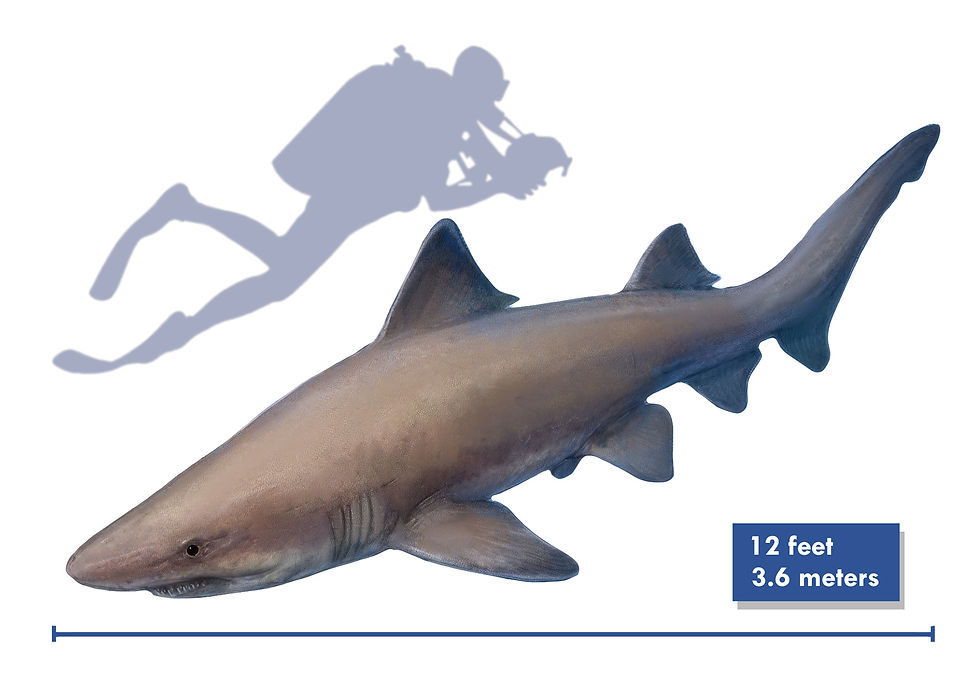
Odontaspis is a genus of sand tiger sharks which has living members today but is also known from fossils found in Cretaceous deposits. The teeth of animals in this genus are tall, narrow, and sharply pointed with a long, thin main cusp bracketed by between two and four rather small lateral cusplets. These teeth are ideally suited for spearing and retaining slippery prey such as fish and cephalopods. Beyond its dental characteristics, Odontaspis has many of the typical features seen in most types of sand tiger sharks including a long, narrow tail fluke, an elongated conical snout, small eyes and jaws equipped with rows of outward-facing grasping teeth. They tend to be slower moving sharks who live closer to the sea floor than other types of large and more pelagic lamniform sharks.
Paranomotodon

Temporal Range: 95 - 66 million years ago
Geographic Range: Worldwide distribution
Species: P. angustidens
Diet: Carnivorous, fish, squid
Paranomotodon was an early relative of the living thresher shark and is currently considered a member of the family alopiidae. Unlike some of the larger predatory lamniforms of the Cretaceous who had broad, powerful teeth adapted for attacking large prey, Paranomotodon had comparatively slender teeth with narrow, elongated crowns and sharp cutting edges. These teeth usually don't have any prominent lateral cusplets. These animals are not known from very complete fossil material besides their teeth so the shapes of their bodies aren’t particularly well understood. It's unknown if they would have had the same unique caudal fin shape as living thresher sharks, Based on scaling using living threshers, they were probably smaller than their living relatives. In addition to their presence in shallow saltwater environments, some teeth belonging to these animals have been found in deposits left behind by estuarine and river environments.
(BELOW) A tooth from a Paranomotodon. Note the lack of lateral cusplets. Original photo taken by
Dylan Falkner/Prehistoric Alabama

Protolamna

Temporal Range: 140 - 70 million years ago
Geographic Range: Worldwide distribution
Species: P. sokolovi, P. borodini, P. carteri, P. compressidens, P. gigantea, P. roanokeensis
Diet: Carnivorous, fish, small sharks, cephalopods, marine reptiles
Protolamna was a fairly large early genus of lamniform shark. Its teeth have large root notches but are fairly narrow. Many of their teeth have triangular cusplets which point outwards away from the central cusp. These animals seem to have been some of the earliest large lamniform shark genera to appear in the fossil record, with their oldest fossils dated to the very early Cretaceous period. Fossils of their teeth are found from deposits which date back to a very long stretch of time in the Cretaceous and it seems that they achieved a nearly global distribution. Although its teeth are comparatively small, size estimates based on the scaling of their vertebral fossils suggest that some species in this genus grew to reach lengths of more than 18 feet. They are known from fossils of their teeth, vertebrae, and dermal denticles. Protolamna was likely an active nearshore predator that fed on fishes, small sharks, cephalopods, and crustaceans.
(BELOW) A Protolamna tooth from the Early Cenomanian Grayson Formation of Texas. Fossil collected and original image taken by Jared Cooke/ jcookepaleo

Pseudocorax

Temporal Range: 95 - 66 million years ago
Geographic Range: North America, parts of Europe and Africa, western Asia
Species: P. affinis, P. heteromorphus, P. laevis, P. granti, P. heteroserratus
Diet: Carnivorous, fish, soft-bodied cephalopods
Pseudocorax is a genus of mackerel sharks which was once considered to be a very close relative of sharks like Squalicorax but which has since been moved to a separate family. Its fossils are mostly found in parts of Europe and the southeastern US but some finds associated with this genus are also found in areas once covered by the Western Interior Sea. Its teeth appear somewhat similar to those of Squalicorax in that they have a large main cusp which projects backwards, but most Pseudocorax teeth do not have the same extensive degree of tooth serrations as those of Squalicorax. The front facing mesial edge of this main cusp is also less convex in shape in Pseudocorax than it is in Squalicorax.
(BELOW) A Pseudocorax tooth. These teeth are outwardly very similar to those of Squalicorax but they lack large serrations on their cutting edges. Teeth are rather small. Original photo taken by Dylan Falkner/Prehistoric Alabama

Pseudomegachasma

Temporal Range: 100 million years ago
Geographic Range: Central North America, parts of Russia
Species: P. casei, P. comanchensis
Diet: Filter feeder, plankton
Pseudomegachasma is a type of odontaspid shark which has been interpreted as a plankton feeder. This makes it the oldest known plankton-feeding shark currently recognized in the fossil record and the only known member of the sand tiger shark lineage to have evolved this lifestyle. Its existence shows that filter feeding evolved independently within several different groups of cartilaginous fishes during the Mesozoic Era. Its teeth had a very unique shape. They were relatively small and would have had relatively low main cusps with reduced lateral cusplets. These teeth were poorly suited for handling large prey. Instead the shape of their teeth would have been best for a feeding strategy that relied on filtering and straining small planktonic organisms from the water. These adaptations seem to be an example of convergent evolution, as they evolved independently from those of other plankton-feeding sharks like basking and megamouth sharks. Pseudomegachasma was a close relative of the fish eating odontaspid Johnlongia.
Ptychodus

Temporal Range: 105 - 75 million years ago
Geographic Range: Worldwide distribution
Species: P. mortoni, P. latissimus, P. articulatus, P. rugosus, P. whipplei, P. multistriatus, P. polygyrus, P. oweni, P. mammillaris, P. marginalis
Diet: Durophagous, bivalves, ammonites, possibly sea turtles
Ptychodus was a specialized genus of durophagous sharks whose teeth were adapted for crushing through hard-shelled prey. Most Cretaceous lamniform sharks had sharp blade-like teeth designed for seizing and/or cutting prey but Ptychodus would have had broad, flattened teeth forming powerful dental batteries that allowed the shark to feed on clams, ammonites, and other heavily armored marine invertebrates. They may have also hunted the sea turtles which would have lived alongside them in the waters of the Cretaceous seas.
The surfaces of their teeth have a unique wavy pattern on their chewing surfaces which somewhat resembles the swirls of a fingerprint. Fossils of Ptychodus teeth have been turning up for hundreds of years and early naturalists studying these remains classified them as belonging to ancient giant porcupinefishes rather than sharks.
During the nineteenth century Louis Agassiz determined that these were actually the remains of ancient shell-crushing sharks and formally named the genus Ptychodus. Since then numerous fossils, including isolated teeth, jaw fragments, vertebrae, dermal denticles, and associated cartilage remains, have been recovered from Cretaceous rocks worldwide. More recently, well preserved specimens from Mexico have helped paleontologists reconstruct the shark’s body form. These animals would have had broad snouts, large heads and pointed triangular dorsal and pectoral fins.
(BELOW) Tooth plate arrangement of a Ptychodus. These large tooth arrangements were positioned along the animal's palate and lower jaws.
_edited.jpg)
(BELOW) A Ptychodus tooth. Image A, top view. B and C front and back view of the tooth. The rounded shapes of these teeth and their distinctive patterns of ridges are a hallmark of the teeth of this genus. Original photo by
Dylan Falkner/Prehistoric Alabama

(BELOW) A Ptychodus marginalis lateral file tooth from the lower Middle Turonian of Texas. Fossil collected and original image taken by Jared Cooke/ jcookepaleo

(BELOW) A Ptychodus mammillaris tooth from the Turonian of Texas. Fossil is shown in lingual view (A), labial view (B) side view (C) and from above (D). Fossil collected and original image taken by Jared Cooke/ jcookepaleo

(BELOW) A Ptychodus whipplei tooth still partially embedded in matrix from the Coniacian of Texas. Fossil collected and original photo taken by Jared Cooke/ jcookepaleo

Scapanorhynchus

Temporal Range: ~119 - 66 million years ago
Geographic Range: Worldwide distribution
Species: S. lewisii, S. texanus, S. rapax, S. raphiodon
Diet: Carnivorous, fish, sharks, marine reptiles
Scapanorhynchus is an extinct shark that belongs to the same taxonomic family as the modern goblin shark. Much like today’s goblin sharks Scapanorhychus would probably have had an elongated snout used to detect electrical signals coming from their prey, as well as narrow, pointed teeth. These extinct goblin sharks are also often restored with the same type of extendable jaw cartilages seen in their extant relatives. Despite these similarities, Scapanorhynchus would have filled a very different ecological niche than its deep water relatives found in today’s oceans. Modern goblin sharks are animals who hunt for deep water fish and cephalopods in complete darkness. In contrast Scapanorhynchus appears to have lived in shallower sunlit marine environments including continental shelves and inland seas where it occupied the role of an active predator. Maximum size estimates for some Scapanorhynchus species point to some of these animals being longer than the largest great white sharks. In some Late Cretaceous marine deposits Scapanorhynchus teeth are among the most common vertebrate fossils.
(BELOW) An upper anterior tooth from a Scapanorhynchus. Original photo by Dylan Falkner/Prehistoric Alabama

(BELOW) A lower anterolateral tooth from a Scapanorhynchus. Original photo by Dylan Falkner/Prehistoric Alabama

(BELOW) A lateral tooth from a Scapanorhynchus. Original photo by Dylan Falkner/Prehistoric Alabama

Squalicorax

Temporal Range: 109 - 66 million years ago
Geographic Range: Worldwide distribution
Species: S. appenduculatus, S. pristodontus, S. falcatus, S. heterodon, S. primaevus, S. curvatus, S. kaupi, S. serratus, S. yangaensis, S. baharijensis
Diet: Carnivorous, Pelagic, fish, sharks, marine reptiles
Squalicorax is a genus of lamniform sharks whose teeth are broadly similar to those of living tiger sharks, although the tiger shark is part of a completely separate order and the two sharks do not seem to have been particularly closely related to one another. Squalicorax had broad, triangular teeth with serrations along their cutting edges. In contrast, many contemporary lamniform sharks, including Cretoxyrhina, had narrower teeth with smooth edges that were better suited for gripping prey rather than slicing through flesh. The serrated dentition of Squalicorax made it especially good at cutting meat. It may have been both an active predator and opportunistic scavenger. It probably fed on fish, turtles, marine reptiles, and other vertebrates living in Cretaceous seas. The scientific study of Squalicorax began with the discovery of its abundant fossil teeth which are among the most recognizable shark fossils found in Cretaceous rocks. Early paleontologists described several species based on these distinctive teeth and later discoveries revealed that the genus had a wide geographic distribution with their remains found all across the world. Although isolated teeth are by far the most common fossils known from this genus, rare articulated skeletons sometimes preserve remains of the animal’s vertebrae and parts of their skulls, and even occasionally complete skeletons. Their teeth are often found embedded in the bones of marine reptiles, pterosaurs, and dinosaurs which has led to them being considered one of the most abundant and successful scavengers of the Western Interior Sea and earned them the nickname “crow shark”.

(BELOW) The teeth of Squalicorax are broad and triangular. The inward-facing cutting edges of their teeth are heavily serrated. Most teeth from this genus do not have a root notch or prominent lateral cusplets. The teeth of some Squalicorax are more spade-shaped and sometimes nearly symmetrical. Below is a Squalicorax yangaensis tooth collected and photographed by Dylan Falkner/ PrehistoricAlabama
(BELOW) A Squalicorax baharijensis tooth from the Early Cenomanian Del Rio Formation of Texas. Fossil collected and original image taken by Jared Cooke/ jcookepaleo

(BELOW) A set of Squalicorax pristodontus teeth from the Maastrichtian Corsicana Formation of Texas. Photos taken in labial view (A), and lingual view (B). Fossil collected and original image taken by Jared Cooke/ jcookepaleo

Media Gallery


Suggested References: Sharks
Case,G. R.;H. Cappetta. (1997). “A new Selachian Fauna from the Late Maastrichtian of Texas” (Upper Cretaceous/Navarroan; Kemp Formation) . Münchner Geowiss. Abh. (A)(34):131–189
Cook, T.D.; Newbrey, M.G.; Murray, A.M.; Wilson, M.V.H.; Shimada, K.; Takeuchi, G.T.; Stewart, J.D. (2011). "A partial skeleton of the Late Cretaceous lamniform shark, Archaeolamna kopingensis, from the Pierre Shale of western Kansas, U.S.A.". Journal of Vertebrate Paleontology. 31 (1): 8–21
Everhart, M. J. (2004). “Late Cretaceous interaction between predators and prey. Evidence of feeding by two species of shark on a mosasaur”. PalArch, vertebrate palaeontology series 1(1):1-7.
Everhart, M.J. (2017). “Oceans of Kansas - A Natural History of the Western Interior Sea”, Second Edition. Indiana University Press, 460 pp.
Everhart, M. J. (2005). “Bite marks on an elasmosaur (Sauropterygia; Plesiosauria) paddle from the Niobrara Chalk (Upper Cretaceous) as probable evidence of feeding by the lamniform shark, Cretoxyrhina mantelli”. PalArch, Vertebrate paleontology 2(2): 14-24.
Everhart, M. J. and K. Ewell. (2006). “Shark-bitten dinosaur (Hadrosauridae) vertebrae from the Niobrara Chalk (Upper Coniacian) of western Kansas”. Kansas Academy of Science, Transactions, 109 (1-2):27-35.
Jambura, P.L.; Stumpf, S.; Kriwet, J. (2021). "Skeletal remains of the oldest known pseudocoracid shark Pseudocorax kindlimanni sp. nov. (Chondrichthyes, Lamniformes) from the Late Cretaceous of Lebanon". Cretaceous Research. 125
Lucas, S. G.; Sullivan, R. M. (2006). “Late Cretaceous Vertebrates from the Western Interior: Bulletin 35.” New Mexico Museum of Natural History and Science.
Maisey, J. G., (1996). Discovering Fossil Fishes. Henry Holt and Company, New York.
McAllister, J. A. (1985). “Reevaluation of the formation of spiral coprolites” - University Kansas Paleontology Contributions, Paper 114, 12 p.
McIntosh, A. P.; Shimada, K.; Everhart, M. J. (2016). "Late Cretaceous marine vertebrate fauna from the Fairport Chalk Member of the Carlile Shale in southern Ellis County, Kansas, U.S.A." Transactions of the Kansas Academy of Science.
Schwimmer, D. R., J.D. Stewart, and G. D. Williams. (1997). “Scavenging by sharks of the genus Squalicorax in the late Cretaceous of North America”. PALAIOS, 12:71-83.
Shimada, K. (2007). "Skeletal and dental anatomy of lamniform shark, Cretalamna appendiculata from Upper Cretaceous Niobrara Chalk of Kansas". Journal of Vertebrate Paleontology, 27(3):584–602.
Shimada, K. (2008). “Ontogenetic parameters and life history strategies of the Late Cretaceous lamniform shark, Cretoxyrhina mantelli, based on vertebral growth increments”. Journal of Vertebrate Paleontology 28(1):21-33.
Shimada, K. and Cicimurri, D.J. (2005). “Skeletal anatomy of the Late Cretaceous shark, Squalicorax (Neoselachii: Anacoracidae).” Paläontologische Zeitschrift 79(2): 241-261.
Shimada, K and M. J. Everhart. (2003). “Ptychodus mammillaris (Elasmobranchii) and Enchodus cf. E. schumardi (Teleostei) from the Fort Hays Limestone Member of the Niobrara Chalk (Upper Cretaceous) in Ellis County, Kansas”. Kansas Academy of Science, Transactions 106(3-4):171-176.
Shimada, K. and M. J. Everhart. (2004). “Shark-bitten Xiphactinus audax (Teleostei: Ichthyodectiformes) from the Niobrara Chalk (Upper Cretaceous) of Kansas”. The Mosasaur 7, p. 35-39.
Shimada, K. and D. J. Martin. (1993). “Upper Cretaceous selachians from the basal Greenhorn Limestone in Russell Co., Kansas”. Kansas Academy of Science Abstracts, 12(78).
Shimada, K. (1993). Upper Cretaceous selachians from the Fort Hays Limestone Member of the Niobrara Formation in Ellis County, Kansas. Kansas Academy of Science Abstracts, 12(78).
Shimada, Kenshu; Ewell, Keith; Everhart, Michael J. (2004). "The First Record of the Lamniform Shark Genus, Johnlongia, from the Niobrara Chalk (Upper Cretaceous), Western Kansas". Transactions of the Kansas Academy of Science. 107 (3/4): 131–135.
Shimada, Kenshu; Popov, Evgeny V.; Siversson, Mikael; Welton, Bruce J.; Long, Douglas J. (2015). "A new clade of putative plankton-feeding sharks from the Upper Cretaceous of Russia and the United States". Journal of Vertebrate Paleontology. 35 (5)
Shimada, Kenshu; Everhart, M.J. (2019). "A new large Late Cretaceous lamniform shark from North America, with comments on the taxonomy, paleoecology, and evolution of the genus Cretodus". Journal of Vertebrate Paleontology. 39 (4)
Siverson, M. and J. Lindgren. (2005). “Late Cretaceous sharks Cretoxyrhina and Cardabiodon from Montana, USA”. Acta Palaeontol. Pol. 50(2) 301-314.
Underwood, C.J.; Cumbaa, S.L. (2010). "Chondrichthyans from a Cenomanian (Late Cretaceous) bonebed, Saskatchewan, Canada". Palaeontology. 53 (4): 903–944.
Welton, B. J., and R. F. Farish (1993). "The Collector's Guide to Fossil Sharks and Rays from the Cretaceous of Texas." Before Time, Lewisville, Texas, 204 pp.
Williamson, T. E., J. I. Kirkland and S. G. Lucas. (1993). “Selachians from the Greenhorn cyclothem ("Middle" Cretaceous: Cenomanian-Turonian), Black Mesa, Arizona, and the paleogeographic distribution of Late Cretaceous selachians”. J. Paleon. 67(3):447-474.