
Ray-finned fishes (continued)

Urenchelys

Tselfatiiform Fishes
Plethodids of the Western Interior Sea
Temporal Range: 113 million years ago - 66 million years ago
Geographic Range: North America, Africa, Europe
Genera in the Western Interior Sea: Pentanogmius, Bananogmius, Thryptodus, Ferrifrons, Zanclites, Niobrara, Martinichthys, Syntegmodus, Luxilites, Pseudanogmius
Diet: Carnivorous, small fish, invertebrates
Tselfatiiform fishes were an extinct group of marine bony fishes from the Cretaceous period. They are known for their roughly diamond-shaped bodies that were flattened from side to side. These fishes had reinforced head bones and many species had long, tall dorsal fins and small pelvic fins. The Tselfatiiform fishes of the Western Interior Sea were all part of the family Plethodidae. Most of these animals were fairly small fishes, only a few feet long at most, although a few genera are known to have grown to be more than 5 feet long in some parts of the world. The best known plethodids are animals like Bananogmius and Pentanogmius who would have appeared somewhat similar to today’s angelfishes. Some plethodids had their own unique structures found on their skulls. Martinichthys had a long-spine-like projection issuing from the front of its upper jaw while Thryptodus had a reinforced nasal area which has given it the nickname “battering ram fish”. These animals seem to have been either plankton-eating filter feeders or animals who ate smaller fish.

(BELOW) Plethodid genera included some genera with long rostral bones and others with very tall dorsal fins. Some genera like Pentanogmius had significant differences between their different species such as P. evolutus and P. fristchi


(BELOW) The plethodid genus Enischnorhynchus has an upermost size estimate which might make it quite a bit larger than many of the other types of plethodids found in the Western Interior Sea.


(BELOW) A plethodid tooth plate from the Cenomanian of Texas. Fossil collected and original photo taken by Jared Cooke/ jcookepaleo

Squirrelfish Relatives
Beryciformes
Temporal Range: 100 million years ago - Present day
Geographic Range: Worldwide distribution
Genera in the Western Interior Sea: Kansius, Caproberyx
Diet: Carnivorous, small fish, invertebrates
Beryciform fishes are an order of ray-finned fishes which contains today’s squirrelfishes, soldierfishes and their closest relatives. They have large eyes, deep bodies, and long spines supporting their dorsal fins. In the Western Interior Sea, beryciform fishes were mainly represented by members of the family Holocentridae, the same family that includes modern squirrelfishes. One of the best-known genera from this region is Kansius, particularly the species Kansius sternbergi, which has been found in Late Cretaceous chalk formations in Kansas. Fossils show that Kansius was a rather small fish, only a few inches long. Most living and extinct beryciforms also had large mouths and rough scales that helped protect them from predators. Their body shape made them quick and agile swimmers in marine environments. The large eyes may have helped them see better in deeper or dimly lit waters.

Beardfishes
Polymixiiformes
Temporal Range: 93 million years ago - Present day
Geographic Range: Worldwide distribution
Genera in the Western Interior Sea: Omosoma
Diet: Carnivorous, small fish, invertebrates
Polymixiiformes (Beardfishes) are a type of fish who are named for the long sensory barbels, or whisker-like structures, located beneath their lower jaws. These barbels were used to help detect food in the water or along the seafloor. Beardfishes also have very large eyes used to see in low light conditions. The best represented genus of beardfishes in the Western Interior Sea is Omosoma. It measured only a few inches long and its fossils are sometimes found inside the shells of large inoceramid clams. They seem to have preferred to live near the seafloor, feeding on small benthic animals.

Bonefishes
Albuliformes
Temporal Range: 147 million years ago - Present day
Geographic Range: North America
Genera in the Western Interior Sea: Paralbula, Pollerspoeckia
Diet: Carnivorous, small fish, crustaceans
Albuliformes is an order of ray-finned fishes which contains today’s bonefishes. Cretaceous albuliform fishes look fairly similar to their modern relatives and they are mostly found in deposits formed by shallow water environments in Texas and Montana. They would have had long, streamlined bodies and forked tails with rounded tips. Today’s bonefish are carnivorous animals who hunt for small fishes and invertebrates in near-shore shallow water environments close to the surface. It’s likely that their prehistoric relatives would have occupied similar ecological niches. Some extinct albuliform fish like Paralbula are known from rocks formed in freshwater and brackish habitats.
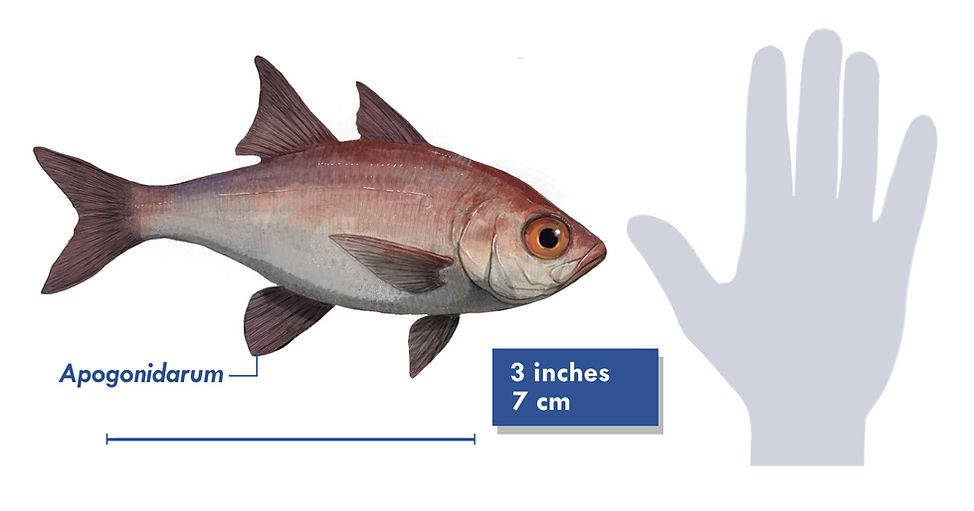
Cardinalfish
Apogonidae
Temporal Range: ~73 million years ago - Present day
Geographic Range: Worldwide distribution
Genera in the Western Interior Sea: Apogonidarum
Diet: Carnivorous, small fish, invertebrates
Cardinalfishes are a group of small ray-finned fishes that belong to the family Apogonidae who have large eyes, relatively large mouths, two separate dorsal fins, and surprisingly strong jaws adapted for feeding on small fish and crustaceans. Modern cardinalfishes are commonly found in reef environments, and fossil species like Apogonidarum show many of the same characteristics as their living kin.

Bowfins
Amiiformes
Temporal Range: ~240 million years ago - Present
Geographic Range: North America
Genera in the Western Interior Sea: Cyclurus, Paraliodesmus?
Diet: Carnivorous, small fish, invertebrates
Bowfins belong to the order Amiiformes, a very old group of ray-finned fishes that has been around since the Mesozoic era and are still found today living in freshwater habitats. They have slender bodies and a dorsal fin that extends along much of their back. This long fin helps them swim smoothly and make quick movements while searching for food. Bowfins also have strong jaws lined with sharp teeth which allow them to catch and eat a variety of prey animals. In the Western Interior Seaway, bowfin fossils include the remains of animals like Cyclurus, especially the species Cyclurus fragosus. Fossils of Cyclurus show the classic bowfin features but their presence in chalk deposits from the ancient seaway is good evidence that some ancient bowfins were able to live outside the freshwater habitats which are home to all living species of bowfins. Another genus, Paraliodesmus, may also be a type of bowfin and is known from fossils found in parts of Kansas.

Eels
Anguilliformes
Temporal Range: ~95 million years ago - Present day
Geographic Range: Worldwide distribution
Genera in the Western Interior Sea: Urenchelys, Anguilavus
Diet: Carnivorous, small fish
Some early eels were present in the Western Interior Seaway, namely two genera, Urenchelys and Anguillavus. Both of these ancient fishes show the classic elongated body shape we are used to seeing in today’s eels. Some of these genera are known from fairly complete body fossils, some of which seem to show that animals like Urenchelys still had fairly large and deeply forked caudal fins, a feature which is not seen in today’s eels.

Saltwater Catfishes
Ariidae
Temporal Range: ~75 million years ago - Present day
Geographic Range: Worldwide distribution
Genera in the Western Interior Sea: Vorhisia
Diet: Carnivorous, small fish, invertebrates
Ariid catfishes, commonly known as sea catfishes, are members of the family Ariidae, a group of catfishes named for their tendency to live in marine environments. They are one of the oldest groups of catfishes and they are easy to recognize with their tall pointed dorsal fins and flattened body shapes. In the Western Interior Seaway, ariid catfishes are known from fossils of a genus called Vorhisia. Most evidence for the presence of Vorhisia in this region comes from fossil otoliths, or ear bones, which are found preserved in marine sediments in parts of the Great Plains.

False Needlefishes
Aspidorhynchidae
Temporal Range: 170 million years ago - 66 million years ago
Geographic Range: Worldwide distribution
Genera in the Western Interior Sea: Belonostomus
Diet: Carnivorous, small fish
Aspidorhynchiform fishes were an extinct group of ray-finned fishes that lived during the Mesozoic Era whose members are often compared to the living needlefishes, although the two groups do not seem to be particularly closely related to one another. In the Western Interior Seaway, the most common and well-known member of the Aspidorhynchiformes was Belonostomus, a fish with a long, narrow snout and a slender spear-like body. They had very large eye openings, deeply forked tails and a very flexible spinal cord. They seem to have been small predatory fishes adapted for hunting in the sunlit waters near the surface.

Gars
Lepisosteidae
Temporal Range: ~150 million years ago - Present day
Geographic Range: North America
Genera in the Western Interior Sea: Atractosteus, Lepisosteus
Diet: Carnivorous, smaller fish
Gars are an ancient group of fishes whose fossil record from the Late Cretaceous is very extensive. This record includes genera like Lepisosteus, a genus which is still around today and includes longnose and shortnose gars. Fossils of gars who seem to share some characteristics in common with the larger Alligator gars (Atractosteus) are also known from this area but they are not as common as the remains of Lepisosteus. The most common gar fossils are the remains of their distinctive diamond-shaped scales, which form a thick layer of defensive armor around the animal in life.

Media Gallery


Suggested References: Ray-Finned Fishes
Alvarado-Ortega, Jesús; Porras- Múzquiz, Héctor ( 2009). "On the occurrence of Gillicus arcuatus (Cope, 1875) (Pisces, Ichthyodectiformes) in Mexico". Boletín de la Sociedad Geológica Mexicana. 61 (2): 215–224.
Bardack, D. (1965). "Anatomy and evolution of chirocentrid fishes". The University of Kansas Paleontological Contributions. 10: 1–88.
Bell, G. L., Jr. (1986). “A pycnodont fish from the upper Cretaceous of Alabama”. Journal of Paleontology 60(5):1120-1126, 2 figs.
Bice, K. N.; Shimada, K.; Kirkland, J. I. (2013). "Late Cretaceous Marine Fishes from the Upper Greenhorn Limestone in Southeastern Nebraska". Transactions of the Kansas Academy of Science. 116 (1–2): 22–26.
Cope, E. D, (1872), “On the families of fishes of the Cretaceous Formation of Kansas”: Proceedings of the American Philosophical Society, v. 12, p. 327-357.
Everhart, M. J. (2007). “Remains of a pycnodont fish (Actinopterygii: Pycnodontiformes) in a coprolite; An upper record of Micropycnodon kansasensis in the Smoky Hill Chalk, western Kansas”. Kansas Academy of Science, Transactions 110(1/2): 35-43.
Everhart, M. J. (2010). “Bonnerichthys gladius – The largest bony fish and first known planktivore from the Late Cretaceous”. Kansas Academy of Science, Transactions 113(1-2):123-124.
Fielitz, C.; Stewart, J. D.; & Wiffen, J. (1999). “Aethocephalichthys hyainarhinos gen. et sp. nov., a new and enigmatic Late Cretaceous actinopterygian from North America and New Zealand”. Mesozoic Fishes 2 – Systematics and Fossil Record, G. Arratia & H.-P. Schultze (eds.): pp. 95-106, 7 figs.
Fielitz, Christopher; González-Rodríguez, Katia A. (2010). "A New Species of Enchodus (aulopiformes: Enchodontidae) from the Cretaceous (albian to Cenomanian) of Zimapán, Hidalgo, México". Journal of Vertebrate Paleontology. 30 (5): 1343–1351. Bibcode:2010JVPal..30.1343F.
Fielitz C, Shimada K. (1999).”A new species of Bananogmius (Teleostei; Tselfatiformes) from the Upper Cretaceous Carlile Shale of western Kansas”. Journal of Paleontology 73(3): 504-511.
Friedman, Matt; Beckett, Hermione T.; Close, Roger A.; Johanson, Zerina (2016). "The English Chalk and London Clay: two remarkable British bony fish Lagerstätten". Geological Society, London, Special Publications. 430 (1): 165–200.
Grande, Lance; Bemis, William E. (1998). "A Comprehensive Phylogenetic Study of Amiid Fishes (Amiidae) Based on Comparative Skeletal Anatomy. an Empirical Search for Interconnected Patterns of Natural History". Journal of Vertebrate Paleontology. 18 (sup1): 1–696.
Kanarkina, A.; Zverkov, N.; Polyakova, I. (2024). "New evidence of the global distribution of the swordfish-like pachycormid Protosphyraena in the late Early Cretaceous and a review of global records of the genus". Cretaceous Research. 166.
Lucas, Spencer G.; Sullivan, Robert M. (2006). “Late Cretaceous Vertebrates from the Western Interior: Bulletin 35”. New Mexico Museum of Natural History and Science.
Maisey, J. G., (1996). “Discovering Fossil Fishes”. Henry Holt and Company, New York.
McIntosh, A. P.; Shimada, K.; Everhart, M. J. (2016). "Late Cretaceous marine vertebrate fauna from the Fairport Chalk Member of the Carlile Shale in southern Ellis County, Kansas, U.S.A." Transactions of the Kansas Academy of Science.
Near, Thomas J.; Thacker, Christine E. (2024). "Phylogenetic Classification of Living and Fossil Ray-Finned Fishes (Actinopterygii)". Bulletin of the Peabody Museum of Natural History. 65 (1): 3–302.
Nelson, Luke E.; Murray, Alison M.; Sims, Megan E. (2026). "A new species of Enchodus from the Western Interior Seaway of North America and a taxonomic revision of Enchodus dirus, Leidy, 1857". Journal of Vertebrate Paleontology.
Russell, D. A. (1988). “A check list of North American marine Cretaceous vertebrates including freshwater fishes”. Royal Tyrrell Museum
Shimada, Kenshu (2016). "A new species of the Late Cretaceous 'sail-finned' bony fish, Pentanogmius (Actinopterygii: Tselfatiiformes), from Texas, USA". Cretaceous Research. 61: 188–198.
Shimada, K. and M. J. Everhart. (2004). “Shark-bitten Xiphactinus audax (Teleostei: Ichthyodectiformes) from the Niobrara Chalk (Upper Cretaceous) of Kansas”. The Mosasaur 7, p. 35-39.
Shimada, K. (2015). “Body form and paleoecology of the large Late Cretaceous bony fish, Pachyrhizodus caninus”. Cretaceous Research, 52, 286-291.
Stewart, A. (1899). “Pachyrhizodus minimus, a new species of fish from the Cretaceous of Kansas”. Kansas University Quarterly, 8(1), 37-38.
Taverne, Louis (2001). "Révision du genre Bananogmius (Teleostei, Tselfatiiformes), poisson marin du Crétacé supérieur d'Amérique du Nord et d'Europe". Geodiversitas. 23 (1): 17–40.
Vavrek, Matthew J.; Murray, Alison M.; Bell, Phil R. (2016). "Xiphactinus audax Leidy 1870 from the Puskwaskau Formation (Santonian to Campanian) of northwestern Alberta, Canada and the distribution of Xiphactinus in North America". Vertebrate Anatomy Morphology Palaeontology. 1: 89.