
Actinopterygii

Ray-Finned Fishes
Ray-finned fishes, or actinopterygians, are a type of fish who have fins supported by thin bony rays known as lepidotrichia rather than the fleshy lobes found in other “lobe-finned” groups of bony fishes. Most have lightweight skeletons, scales, gills protected by a bony operculum, as well as a swim bladder that helps keep them buoyant in the water. The Late Cretaceous Western Interior Sea was home to many types of ray-finned fishes, including giant predatory animals like Xiphactinus and Protosphyraena, filter feeders like Bonnerichthys and smaller fish like Omosoma and Kansius who would have made their homes along the bottom of the ancient seafloor.
Anatomy
(BELOW) Features of the skeletal anatomies of ray-finned fishes, in this case a pycnodont fish.

Skeletal Anatomy
Ray-finned fishes are named for the skeletal structures of their fins which are supported by thin, flexible bony rays called lepidotrichia. Unlike the fleshy muscular fins of lobe-finned fishes, these rays are only connected to supporting skeletal elements known as radials. Ray-finned fishes also have a skull composed of many articulating small bony plates, a column of vertebral centra, ribs, and a series of bones and radial cartilages that support their fins. In many species, the bones of the jaws are highly mobile and specialized for the preferred feeding strategy of each fish, such as suction feeding. They are often able to hinge forward and extend the reach of the mouth as part of the biting motion of the fish. The gills of ray-finned fishes are protected by a bony covering called the operculum, which also helps move water across the gill surfaces as they breathe. Many ray-finned fishes also have a gas-filled swim bladder that helps control buoyancy and allows them to remain suspended in the water with minimal effort.

External Anatomy
Ray-finned fishes have bodies which can usually be divided into three main regions: the head, trunk, and tail. The outer surface of the body of the fish is usually covered with scales that provide protection while also helping to reduce resistance as the fish moves through the water. These scales are coated with a thin mucus layer that reduces friction while swimming and that can also help protect the fish from parasites and/or infections. Some groups of ray-finned fishes, such as catfish, do not have these scales but they are common in other groups. The head carries the mouth, eyes, and nostrils of the fish, which are used for feeding, vision and detecting chemical cues in the surrounding water. The trunk of the fish is used mostly for locomotion and carries the animal’s fins. The paired pectoral and pelvic fins are primarily used for steering, maneuvering, and maintaining balance. Along the midline of the body the dorsal fin and anal fin help stabilize the fish during swimming and prevent uncontrolled rolling. The caudal fin is found at the base of the tail of the fish and is the animal’s main source of propulsion. Another important external feature is the lateral line which is a sensory system that runs along the sides of the body and detects vibrations, water currents, and nearby movement.
Urenchelys
Ichthyodectiformes

Giant Carnivores and Filter Feeders
Ichthyodectiform fishes were a group which contained some of the best known fishes of the Western Interior Sea. This included animals like Xiphactinus, Ichthyodectes and Gillicus who were characterized by sleek, streamlined bodies, powerful tails and large mouths designed for capturing prey or filter feeding. Many species were fast-moving hunters capable of pursuing a wide variety of marine prey. Cretaceous ichthyodectiform fishes are generally split into two groups; the saurodontids, who had longer and narrower skulls, often with a large bar or spike on their lower jaw, and the ichthyodectids, who had shorter faces and wider mouths.

Gillicus
Temporal Range: 100 million years ago - 72 million years ago
Geographic Range: Central North America, the UK, Japan
Species: G. arcuatus, G. serridens
Diet: Filter feeder or suction feeder, small fish/invertebrates
Gillicus was a possibly filter feeding member of the ichthyodectiform order. Although it was outwardly pretty similar in appearance to animals like Ichthyodectes, it is currently considered to be part of the same group as animals like Saurodon. Gillicus had many very small teeth lining its jaws. These teeth were so tiny that the jaws could appear almost toothless at first glance. Paleontologists infer that Gillicus captured food by rapidly opening its mouth and sucking in smaller fish and some researchers have even suggested that it may have filtered small organisms out of the water. Gillicus was frequently preyed upon by larger marine animals, most famously its distant relative Xiphactinus. Several famous fossils preserve entire Gillicus individuals inside the stomachs of Xiphactinus.

(BELOW) A famous skeleton housed at the Sternberg Museum of Natural History in Hays, Kansas, preserves the remains of a Xiphactinus with a complete skeleton of a smaller Gillicus in its stomach cavity. One reason for this type of preservation is that the large size of the Gillicus caused the death of the Xiphactinus after swallowing its prey. Photo taken by Corbin Rainbolt


(BELOW) A skeleton of Gillicus on display at the KU Natural History Museum. In addition to the animal's bones, this particular specimen also preserves fossils of the animal's skin and scales. Photo by Corbin Rainbolt.

(BELOW) Closeup view of the skull of a Gillicus. Note the presence of only very small teeth along the animal's jaws. These small teeth are often suggested to be a sign that these animals were filter feeders. Photo by Corbin Rainbolt.

Ichthyodectes
Temporal Range: 85 million years ago
Geographic Range: Kansas, Alabama, South Dakota, Alberta, Manitoba, the UK
Species: I. ctenodon, I. tenuidens
Diet: Carnivorous, fish, marine reptiles
Ichthyodectes was a large ichthyodectiform fish known for its unique dentition. Unlike Xiphactinus, which had large fang-like teeth for capturing large prey, Ichthyodectes had numerous small, uniformly sized teeth, giving rise to its species name “ctenodon,” which translates roughly to “comb tooth.” These teeth suggest a feeding strategy focused on grasping or sucking in smaller fish rather than overpowering large prey. Fossil evidence in the form of a specimen preserved with the remains of another fish in its stomach, confirms that Ichthyodectes was piscivorous and actively hunted other fishes.

(BELOW) A skeleton of Ichthyodectes on display at the KU Natural History Museum. Note the position of the dorsal fin. As we see in Xiphactinus, many ichthyodectiform fishes had dorsal fins which were positioned further along their backs than in other fishes. The tails of these animals were broad and heavily forked. Photo by Corbin Rainbolt

(BELOW) An Ichthyodectes skull on display at the Sternberg Museum of Natural History. The teeth of Ichthyodectes are much smaller relative to the size of the rest of the skull than the teeth of Xiphactinus. Note the enlarged orbit, these animals probably had large eyes which could have allowed them to see in low light conditions. Photo by Corbin Rainbolt
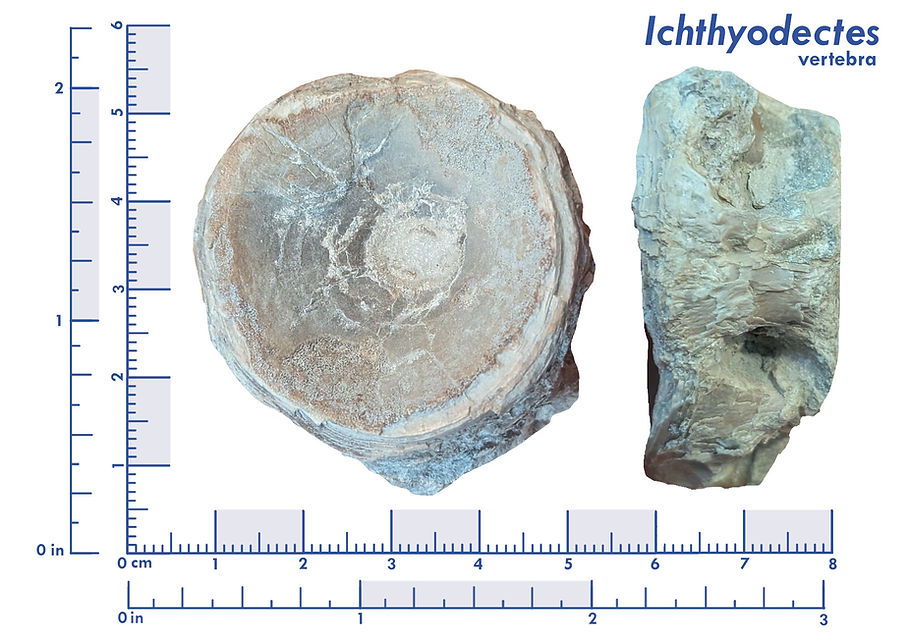
(BELOW) An Ichthyodectes vertebra from the Niobrara Chalk Formation in front view and side view. Fossil collected by Kris Super, photo by Corbin Rainbolt

Prosaurodon
Temporal Range: 83 million years ago
Geographic Range: Kansas
Species: P. pygmaeus
Diet: Carnivorous, small prey, fish
Prosaurodon was a relatively uncommon member of the ichthyodectiform fishes. It was closely related to Saurodon and Saurocephalus and would have had a slight extension to the length of its lower law’s predentary bone. Like other saurodontids, Prosaurodon was most likely an active marine predator with a streamlined body suited for pursuing prey in the open waters of the Late Cretaceous seas. It was smaller than most species of Saurodon or Saurocephalus and it seems to be one of the most basal members of this group, without many of the specialized jaw features seen in many of its relatives. It was originally considered a species of Saurodon, classified as “Saurodon pygmaeus”.

Saurocephalus
Temporal Range: ~120 million years ago - 64 million years ago
Geographic Range: Kansas, New Jersey, Jordan
Species: S. lanciformis, S. ferox, S. albensis, S. dispar, S. dentatus
Diet: Carnivorous, fish, squid
Saurocephalus was a member of the saurodontid lineage of ichthyodectid fishes. Unlike its relative Saurodon it did not have a large pointed spike on its lower jaw and instead it seems to have depended largely on its specialized tooth arrangement when hunting. Both of its jaws were equipped with densely packed, sharp teeth that interlocked to form an efficient cutting mechanism. Rather than relying on large fangs to seize prey, as seen in Xiphactinus, or the smaller suction-feeding teeth found in Gillicus and Ichthyodectes, Saurocephalus had teeth specialized for slicing and shearing flesh. This arrangement allowed it to tackle relatively large prey by cutting it into manageable pieces before swallowing. Saurocephalus also had a slight extension of a part of the lower jaw known as the predentary bone. Although similar structures occurred in related saurodontid fishes, the blockier squared-off shape and proportions of this element gave Saurocephalus a unique skull profile. Saurocephalus lanciformis may have been among the final surviving ichthyodectiforms, persisting into the earliest Paleocene after most members of the group had become extinct.
(BELOW) The dentary and maxilla of a Saurocephalus showing the pointed conical teeth found in these animals. The front of the dentary would have had a reinforced extension in life instead of the spines seen on the jaws of some of its close relatives. This fossil is on display at the McWane Science Center. Photo by Skye McDavid, accessed via Wikimedia Commons, distributed under a CC BY-NC-SA 4.0 license


Saurodon
Temporal Range: 84 million years ago - 72 million years ago
Geographic Range: Kansas, Italy, Jordan
Species: S. leanus, S. elongatus, S. intermedius
Diet: Carnivorous, fish, squid
Saurodon was a type of Ichthyodectiform fish well known for the large spike on its lower jaw. A long, pointed predentary bone projected well beyond the extent of the upper jaw which would have given these animals a prominent underbite unlike that seen in most other ichthyodectiform fishes. This unusual structure may have improved its ability to capture fast-moving prey and likely reflects a specialized feeding strategy. It may have used this bony spike to spear or slice through the smaller fish it hunted. Its narrow body and the streamlined shapes of its dorsal fin both suggest that these animals were built for moving very quickly though the water.

(BELOW) A Saurodon skeleton on display at the LA County Museum. The skull of the animal is somewhat dissarticulated but it is positioned on the right-hand side of the image. Note the long, narrow shape of the animal's body. Photo by Jonathan Chen, accessed via Wikimedia Commons, distributed under a CC BY-NC-SA 4.0 license
(BELOW) A Saurodon skull fossil on display at the Sternberg Museum of Natural History. This skull is particularly well preserved and the teeth and the jaw spike are all present in association with the other elements of the skull. Photo by Neil Pezzoni, accessed via Wikimedia Commons, distributed under a CC BY-NC-SA 4.0 license


Xiphactinus
Temporal Range: 100 million years ago - 66 million years ago
Geographic Range: the US, Canada, Venezuela, Argentina
Species: X. audax, X. vetus?
Diet: Carnivorous, fish, marine reptiles
Among the ichthyodectiform fishes of the Cretaceous, Xiphactinus was one of the most distinctive and formidable predators. It could grow to be nearly 20 feet long which would have made it much larger than many of its relatives, including Gillicus and Ichthyodectes. Its elongated, streamlined body and powerful tail made it a fast-swimming hunter capable of pursuing prey in open water. One of the most striking features of Xiphactinus was its enormous jaws, which were lined with large, fang-like teeth designed for gripping slippery prey.
Unlike some smaller ichthyodectiforms that had relatively small teeth and may have relied on suction feeding, Xiphactinus was adapted to seize and swallow large fishes whole. Fossil specimens have famously been discovered with entire prey animals preserved inside their stomachs, even including a six-foot long fossil of the related fish Gillicus arcuatus. Another characteristic that set Xiphactinus apart was its ecological dominance. While most ichthyodectiforms were predatory, Xiphactinus occupied some of the higher levels of the marine food web within the Western Interior Sea, the same levels occupied by mid-sized mosasaurs and the largest ancient sharks.

(BELOW) A Xiphactinus skull on display the the Sternberg Museum of Natural History. The opercular bones seen on Xiphactinus are particularly large and very sturdy. This particular specimen also preserves a series of vertebrae which can be seen to the right of the orbit in this picture. Their vertebral centra were circular and their sides were covered in a ridged texture. Fossils of ichthyodectiform vertebrae are common finds in some parts of Kansas. Photo - Corbin Rainbolt
(BELOW) A Xiphactinus tooth. The largest teeth in the mouths of these fish were found at the front of their mouths. Fossil collected by Kris Super, photo by Corbin Rainbolt

(BELOW) A Xiphactinus skeleton. This fossil preserves the remains of a smaller fish, whose skeleton can be seen underneath the spine of the Xiphactinus. Several Xiphactinus skeletons have been found preserved with smaller fish in their stomachs. Photo by Chip Clark, Smithsonian, National Museum of Natural History, accessed via Wikimedia Commons, Public Domain image.

Pycnodontiformes

Cretaceous Shell Crushing Fish
Cretaceous pycnodont fishes were a group of Mesozoic ray-finned fishes who mostly had specialized durophagous diets, meaning that they used their flattened teeth to crush hard-shelled prey. Some types of pycnodonts may have also evolved more unusual tooth structures capable of capturing soft-bodied prey and may have preferred to hunt fish and squid. These fishes were especially common in shallow coastal and reef ecosystems, though certain species also inhabited brackish and possibly even freshwater settings. Many species had nearly circular body profiles which is an adaptation that we see in many living reef fish that likely allowed them to move efficiently through fields of giant clams, rudist shell beds and other structurally complex environments. Their most recognizable feature was a battery of rounded, pavement-like teeth set within strong jaws, which were built for crushing hard-shelled prey such as clams, oysters, crabs and shrimp. They are often compared to living triggerfishes, a separate group whose members also have deep bodies and teeth used to crush hard shells.

Anomoeodus
Temporal Range: 100 million years ago - 66 million years ago
Geographic Range: North America, Europe, northern Africa, central Asia
Species: A. latidens, A. phaseolus, A. pauciseriale, A. wolfi, A. mississippiensis,
A. angustus, A. willetti, A. subclavatus
Diet: Durophagous, bivalves, crabs, shrimp
Anomoeodus was a pycnodont fish that lived in the Cretaceous seas and was especially well adapted for feeding on hard-shelled prey. Like other pycnodonts, it had a deep and laterally compressed body that allowed it to swim easily through shallow marine habitats. Its most characteristic features were its strong jaws and broad crushing teeth which ranged from rounded to kidney-shaped in form and were arranged in multiple rows. These specialized dental batteries helped these animals crack and process tough-shelled organisms. It was primarily a durophagous predator, feeding on different types of marine mollusks and crustaceans. Its fossils are found in many deposits from shallow seas found across the world, mostly representing individual teeth or sets of tooth plates.


(BELOW) A tooth of Anomoeodus. The teeth of these fish were arranged in complex tooth plates with rounded or oval-shaped teeth. Image A shows the chewing surface, Image B shows the lower surface of the tooth. Original photo taken by Dylan Falkner/Prehistoric Alabama

(BELOW) A partial pycnodont tooth plate from the Early Cenomanian of Texas. Fossil collected and original photo taken by Jared Cooke/ jcookepaleo

Coelodus
Temporal Range: ~90 million years ago
Geographic Range: Worldwide distribution
Species: C. saturnus, C. stantoni
Diet: Durophagous, bivalves, crabs, shrimp
Coelodus was a pycnodont fish that looked broadly similar to Amomoedus, although these two types of fish had fairly distinct tooth arrangements. Coelodus had tooth sets consisting of rows of smooth, rounded crushing teeth adapted for processing hard food items. In some species, such as Coelodus stantoni, the teeth were more elongated and kidney-shaped. These animals would have made their homes at the bottoms of shallow Cretaceous seas and would have used their broad teeth to crush up the shells of many types of benthic animals. Given the relative scarcity of arthropod remains in the places where its fossils are found in the Western Interior Sea, it is likely that its diet would mostly have been primarily composed of small bivalves, relatives of today’s clams and oysters.
(BELOW) A Coelodus costai skeleton on display at the Natural History Museum of Milan, Italy. This skeleton shows the distinctive crosshatch-like pattern of bones along the neural spines behind the head of the fish, a feature seen in many pycnodonts. Photo by Giovanni Dall'Orto, accessed via Wikimedia Commons, distributed under a CC BY-SA 2.5 IT license

(BELOW) A Coelodus saturnus tooth plate. Photo accessed via Wikimedia Commons, uploaded by user Ghedo and distributed under a CC BY-NC-SA 4.0 license


Gyrodus
Temporal Range: 169 million years ago - 120 million years ago
Geographic Range: Possible North American record, Germany, Argentina, Italy, Spain
Species: G. circularis, G. hexagonus, G. huiliches
Diet: Durophagous, bivalves, crabs, shrimp
Gyrodus has a set of teeth which differs somewhat from the arrangement seen in many other pycnodont genera. Its teeth had a distinctive depressed pit on their chewing surfaces and the lower jaw held within it a set of four highly specialized dentary teeth. While most pycnodonts are thought to have been closely associated with shallow coastal or reef environments, evidence suggests that Gyrodus may have spent considerable time in more open-water, pelagic settings. Its body form and fin structure appear to support this interpretation. Although fossils of Gyrodus found in North America are usually fairly small, some fossils from Europe seem to have belonged to animals that were well over 3 feet long, making them rather large by the standards of the pycnodont group.
(BELOW) A fossil skeleton of a Gyrodus circularis. This particular fossil is from the Jurassic of Germany. On display at the Natural History Museum of Vienna. Photo by Thaler Tamas, accessed via Wikimedia Commons, distributed under a CC BY-NC-SA 4.0 license

(BELOW) A Gyrodus cuvieri tooth plate fossil. This particular fossil is from the Jurassic of France. Scale bar is measured in centimeters. Part of a collection produced by the Muséum d'histoire naturelle de Neuchâtel, accessed via Wikimedia Commons, distributed under a CC BY-NC-SA 4.0 license


Micropycnodon
Temporal Range: 85 million years ago
Geographic Range: North America, Europe, western Asia
Species: M. kansasensis
Diet: Durophagous, bivalves, crabs, shrimp
Micropycnodon was a small type of pycnodont known primarily from fossils found in parts of central and western Kansas. It had a set of specialized incisor-like teeth at the front of its jaws and crushing tooth plates farther back. Compared with many other pycnodonts, Micropycnodon is known from relatively complete fossil material that reveals details of its body armor and skeletal structure. It had a roughly diamond-shaped body and was covered in thick scales. It also would have had a few rows of larger raised scale-like features on some parts of its body, similar to the hardened denticles found in many other types of fish.
(BELOW) Micropycnodon's range wasn't limited to North America! This tooth fossil from a Micropycnodon kansasensis was found in the Menuha Formation in the Negev desert. Photo by Andrew Retzler, accessed via Wikimedia Commons, distributed under a CC BY-NC-SA 4.0 license


Palaeobalistum
Temporal Range: 112 million years ago -48 million years ago
Geographic Range: central US, Brazil, Lebanon
Species: P. goedeli, P. flavellatum, P. geiseri, P. orbiculatum, P. rectidens, P. dossantosi
Diet: Durophagous, bivalves, crabs, shrimp
Palaeobalistum is a pycnodont fish known from many sites around the world, including parts of the central US, Brazil and Lebanon. Its fossil record even extends past the end of the Cretaceous period and into the Cenozoic era with possible fossils belonging to this genus dating to as recently as the Eocene epoch around 48 million years ago. Like many other pycnodont fishes it had column-shaped teeth adapted for a durophagous diet of hard-shelled animals.
(BELOW) A photo of a skeleton of Palaeobalistum goedeli from the Late Cretaceous of Lebanon, on display at the Museo Civico di Storia Naturale di Milano. Photo accessed via Wikimedia Commons, uploaded by user Hectonichus distributed under a CC BY-NC-SA 4.0 license

Semionotiformes
Semionotiform fishes were members of an extinct order of fishes who were distant relatives of modern gars. They came in many forms, including some animals who had long, narrow bodies while others were more heavily built. In the Western Interior Sea this order is possibly represented by a type of fish called Hadrodus, which is sometimes also classified as a member of the pycnodont fish group. It seems to have been a mid-sized durophagous fish adapted for crushing hard shells and exoskeletons.

Hadrodus
Temporal Range: 83 million years ago - 73 million years ago
Geographic Range: Central and eastern North America
Species: H. priscus
Diet: Durophagous, bivalves, crabs, shrimp
Hadrodus was an enigmatic fish from the Cretaceous period which is sometimes considered to be part of the larger pycnodont group, or alternatively considered a member of its own separate family, Hadrodontidae, within the order Semionotiformes. These animals had individual separate teeth in their mouths instead of the fused tooth plates seen in pycnodonts. They also had highly specialized blunt branchial teeth along the insides of their throats. These teeth probably helped break down food after it had been crushed by the jaws as a way to further break up its food while swallowing.


(BELOW) A Hadrodus tooth and jaw fragment from the Campanian of Texas. Fossil collected and original photo taken by Jared Cooke/ jcookepaleo
Crossognathiformes

Crossognathiform Fishes of the Midwest
Crossognathiform fishes were a diverse group of early teleost fishes that lived in marine environments throughout much of the Cretaceous Period. They were typically streamlined, fast-swimming predators with elongated bodies adapted for life in open water. During the Late Cretaceous, the group diversified and moved into many new ecological niches occupied by animals like tuna today. Their fossils are found in Cretaceous marine deposits around the world. They typically had elongated opercular bones covering their gills and specialized sensory canals along the upper parts of their skulls. Some genera such as Apsopelix and the members of the family pachyrhizodontidae, developed sleek body shapes that were well suited for active predation, although they varied widely in size. Some grew to be as large as a bluefin tuna, while others were only a few feet long.
Apsopelix
Temporal Range: 95 million years ago - 80 million years ago
Geographic Range: Kansas, Nebraska, Texas, western Europe, Japan
Species: A. anglicus, A. sauriformis, A. miyazakii
Diet: Carnivorous, small fish, squid
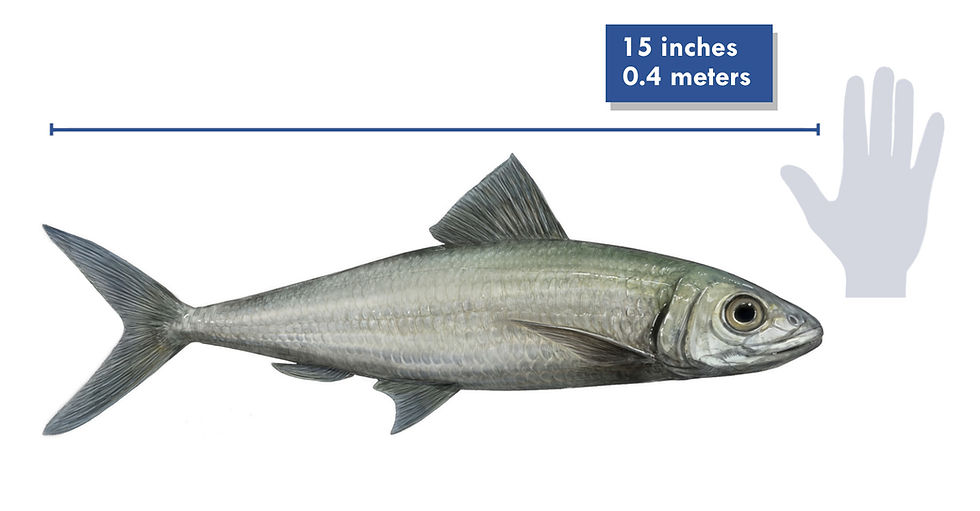
Apsopelix was a small crossognathiform fish that lived in the Late Cretaceous seas, including the Western Interior Sea. In contrast to many of its relatives, which were adapted for hunting other fishes, Apsopelix appears to have specialized in feeding on very small organisms suspended in the water. Fossils show that it had long, densely packed gill rakers that would have been useful for filtering plankton and other microscopic food particles. Its remains are sometimes found in the stomachs of other larger animals from the Western Interior Sea.
(BELOW) A photo of an Apsopelix skeleton, on display at the Sternberg Museum of Natural History. Photo by James St. John. accessed via Wikimedia Commons and distributed under a CC BY-NC-SA 4.0 license


Elopopsis
Temporal Range: 100 million years ago - 90 million years ago
Geographic Range: Kansas, Nebraska, Colorado, Saskatchewan, parts of Europe
Species: E. crassus, E. fenzli, E. microdon, E. smithwoodwardi, E. ziegleri
Diet: Carnivorous, small fish, squid
Elopopsis is a crossignathiform fish classified as part of the family Pachyrhizodontidae. It was a streamlined predatory fish that lived across a broad geographic range extending throughout Europe, North Africa and North America, including the Western Interior Sea. Its name, meaning “Elops-like face,” reflects its superficial resemblance to modern ladyfish, Elops, and related fishes. Fossil evidence suggests that Elopopsis preyed on smaller fishes and occupied an important role as a mid-level marine predator despite its fairly small body size.

Pachyrhizodus
Temporal Range: 94 million years ago - 61 million years ago
Geographic Range: North and South America, Australia, Europe
Species: P. caninus, P. minimus, P. leptognathus, P. curvatus, P. kingi
Diet: Carnivorous, fish, marine reptiles
Pachyrhizodus was a genus of predatory crossognathiform fish that lived in ocean environments from the Late Cretaceous into the Paleocene. It had a streamlined body, heavily built jaws and large conical teeth that were well suited for capturing and holding prey. Some species grew to be very large and were fearsome predators within ancient marine ecosystems. The best known species of Pachyrhizodus from the Western Interior Sea is Pachyrhizodus caninus. Among its most distinctive characteristics were its heavy lower jaws and strongly developed premaxillary bones, adaptations that gave it a powerful bite. A much smaller species, Pachyrhizodus minimus, is known from very complete body fossils which preserve their scaly skin as well as their skeletal remains.

(BELOW) A small skeleton of Pachyrhizodus on display at the Sternberg Museum of Natural History in Hays, Kansas. This particular specimen is notable since it not only preserves the animal's bones but also a section of its digestive tract. Photo by Corbin Rainbolt
(BELOW) A Pachyrhizodus caninus vertebra from the Middle Turonian of Texas. Fossil collected and original photo taken by Jared Cooke/ jcookepaleo

(BELOW) A photo of a Pachyrhizodus jaw. The shape of the teeth and strong jaws of these fish led them to occasionally have their remains mistaken for those of mosasaurs. Photo by user "the_paleobear". accessed via Wikimedia Commons and distributed under a CC BY 2.0 license
%20(1).jpg)
Elopiformes
The elopiform fishes are an order of animals which includes today’s tarpons and ladyfishes. These animals typically have long, streamlined bodies, smooth scales, forked tails, and large mouths. One of their main identifying features is an extra set of bones in the throat, which helps distinguish them from other fish groups. They also have a unique larval stage called a leptocephalus. In the Western Interior Seaway during the Late Cretaceous, elopiforms included extinct animals like Laminospondylus.

Laminospondylus
Temporal Range: 87 million years ago
Geographic Range: Texas
Species: L. transversus
Diet: Carnivorous, fish, squid
Laminospondylus was an uncommon Cretaceous fish represented by the species Laminospondylus transversus, which was first described from Late Cretaceous deposits in Texas. The genus is classified as either a crossognathiform fish or early elopiform fishes, part of a lineage that includes the ancestors of modern ladyfish and tarpon-like fishes. Its most distinctive characteristic was its unusual layered and thickened vertebral anatomy, which inspired the genus name and served as one of the primary features used to distinguish it from related fishes.

Pachycormidae

Ancient Swordfish Mimics
Pachycormid fishes were a group of very bizarre Mesozoic fishes which had elongated pectoral fins, reduced pelvic fins and a reduced bony skeleton with many elements replaced with cartilage. Some species evolved streamlined, powerful bodies resembling modern tunas or swordfish and became active predators, while others developed into enormous filter-feeding fishes that consumed plankton and other tiny organisms suspended in the water. Within the Western Interior Sea we find fossils of both filter feeding and macropredatory pachycormid fishes.
Bonnerichthys
Temporal Range: 89 million years ago - 66 million years ago
Geographic Range: Kansas, Alabama, South Dakota
Species: B. gladia
Diet: Filter feeder, plankton
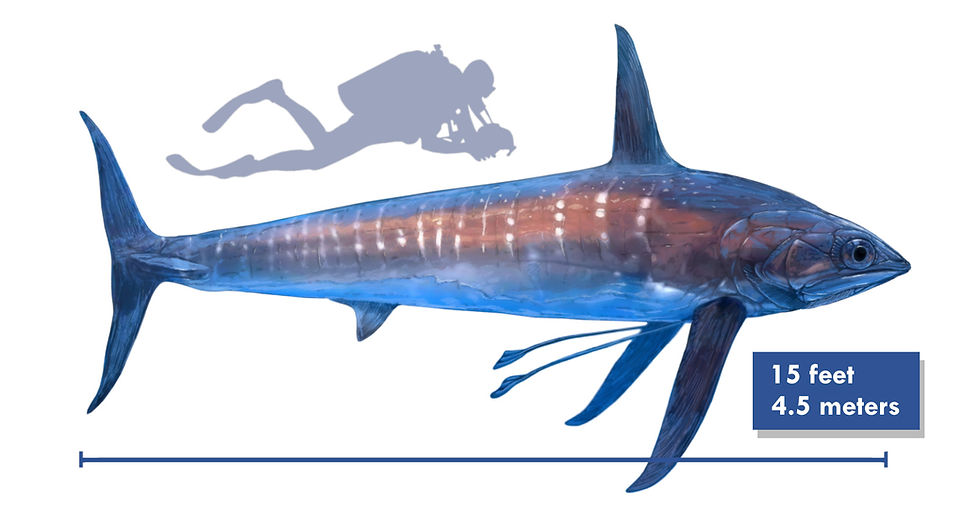
Bonnerichthys was a giant filter-feeding pachycormid which could grow to be much larger than other Cretaceous pachycormids like Protosphyraena. It was a giant suspension feeder that got its food by filtering plankton from seawater rather than actively pursuing prey. Unlike the sharp-toothed, fish-eating pachycormids, Bonnerichthys did not have large grasping teeth and instead had a specialized filtering system made up of gill arches and a series of closely spaced gill rakers. These structures formed a sieve used for capturing tiny organisms from the water column. Bonnerichthys occupied an ecological niche comparable to that of modern whale sharks, basking sharks and baleen whales. Its specialized feeding strategy shows us that giant plankton-feeding fishes had already evolved millions of years before the appearance of today's largest marine filter feeders. Remains from this animal were described during the nineteenth century but were mistakenly assigned to several different genera, including Portheus (Xiphactinus) and Protosphyraena. As additional and more complete material became available, researchers recognized that these fossils represented a distinct type of pachycormid. In 2010, the genus Bonnerichthys was formally established and named in honor of the Bonner family and their work collecting Kansas fossils.

Protosphyraena
Temporal Range: 100 million years ago - 66 million years ago
Geographic Range: Kansas, parts of the UK, Australia
Species: P. ferox, P. perniciosa, P. nitida
Diet: Carnivorous, fish, squid
Protosphyraena's anatomy has often been compared to that of a modern swordfish, Despite this it was actually a Pachycormid and not closely related to either swordfish or the barracudas for which it was named (Name roughly translates to "early barracuda). In contrast to many pachycormids, which were adapted for filter feeding or general predation, Protosphyraena evolved into a highly efficient open-water hunter. It had a long, pointed snout, large forward-facing teeth, a torpedo-shaped body and elongated pectoral fins. In certain species, these fins were strengthened and lined with serrations along their leading edges. They would have had very wide crescent-shaped tails. Their fossils have been found in parts of Kansas since as far back as the 1870s and became famous thanks to the impressive fossils of their large teeth and sword-like fins.
(BELOW) A tooth of a Protosphyraena from the front of the animal's mouth viewed from the front and back (A, B) and from the side (C). Original photo taken by Dylan Falkner/Prehistoric Alabama

(BELOW) A photo of an Protosphyraena skull, on display at the University of Michigan Museum of Natural History. Photo by Jonathan Chen. accessed via Wikimedia Commons and distributed under a CC BY-NC-SA 4.0 license

(BELOW) A photo of a Protosphyraena ferox fin showing the serrations on the front edges of the front-most fin ray. Photo by user Ghedoghedo. accessed via Wikimedia Commons and distributed under a CC BY-SA 3.0 license

Aulopiformes

Prehistoric Relatives of Barracudas
Aulopiformes is an order of fish which includes today’s barracudas and lizardfishes. Although this group has many living members still found today, several extinct aulopiform lineages are known from fossils dated to the Cretaceous period. The most successful aulopiforms found in the Western Interior Sea were the Enchodontoidei, including the well-known saber-toothed fish Enchodus, the long-bodied predator Cimolichthys and the sleek, pelagic fish Apateodus.

Apateodus
Temporal Range: 87 million years ago - 72 million years ago
Geographic Range: central and southern North America, the UK, India, Russia
Species: A. crenellatus, A. busseni
Diet: Carnivorous, fish, squid
Apateodus was a medium-sized fish with a slender, streamlined body adapted for active swimming in open marine environments. The genus is primarily recognized from cranial remains. Its jaws carried sharp teeth adapted for capturing prey, but compared with the saber-toothed Enchodus, Apateodus lacked the enormous fang-like palatine teeth and instead had a more generalized dentition. Its skull was narrower than the crania seen in most Enchodus species.


Cimolichthys
Temporal Range: 95 million years ago - 66 million years ago
Geographic Range: Parts of the US and Canada, western and central Europe
Species: C. nepaholica, C. levesiensis
Diet: Carnivorous, fish, squid
Cimolichthys was an aulopiform with a long, streamlined body similar to that of a barracuda. This lance-shaped body probably made it a fast swimmer as it moved through open water. The skull of Cimolichthys was relatively lightly constructed but supported multiple rows of sharp, forward-leaning teeth that were just the right shape for capturing and holding active prey such as fish and cephalopods. This genus is also known for the sets of robust bony scutes along its dorsal and ventral sides. These armored structures provided protection while still allowing the fish to remain an effective swimmer. It seems to have had two rows of scutes along the top and bottom of its body.

(BELOW) A fossilized skeleton of Cimolichthys on display at the KU Natural History Museum in Lawrence, Kansas. Note the rows of bony scales running along the dorsal and ventral sides of the animal and the deeply forked tail. Photo was taken by Corbin Rainbolt

(BELOW) A fossilized set of Cimolichthys hypurals found in the Niobrara Chalk Formation. These bony rays support the tail fin lobes of most types of ray-finned fishes, fossil collected by Kris Super, photo by Corbin Rainbolt

(BELOW) A fossilized Cimolichthys vertebra found in the Niobrara Chalk Formation. Side facing upwards (A) and lower portion showing leftover chalk matrix (B). Hourglass-shaped vertebrae are often seen in aulopiform fishes. Fossil collected by Kris Super, photo by Corbin Rainbolt

Enchodus
Temporal Range: 105 million years ago - 66 million years ago
Geographic Range: Worldwide distribution
Species: E. petrosus, E. dirus, E. ferox, E. gladiolus, E. machairus, E. shumardi
Diet: Carnivorous, fish, squid
Enchodus is one of the most recognizable predatory fishes of the Late Cretaceous and is best known for the enormous fang-like teeth that earned it the nickname “saber-toothed herring.” This genus had a pair of large fangs positioned near the front of the mouth, often accompanied by additional enlarged teeth in the upper and lower jaws. These spear-like teeth were used for seizing and holding slippery prey and are among the most commonly preserved Enchodus fossils. The genus name itself translates to “spear tooth,” which reflects this particular adaptation. In addition to its enlarged fangs, Enchodus had large eyes and a lightly built skull, which hints at an active predatory lifestyle. Most species grew to be only a few feet long. Some species also had particularly large fan-shaped pectoral fins.
(BELOW) An Enchodus fang viewed from the front (A) and the side (B). Original photo taken by Dylan Falkner


Leptecodon
Temporal Range: 85 million years ago
Geographic Range: Kansas
Species: L. rectus
Diet: Carnivorous, fish, small invertebrates
Leptecodon is a genus of small aulopiform fishes which were related to animals like Enchodus. They had mouths with small pointed teeth and seem to have preyed upon smaller fishes and invertebrates living near the seafloor. Their fossils are often found in association with large Inoceramid clams and they are thought to have used the insides of these mollusks as a place to shelter from possible predators. Its fossils are sometimes found in the same places as those of the small Cretaceous beardfish Omosoma.


Stratodus
Temporal Range: 66 million years ago - 50 million years ago
Geographic Range: Kansas, Alabama, South Dakota, western Africa, western Asia
Species: S. apicalis, S. indamanensis,
Diet: Carnivorous, fish, squid
Stratodus was a giant aulopiform fish with an eel-like body, an elongated dorsal fin and a strange set of tiny teeth unlike those seen in most other predatory fishes. One of its most unique features was the presence of several rows of small teeth lining the upper jaw, along with more rows of larger inward-curving conical teeth. This dental arrangement was probably used for seizing and retaining prey and inspired the genus name, which means “layered tooth.” Stratodus also stands out among aulopiform fishes because of its large size. Fossil evidence indicates that some individuals grew to be well over 14 feet long, which would make it among the largest known members of the order Aulopiformes. Its body was slender and elongated, similar to an enlarged and stretched out lizardfish and was protected by thick, spiny scutes along the flanks.
Media Gallery


Suggested References: Ray-Finned Fishes
Alvarado-Ortega, Jesús; Porras- Múzquiz, Héctor ( 2009). "On the occurrence of Gillicus arcuatus (Cope, 1875) (Pisces, Ichthyodectiformes) in Mexico". Boletín de la Sociedad Geológica Mexicana. 61 (2): 215–224.
Bardack, D. (1965). "Anatomy and evolution of chirocentrid fishes". The University of Kansas Paleontological Contributions. 10: 1–88.
Bell, G. L., Jr. (1986). “A pycnodont fish from the upper Cretaceous of Alabama”. Journal of Paleontology 60(5):1120-1126, 2 figs.
Bice, K. N.; Shimada, K.; Kirkland, J. I. (2013). "Late Cretaceous Marine Fishes from the Upper Greenhorn Limestone in Southeastern Nebraska". Transactions of the Kansas Academy of Science. 116 (1–2): 22–26.
Cope, E. D, (1872), “On the families of fishes of the Cretaceous Formation of Kansas”: Proceedings of the American Philosophical Society, v. 12, p. 327-357.
Everhart, M. J. (2007). “Remains of a pycnodont fish (Actinopterygii: Pycnodontiformes) in a coprolite; An upper record of Micropycnodon kansasensis in the Smoky Hill Chalk, western Kansas”. Kansas Academy of Science, Transactions 110(1/2): 35-43.
Everhart, M. J. (2010). “Bonnerichthys gladius – The largest bony fish and first known planktivore from the Late Cretaceous”. Kansas Academy of Science, Transactions 113(1-2):123-124.
Fielitz, C.; Stewart, J. D.; & Wiffen, J. (1999). “Aethocephalichthys hyainarhinos gen. et sp. nov., a new and enigmatic Late Cretaceous actinopterygian from North America and New Zealand”. Mesozoic Fishes 2 – Systematics and Fossil Record, G. Arratia & H.-P. Schultze (eds.): pp. 95-106, 7 figs.
Fielitz, Christopher; González-Rodríguez, Katia A. (2010). "A New Species of Enchodus (aulopiformes: Enchodontidae) from the Cretaceous (albian to Cenomanian) of Zimapán, Hidalgo, México". Journal of Vertebrate Paleontology. 30 (5): 1343–1351. Bibcode:2010JVPal..30.1343F.
Fielitz C, Shimada K. (1999).”A new species of Bananogmius (Teleostei; Tselfatiformes) from the Upper Cretaceous Carlile Shale of western Kansas”. Journal of Paleontology 73(3): 504-511.
Friedman, Matt; Beckett, Hermione T.; Close, Roger A.; Johanson, Zerina (2016). "The English Chalk and London Clay: two remarkable British bony fish Lagerstätten". Geological Society, London, Special Publications. 430 (1): 165–200.
Grande, Lance; Bemis, William E. (1998). "A Comprehensive Phylogenetic Study of Amiid Fishes (Amiidae) Based on Comparative Skeletal Anatomy. an Empirical Search for Interconnected Patterns of Natural History". Journal of Vertebrate Paleontology. 18 (sup1): 1–696.
Kanarkina, A.; Zverkov, N.; Polyakova, I. (2024). "New evidence of the global distribution of the swordfish-like pachycormid Protosphyraena in the late Early Cretaceous and a review of global records of the genus". Cretaceous Research. 166.
Lucas, Spencer G.; Sullivan, Robert M. (2006). “Late Cretaceous Vertebrates from the Western Interior: Bulletin 35”. New Mexico Museum of Natural History and Science.
Maisey, J. G., (1996). “Discovering Fossil Fishes”. Henry Holt and Company, New York.
McIntosh, A. P.; Shimada, K.; Everhart, M. J. (2016). "Late Cretaceous marine vertebrate fauna from the Fairport Chalk Member of the Carlile Shale in southern Ellis County, Kansas, U.S.A." Transactions of the Kansas Academy of Science.
Near, Thomas J.; Thacker, Christine E. (2024). "Phylogenetic Classification of Living and Fossil Ray-Finned Fishes (Actinopterygii)". Bulletin of the Peabody Museum of Natural History. 65 (1): 3–302.
Nelson, Luke E.; Murray, Alison M.; Sims, Megan E. (2026). "A new species of Enchodus from the Western Interior Seaway of North America and a taxonomic revision of Enchodus dirus, Leidy, 1857". Journal of Vertebrate Paleontology.
Russell, D. A. (1988). “A check list of North American marine Cretaceous vertebrates including freshwater fishes”. Royal Tyrrell Museum
Shimada, Kenshu (2016). "A new species of the Late Cretaceous 'sail-finned' bony fish, Pentanogmius (Actinopterygii: Tselfatiiformes), from Texas, USA". Cretaceous Research. 61: 188–198.
Shimada, K. and M. J. Everhart. (2004). “Shark-bitten Xiphactinus audax (Teleostei: Ichthyodectiformes) from the Niobrara Chalk (Upper Cretaceous) of Kansas”. The Mosasaur 7, p. 35-39.
Shimada, K. (2015). “Body form and paleoecology of the large Late Cretaceous bony fish, Pachyrhizodus caninus”. Cretaceous Research, 52, 286-291.
Stewart, A. (1899). “Pachyrhizodus minimus, a new species of fish from the Cretaceous of Kansas”. Kansas University Quarterly, 8(1), 37-38.
Taverne, Louis (2001). "Révision du genre Bananogmius (Teleostei, Tselfatiiformes), poisson marin du Crétacé supérieur d'Amérique du Nord et d'Europe". Geodiversitas. 23 (1): 17–40.
Vavrek, Matthew J.; Murray, Alison M.; Bell, Phil R. (2016). "Xiphactinus audax Leidy 1870 from the Puskwaskau Formation (Santonian to Campanian) of northwestern Alberta, Canada and the distribution of Xiphactinus in North America". Vertebrate Anatomy Morphology Palaeontology. 1: 89.