
Artiodactyla (continued)

Protoceratids (Protoceratidae)

Synthetoceratines of the Ogallala Formation
Protoceratids are a now-extinct group of even-toed ungulates. These animals had long skulls and a set of horns at the back of their heads. In some earlier genera the front of the mouth would have held a set of enlarged upper teeth similar to the fangs seen in musk deer. In the later forms known from the Ogallala Formation however, the front of the snout often supported a tall fused ossicone. These structures were not composed of the same materials as the rear horns of these animals. Instead of being covered in a keratinous outer sheath, these bony ornaments which sat over the noses of these animals may have been covered in hair. In some later groups of protoceratids in the subfamily Synthetoceratinae, the bony structure over the nose took on a Y-shape or a slingshot-shaped form.
Artiodactyls
Not all artiodactyls are listed on this page. See the list below for the order in which entries are listed
This page
Previous Page

Lambdoceras
Temporal Range: 20.6 - 13.6 million years ago
Geographic Range: Great Plains from South Dakota to Texas
Species: L. hessei, L. siouxensis, L. siouxensis
Diet: Herbivorous mixed feeder, grass, leaves
Lambdoceras was a Miocene protoceratid from North America and a member of the subfamily Synthetoceratinae. Although its body shape was superficially similar to that of a deer it was unrelated to true deer and would have had permanent skull ornaments rather than antlers shed each year. Lambdoceras had widely curving horns behind its eyes and a large rostral ossicone at the tip of its snout. Lambdoceras was quite different from earlier protoceratids whose skulls lacked these complex cranial appendages. Later Middle Miocene protoceratids also seem to have undergone a trend towards larger body sizes and developed taller molar crowns in order to move from a browsing diet of a mixed diet of grasses and woody plants. Along with these specializations shared among many protoceratids known from the Ogallala Formation, Lambdoceras also had unfused metatarsals and side toes that were larger than those of many modern hoofed mammals.


Prosynthetoceras
Temporal Range: 20.6 - 13.6 million years ago
Geographic Range: Southern Great Plains and southeastern North America
Species: P. francisi, P. orthrionanus, P. texanus
Diet: Herbivorous mixed feeder, grass, leaves
Prosynthetoceras was a North American protoceratid which was a close relative of the genus Sythetoceras and was part of the subfamily Synthetoceratinae, an advanced protoceratid subfamily known for elaborate cranial ornamentation. In Prosynthetoceras, a seires of bony plates on the maxillary bones were fused together into a single structure which created the shared base of the nasal ornament which is seen in all synthetoceratines. However, this structure had a tip which was less deeply forked than the rostral horn of animals like Synthetoceras, which divided near its tip into a prominent slingshot-shaped bony projection.

Sythetoceras
Temporal Range: 12.5 - 4.7 million years ago
Geographic Range: Nebraska, Texas, Florida,
Species: S. tricornatus, S. davisorum
Diet: Herbivorous mixed feeder, grass, leaves
Synthetoceras was a North American protoceratid from the late Miocene and the namesake of the subfamily Synthetoceratinae. In fossil skeletons which seem to belong to males of this genus, the skull is heavily ornamented. They would have had a pair of elongated postorbital horns which curved outwards and upward above the eyes, as well as a larger rostral horn projecting from the tip of the snout. This nasal appendage was formed from a fused base which then separated near its end into a slingshot-like Y-shaped fork. Very few types of non-synthetocerine protoceratids had this same set of horns and large forked ossicones. More basal forms such as the genus Leptotragulus lacked horns entirely, whereas the Early Miocene genus Syndyoceras retained two separate rostral horns. Synthetoceras appears to represent the peak of complex cranial ornamentation within the family Protoceratidae. Females of this genus seem to have been hornless or had much smaller appendages. The horns likely functioned as display structures used to signal maturity and fitness, although their precise function remains uncertain
Pronghorns (Antilocapridae)

Ancient Pronghorns of the Ogallala Formation
Antilocaprids are an endemic North American family of hoofed ruminants whose closest living relatives are giraffes and okapis, despite often being described colloquially as “antelopes.” Fossils from the Miocene and Pliocene deposits of the Ogallala Formation show us that this family was once considerably more diverse than it is today. The Great Plains were once home to several early smaller forms of antilocaprids, including animals similar to the genus Merycodus, as well as later antilocaprids such as Texoceros, which more closely resembled modern pronghorns and may in fact be the closest extinct relative of all of today’s antilocaprids. These animals are often distinguished by the shapes of their horn cores, which can be long and sharp, palmate, or form 3 pairs of rounded horn apexes. Although their horns are similar in appearance to those of cows, goats and other bovids, the outer coverings of these horns are shed periodically, similar to the antlers of deer. Some ancient antilocaprids were grassland specialists and fed on a diet primarily composed of grass, although some ancient antilocaprid varieties from the Miocene epoch seem to have had a greater preference for browsing on leaves.
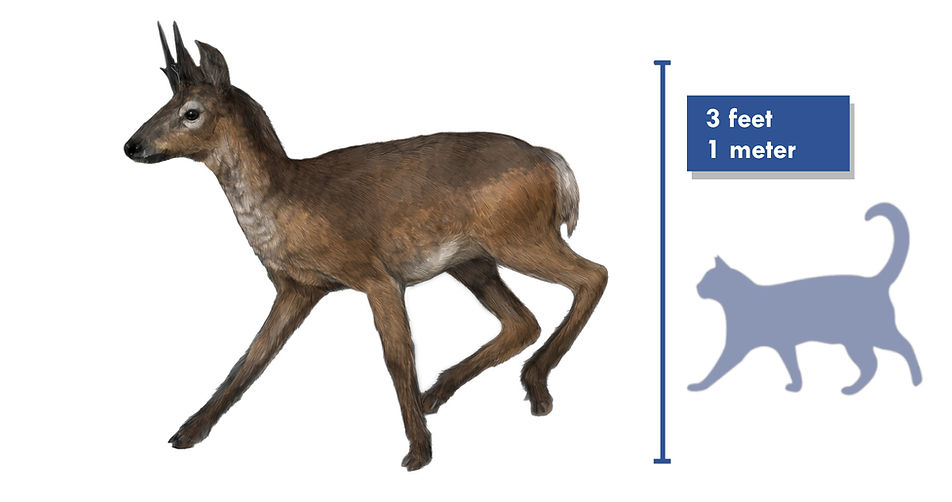
Capromeryx
Temporal Range: 5 million years ago to approximately 11,000 years ago
Geographic Range: Found throughout North and South America
Species: C. arizonensis, C. furcifer, C. gidleyi, C. mexicanus, C. minor
Diet: Herbivorous, grasses, twigs, leaves
Capromeryx, also known as the dwarf pronghorn, was the smallest known antilocaprid genus. It lived in North America from the start of the Pliocene to the late Pleistocene epoch, with its fossils having been found from Nebraska to as far south as central Mexico. The smallest species of Capromeryx had estimated adult body weights in the area of around 25 pounds, making them much smaller that today’s pronghorns.
The horns of Capromeryx were arranged into four points. Unlike in Stockoceros or Tetrameryx where their horns point in opposite directions, forwards and backwards, in Capromeryx the horn cores seem to be positioned parallel to one another on each side of the skull. In the remains of some individuals the front and rear horns are of roughly equal length while in others the front horns are considerably shorter than the rear horns. In general it seems as though later species of Capromeryx had smaller horns than their relatives in the Pliocene.


Cosoryx
Temporal Range: Middle Miocene
Geographic Range: Western parts of North America
Species: C. furcatus, C. cerroensis, C. ilfonensis
Diet: Herbivorous mixed feeder, grass, leaves
Cosoryx was an extinct genus of antilocaprids which had relatively simple, branching horn cores which seem to have supported a pair of slingshot-shaped horns. Each horn core separates into two similarly sized tines. The teeth of these animals are also fairly useful for identifying this genus; its premolars were reduced, and the cheek teeth lacked an ectostylid, a type of enamel projection present in some other types of ruminants. Based on known skeletal material, it seems as though Cosoryx was a relatively small animal, similar in size of many early antilocaprids traditionally classified as merycodontines. The genus lived during the Miocene, with fossils attributed to it discovered in Nevada and the Santa Fe Group of New Mexico. Its taxonomic position remains uncertain because some paleontologists consider Cosoryx to be synonymous with a similar genus, Merycodus.

Merycodus
Temporal Range: 17 - 10 million years ago
Geographic Range: Western North America from Saskatchewan to central Mexico
Species: M. crusensis, M. hookwayi, M. joraki, M. major, M. minimus, M. minor, M. necatus, M. nenzelensis, M. prodromus, M. sabulonis, M. warreni, M. osborni
Diet: Herbivorous mixed feeder, grass, leaves
Merycodus was a genus of pronghorns whose horn cores had relatively short forked shafts that were usually divided into two tines of approximately equal size. This makes the, quite distinct from the strongly asymmetrical horns found in fossils of the related genus Ramoceros. Their horns are somewhat similar to those of animals in the genus Cosoryx and the two genera have occasionally been considered synonymous. Specimens of Merycodus once assigned to another genus, “Meryceros”, were identified as a separate group of animals since they had larger, more laterally flattened horns, although “Meryceros" is now frequently considered synonymous with Merycodus. Like other grazing antilocaprids, Merycodus also would have had high-crowned cheek teeth suited to resisting wear from coarse grasses. Its range extended across much of western North America, particularly in areas which would have been dominated by open habitats and grasslands.

Proantilocapra
Temporal Range: Middle Miocene
Geographic Range: Western North America, Nebraska
Species: P. platycornea
Diet: Herbivorous mixed feeder, grass, leaves
Proantilocapra was an extinct genus of antilocaprids known from fossils discovered in deposits from the Ash Hollow Formation in parts of Nebraska. The genus can be separated from other contemporary antilocaprids by the unique shape of its horn cores. Rather than having the strongly forked horns seen in modern pronghorns, Proantilocapra had shorter horn cores which were somewhat flattened from side to side. This flattened appearance is the namesake of the species “platycornea”, which means “flat-horned.” The horn cores of these animals extended upward and outward above the eyes and ended in rounded apexes. Proantilocapra also had high-crowned cheek teeth that would have helped it process coarse, abrasive vegetation such as tough grasses. Much like living pronghorns, the long, thin limbs of Proantilocapra suggest that it was an active and agile animal which would have been able to outrun many of the large carnivores found in the ancient Miocene savannahs

Ramoceros
Temporal Range: 13.6 - 10.3 million years ago
Geographic Range: Great Plains, western North America
Species: R. brevicornis, R. marthae, R. merriami, R. osborni, R. palmatus, R. ramosus
Diet: Herbivorous mixed feeder, grass, leaves
Ramoceros was a bizarre genus of antilocaprids best known for their asymmetrical horns. Most antilocaprids, including the living pronghorn, had/have paired horns of approximately equal size. Ramoceros would not have followed this pattern and instead developed one horn that was considerably larger than the other. In some individuals, the larger horn reached three or four times the size of its smaller counterpart. Its horns were antler-like and formed a series of deep forks. They are very different from the more regularly arranged multiple horns of other extinct genera such as Stockoceros and Hexameryx (See our entries about these animals in our Pleistocene guide). Ramoceros was a comparatively small antilocaprid with an estimated body mass of approximately 10 to 20 kilograms. It lived in North America during the Clarendonian interval of the Miocene and belonged to the group of ancient antilocaprids traditionally classified as part of the now extinct merycodontines. Most merycodontines were also fairly small animals, usually around 2/3 the size of extant pronghorns in the genus Antilocapra.
Rare and Polyphyletic Antilocaprids
Some antilocaprid genera from the Ogallala Formation are known from very fragmentary or poorly documented fossils while others are composed of fossil material which may belong to many other types of antilocaprids who are likely to be distantly related to one another. Information about these other genera is listed below.

Other Antilocaprid Genera
Sphenophalos: An antilocaprid which would have had short, slightly twisted horns which ended in two short tines, one of which faced forward, the other facing towards the rear. These animals had fairly short and compact snouts when compared with other contemporary antilocaprids. They seem to have been close relatives of the genus Ilingoceras, an antilocaprid with corkscrew-shaped horns which is known from fossils found in deposits further to the west in parts of Nevada.
Texoceros: A mid-sized genus of antilocaprids. It seem to have been a larger animal than early members of the antilocaprid family such as the genus Merycodus but it seems to have been smaller than the living pronghorn genus Antilocapra. Its teeth were distinctive enough that the type species, Texoceros altidens, was originally named primarily from relatively incomplete dental and jaw material. Dental wear from fossils of these animals which were found in central Mexico most closely resembles the types of wear found on the teeth of browsing and mixed-feeding ruminants. This most likely means that these animals were feeding on a mixture of different plant sources, instead of specializing solely on grass.
Suggested References: Artiodactyls
Chen, Katheryn. (2015). Ecology and Morphology of the Late Miocene Musk Deer, Longirostromeryx wellsi (Artiodactyla: Moschidae: Blastomerycinae).
Frick, C. (1937). "Horned ruminants of North America". Bulletin of the American Museum of Natural History. 69: 1–669.
Janis, Christine M.; Theodor, Jessica M.; Boisvert, Bethany (2002). "Locomotor evolution in camels revisited: a quantitative analysis of pedal anatomy and the acquisition of the pacing gait". Journal of Vertebrate Paleontology. 22 (1): 110–121
Marriott, Katherine; Prothero, Donald R.; Lukowski, Stephanie M.; Forcellati, Meghan R. (2026). "CHAPTER 10: VAMPYROCAMELUS WELSHI, A NEW GENUS AND SPECIES OF GIRAFFE-LIKE CAMEL (ARTIODACTYLA: CAMELIDAE)". New Mexico Museum of Natural History and Science Bulletin. 104: 221–233.
Lander, B. (1998). "Oreodontoidea". In Janis, C.M.; Scott, K.M.; Jacobs, L.L. (eds.). Evolution of Tertiary mammals of North America. Cambridge: Cambridge University Press. pp. 402–425
Prothero, Donald (2007). The Evolution of Artiodactyls. Johns Hopkins University Press.
Sánchez, Israel M.; Cantalapiedra, Juan L.; Ríos, María; Quiralte, Victoria (2015). "Systematics and Evolution of the Miocene Three-Horned Palaeomerycid Ruminants (Mammalia, Cetartiodactyla)". PLoS One. 10 (12)
Semprebon, Gina; Janis, Christine; Solounias, Nikos (2004). "The Diets of the Dromomerycidae (Mammalia: Artiodactyla) and Their Response to Miocene Vegetational Change". Journal of Vertebrate Paleontology. 24 (2): 427–444
Semprebon, G.M.; Rivals, F. (September 2007). "Was grass more prevalent in the pronghorn past? An assessment of the dietary adaptations of Miocene to Recent Antilocapridae (Mammalia: Artiodactyla)". Palaeogeography, Palaeoclimatology, Palaeoecology. 253 (3–4): 332–347.
Sowls, Lyle K. (1997). Javelinas and Other Peccaries: Their Biology, Management, and Use (2nd ed.). Texas A&M University Press. pp. 67–68.
Stevens, M.S.; Stevens, J.B. (1996). "Merycoidodontinae and Miniochoerinae". In Prothero, D.R.; Emry, R.J. (eds.). The terrestrial Eocene-Oligocene transition in North America. Cambridge: Cambridge University Press. pp. 498–573.