
Artiodactyla

Even-Toed Ungulates
Fossils preserved in the Ogallala Formation preserve the remains of several groups of artiodactyls, or even-toed hoofed ungulates, that lived in the Great Plains during the Miocene and Pliocene epochs. These included members of the family Camelidae (camels) Antilocapridae (pronghorns) and Tayassuidae (peccaries), along with the extinct protoceratid and dromomerycid families. The family Camelidae, which comprises all of today’s camels, llamas, alpacas and their relatives, is a family which originated in North America and is known from fossils of large and small animals such as Megatylopus and Aepycamelus. These extinct camels were often large, with long legs and, in some species, elongated necks that helped them browse and travel efficiently across open landscapes. Some smaller camelid genera, such as Protolabis, are also found in these deposits. The family Tayassuidae (peccaries) includes several extinct Miocene genera, some of which had ong flanges of bone along the edges of their cheekbones. Their teeth and long snouts were useful for rooting through soil in search of food. The family Antilocapridae is the pronghorn family and includes animals with long palmate horns and shorter horns with rounded tips. Other now extinct families of artiodactyls are also found in these deposits, including the dromomermerycids and protoceratids. Some of these animals had paired structures above their eyes and in some genera a third projection is found further back, towards the base of the skull. The order artiodactyla was one of the most diverse orders of large mammals found in North American Neogene deposits. Some groups found in North America are absent from the fossil record of the Miocene and Early Pliocene. These include deer, bison, sheep and goats, which would later arrive from Eurasia during the late Pliocene and Early Pleistocene.
Anatomy
Skeletal Anatomy
Even-toed ungulates take their name from the structure of their feet. In most members of the group, the animal’s weight is concentrated on the third and fourth toes which are protected by keratinous hooves. A second pair of reduced hooves are present in some types of artiodactyls, conserved as small dewclaws behind the main hooves. Many fast-running artiodactyls such as protoceratids, antilocaprids and dromomerycids also have very long legs and fused metacarpal and metatarsal bones called cannon bones, features which help to limit unnecessary sideways movement, and allowing these animals such as deer, pronghorns, and cattle to move quickly over open ground. On the other hand, some types of artiodactyls, such as large Miocene camels, hippos, pigs and oreodonts for example, are much more heavily built. The skulls of artiodactyls are equally diverse. Some have horns or antlers used for display, defense, or competition, while their teeth reflect diets ranging from mixed feeding to specialized grazing and browsing. They often have broad molars which are well-adapted for grinding, although some omnivorous groups have molars which are covered in tooth lobes or angular cusps. Many types of artiodactyls, such as musk deer, early protoceratids, peccaries, pigs, hippos and camels, have long canine teeth which are used for defense or when competing with other members of their own species.
(BELOW) Features of the skeletal anatomy of the long-snouted peccary Mylohyus. These animals had many of the traits which are commonly found in artiodactyls, including feet supported by hooves on two toes, tall spinous processes on the thoracic vertebrae and a short tail. These peccaries would have also had rather long tusks.

(BELOW) The hooves of artiodactyls are quite different from those of odd-toed ungulates such as horses and rhinos. Like most even-toed ungulates, The hooves of roe deer (A) are cloven, with two hooves contacting the ground and two smaller dew claws positioned off the ground further up on the leg. These dew claws are not found in odd-toed ungulates. Horses (B) support their weight on a single hoof while rhinos and tapirs walk on multiple toes supported by a thick pad. Photo A, Public Domain image, Photo B accessed via Wikipedia Commons, uploaded by user Montanabw, CC BY-SA 3.0

Artiodactyls have a huge range of different types of adornments on their crania. The best known of these structures are horns and antlers. True horns, such as those of cattle, goats, sheep, and antelopes, are composed of permanent bony cores surrounded by keratin sheaths. These structures generally grow throughout an animal’s life and are rarely shed. The exceptions to this trend are pronghorns and other types of antilocaprids which will shed the outer sheaths of their horns. Deer on the other hand have antlers, which are branching structures formed entirely from bone. Developing antlers are initially covered by a sensitive, blood-rich layer of skin known as velvet. After they are finished growing, the velvet is removed as the animals scrape them along rocks and trees, and later the antlers are eventually shed and replaced. This typically happens over the course of an annual cycle. Giraffes, okapis, and several extinct groups, such as protoceratids and dromomerycids from the Miocene and Pliocene of the Great Plains, have ossicones, which are skin-covered bony projections that develop separately before fusing with the skull. In many dromomerycids these ossicones sit over the eyes and, in some groups, at the back of the skull over the neck. Some of the last members of the family Protoceratidae the skulls of these animals show a combination of features, with a pair of true horns along the back of the head and fused ossicone-like protrusions sitting along the upper portions of their muzzles.
Cranial Ornamentation
(BELOW) Horns of a pronghorn. Like many other types of horned artiodactyls the bony cores of the horns of antilocaprids are sheathed in a thick layer of keratin. Unlike horned ruminants however, pronghorns are able to shed and regrow their horn sheaths. Photo accessed via Wikimedia Commons, photo by James St. John, CC BY 2.0

(BELOW) Ossicones are another type of cranial projection found in some types of artiodactyls. In the skull of a giraffe, the ossicones are the horn-like features at the rear of the head. These structures are covered in skin and fur. Similar ossicones seem to have been present in dromomerycids and on the noses of protoceratids. Photo was taken at the KU Natural History Museum by Corbin Rainbolt

Artiodactyls
Not all artiodactyls are listed on this page. See the list below for the order in which entries are listed
Next page
This page
Dromomerycids (Dromomerycidae)

Ruminants With Elaborate Headgear
Dromomerycids were an ancient group of artiodactyls who superficially resembled deer or antelopes, despite not being particularly closely related to either group. The males of many dromomerycid genera had long projections called ossicones on their skulls. Unlike antlers, these structures were usually unbranched and were not shed each year. Most groups of dromomerycids had paired ossicones above their eyes, while some genera also had a central projection at the back of their skulls. Over the course of the Miocene epoch several dromomerycid genera underwent a gradual transition towards a grazing diet, developing high-crowned molars which could resist more wear and tear from silica-rich grasses.

Bouromeryx
Temporal Range: 17 - 11 million years ago
Geographic Range: Parts of the Great Plains, Florida, Saskatchewan
Species: B. americanus, B. submilleri, B. trigonocorneus
Diet: Herbivorous browser, leaves
Bouromeryx was a North American dromomerycid ruminant which was a relative of animals like Cranioceras and Pediomeryx. Like other dromomerycids, it carried tall cranial appendages on the top of its head. They would not have shed these projections and instead they would have grown over the course of the lives of these animals. The ossicones over their eyes were medium-sized for a dromomerycid while the rear appendage was noticeably smaller than the elongated occipital ossicones of later related genera such as Cranioceras. Bouromeryx also would not have had any upper canines and had only a short diastema, a gap separating the teeth at the front of the mouth from the cheek teeth. It would have had comparatively large premolars and low-crowned teeth which were probably more useful for browsing on leaves than for grinding up tough grasses.


Cranioceras
Temporal Range: 15.97 - 5.3 million years ago
Geographic Range: Found across parts of central and western North America
Species: C. unicornis, C. clarendonensis, C. pawniensis, C. teres
Diet: Herbivorous browser, leaves
Cranioceras was a North American dromomerycid ruminant that survived from the Miocene into the early Pliocene and the namesake of the tribe Cranioceratini. Like most other types of dromomerycids, Cranioceras had large giraffe-like ossicones over its eyes. Like its closest relatives it also would have had a third smaller projection issuing from the back of its skull just over the uppermost portion of the neck. These ossicones were likely covered in fur instead of a keratinous outer sheath and are associated with the remains of animals who are thought to have been male individuals. They would not have been shed like the antlers of deer. The postcranial remains of these animals resemble those of deer and antelopes and Cranioceras was likely an able runner, living in both wooded and open environments.

Dromomeryx
Temporal Range: 13.6 to 10 million years ago
Geographic Range: Western North America from Nebraska to California
Species: D. borealis
Diet: Herbivorous browser, leaves
Dromomeryx was a Miocene artiodactyl native to North America and the namesake of the family Dromomerycidae. Unlike some other types of dromomerycids, Dromomeryx only had two projections on its skull instead of the three projections usually seen in cranioceratini such as Cranioceras and Pediomeryx. They also would have lacked the long canine teeth which we see in some groups of earlier dromomerycids. Based on the wear patterns on their teeth and their low crowned molars it seems as though Dromomeryx preferred to live in wooded environments and browsed mainly on leaves and other soft plants, although later species may have consumed tougher vegetation as conditions became cooler and drier. Like many other members of its family, it would have had very long legs and was likely an efficient runner.
(BELOW) Cranial projections and limb bones of Dromomeryx borealis at the University of California Museum of Paleontology. Unlike the projections of most dromomerycids, those of some Dromomeryx species are branched into a large upper tine and a short rounded lower tine. Photo by Ted Fremd, Public Domain


Procranioceras
Temporal Range: 16 - 13.6 million years ago
Geographic Range: Nebraska, Florida, Saskatchewan
Species: P. skinneri
Diet: Herbivorous browser, leaves
Procranioceras was a dromomerycid that lived during the Middle Miocene epoch and whose fossils are known from parts of Nebraska, Florida, and Saskatchewan. In addition to paired hornlike projections above its eyes, Procranioceras would have had the long third horn-like projection arising from the occipital region at the rear of the skull seen among members of the tribe cranioceratini. This feature tells us that these animals were close relatives of genera such as Cranioceras and its kin. These animals differed from the members of the tribe dromomerycini, which only had a single pair of supraorbital appendages and from the members of the subfamily aletomerycinae which often had enlarged canine teeth similar to those of musk deer. Compared with later cranioceratini such as the genus Pediomeryx, Procranioceras had shorter cranial appendages and lower-crowned teeth which were better suited for browsing on soft leaves instead of grass.
(BELOW) Skull of "Cranioceras" (Procranioceras) skinneri from Nebraska at the Museum für Naturkunde, Berlin. Note the size of the cranial projections over the eyes, which are longer than the projection at the base of the skull. Image accessed via Wikimedia Commons, uploaded by user FunkMonk, CC BY-SA 3.0


Yumaceras and Pediomeryx
Temporal Range: ~13 - 4.9 million years ago
Geographic Range: Found in the Great Plains, Florida, California
Species: Y. figginsi, P. hamiltoni, P. hemphillensis, P. ruminalis
Diet: Herbivorous, some species are browsers, later species seem to have grazed on grass as mixed browsers.
Yumaceras
Yumaceras was a large North American dromomerycid genus. This animal is sometimes considered to be a subgenus or synonym of Pediomeryx rather than an independent genus. As in other cranioceratin dromomerycids, males of this genus had large paired frontal ossicones above their eyes and a single median occipital ossicone extending from the back of the skull just above the neck. These appendages were especially elongated in Yumaceras, and it had more elaborate cranial ornamentation than earlier genera such as Bouromeryx, which had shorter, more rounded projections. Compared with animals in the genus Pediomeryx, specimens assigned to the genus Yumaceras are generally larger and have longer premolar rows and lower-crowned molars. Like many types of artiodactyls, these animals seem to have become smaller over the course of the Miocene epoch and these later forms evolved more high-crowned teeth better suited to grazing on abrasive plants.

Pediomeryx
Pediomeryx was an extinct North American dromomerycid that lived from the Late Miocene epoch to the Early Pliocene epoch. Like many of its relatives, it would have had tall cranial projections over its eyes, similar to the ossicones of giraffes. Fossil skeletons which are thought to have belonged to male individuals of this genus have two elongated frontal ossicones above the eyes and a third ossicone extending from the back of the skull. Each of these projections tends to grow to be around 9-10 inches tall (around 25 cm). Their ossicones were longer on average than those of related genera such as Cranioceras. Later species in the genus Pediomeryx became smaller than their earlier ancestors and developed higher-crowned molars and even shorter premolar rows. In most animals who go through these sorts of transitions, it seems as though the development of taller crowns reflects a preference for grass as a part of their diets and a switch over to a grazing feeding style. Microwear patterns on their teeth also suggest that some of these species were mixed feeders, unlike many earlier dromomerycids, which primarily browsed on leaves. Pediomeryx was one of the last surviving dromomerycid genera during the Pliocene epoch.
(BELOW) A drawing of the head of Pediomeryx, one of the last dromomerycid genera and one of the few to survive into the Early Pliocene epoch. The ossicones of these animals were longer than those of related genera and may have been covered in a layer of skin and fur.

Camels (Camelidae)

Ancient Camels in North America
Camelids are a family of hoofed mammals which includes today’s Old World camels, South American llamas, alpacas, vicunas, and guanacos, along with their extinct relatives. Camelids spent most of their evolutionary history in North America. Some of the first camels found in the Great Plains were small animals who lived in forests during the Paleogene period. Over the course of the Miocene, several groups of camels independently developed larger body sizes, with some even having long giraffe-like necks used to browse along tall branches. Camelids only spread to other continents within the past few million years. They are split into two living lineages; the cameline subfamily, which include all camels found in Asia and Africa, and the lamine subfamily , which includes South America’s native camelids such as llamas and alpacas. The camelid family is part of Tylopoda, a suborder named for the distinctive padded feet found in later members of the camelid family. Unlike true ruminants, which have four stomach chambers, camels have three and digest tough grasses less efficiently.

Aepycamelus and Vampyrocamelus
Temporal Range: 16 - 2 million years ago
Geographic Range: Found across southern and western North America
Species: A. bradyi, A. giraffinus, A. major
Diet: Herbivorous browser, leaves
Aepycamelus
Aepycamelus was a very strange genus of camelids which would have had a giraffe-like body shape unlike those of their relatives. Aepycemelus had a very small head which was supported by a very long neck. As with all long-necked mammals, this neck length was achieved thanks to the lengthened shape of its cervical vertebrae, not from an increased number of neck bones. The limbs of these animals were also very long and thin which gave it an elevated, stilt-legged build in which the knees and elbows were positioned at similar heights relative to the feet and torso. In some individuals, the head would have managed to reach around 10 feet, or three meters, up above the ground, which gave these animals more room to browse along the tops of trees. Compared with earlier camelids, Aepycamelus had more derived feet similar to those of living camels. It walked on its toes and would have had cushioned foot pads comparable to those of modern camels. They do not seem to have been primarily adapted for running based their proportionally long and very thin legs.
Vampyrocamelus
The genus Vampyrocamelus was named in 2026 based on material which appears to be very similar to the genus Aepycamelus. The name of the genus, which translates to “vampire camel” refers to the enlarged upper canines and first premolars found in the skulls of these animals. Fossils of this animal are known from parts of Nebraska in the Ash Hollow Member of the Ogallala Formation as well as the Clarendon Beds in Texas and Oklahoma. Most Aepycamelines had very large upper canines but the teeth found in Vampyrocamelus are particularly large compared with all known camelids. Female members of this genus had reduced canines compared with the teeth of skeletons which are presumed to be from males.

(BELOW) A restoration of the life appearance of the head and neck of Vampyrocamelus. Like Aepycamelus this genus would have had a very long neck and a rather slender snout. Skull drawing is adapted from "The Evolution of North American Camels", New Mexico Museum of Natural History and Science Bulletin 104 (2026), Figure 10.1
(BELOW) Bones of the neck and leg bones of an Aepycamelus (right) alongside the skeleton of a Procamelus on display at the American Museum of Natural History. Photo accessed via Wikimedia Commons, photo by Ryan Somma, CC BY-SA 2.0


Alforjas
Temporal Range: 10.3 - 5.3 million years ago
Geographic Range: Found from Oregon to central Mexico
Species: A. taylori
Diet: Herbivorous mixed feeder, grass, leaves
Alforjas was a medium-sized genus of North American camelids which was a member of the lamine tribe, along with today’s South American camelids such as llamas and alpacas. Their range would have extended across parts of central and southern North America, as far south as central Mexico. They seem to have been somewhat larger animals than living lamines, growing to be around 20 percent larger than today’s llamas. They also would have had longer snouts than most of their relatives such as the genus Pleiolama.

Floridatragulus
Temporal Range: 20.6 - 15.9 million years ago
Geographic Range: Florida, Texas, Nebraska
Species: F. dolichanthereus, F. hesperus, F. nanus, F. texanus
Diet: Herbivorous browser, leaves
Floridatragulus was an extinct North American camelid with a long, slender, tube-shaped muzzle. The snouts of these animals would have been almost uniform in their width toward the front but expanded considerably around the cheek teeth, which gave the skull proportions unlike those of most other camelids. The lower jaw was similarly long and narrow and it would have had an extended fused symphysis and several prominent gaps between the teeth. One particular gap which distinguishes this genus from other types of camelids was the rather large space which separated the second and third lower premolars. The incisors of these animals were large and somewhat canine-like, while the cheek teeth were low-crowned and adapted for slicing and grinding softer vegetation. When fossils of these animals were first found, paleontologists initially mistook Floridatragulus for an ancient type of ruminant because of its unusual skull and tooth structure. In terms of its body size it seems to have been a mid-sized genus of camelid, around the same size as a living guanaco.

Hemiauchenia
Temporal Range: 10.3 million years ago to approximately 12,000 years ago
Geographic Range: Found in parts of North and South America
Species: H. macrocephala, H. minima, H. blancoensis, H. vera, H. paradoxa,
H. seymourensis, H. edensis, H. mirim
Diet: Herbivorous, grasses, twigs, leaves
Hemiauchenia is a genus of camels in the tribe lamini which seems to have been the direct ancestor of today’s South American camelids like llamas and alpacas. The genus first appeared during the Miocene in North America with fossils of these early animals uncovered in Texas, Kansas, Nebraska and Florida as well as parts of Central America. The genus further expanded into South America once the isthmus of Panama joined the Americas around 2-2.5 million years ago. Species like Hemiauchenia paradoxa appear in South America during the middle Pleistocene. Like many other lamine camelids, Hemiauchenia had a long neck habitually held in a posture which would have positioned most of the cervical vertebrae above the shoulder blades. Their torsos were relatively narrow and they would have lacked the tall spinous processes which could have anchored fleshy humps like those seen in dromedary and bactrian camels. Some species of Hemiauchenia had proportionally larger heads than their living relatives.


Megatylopus
Temporal Range: 10.3 - 2.58 million years ago
Geographic Range: Found across southern, central North America
Species: M. gigas, M. cochrani, M. matthewi, M. primaevus
Diet: Herbivorous mixed feeder, grass, leaves
Megatylopus was among the largest camelids known to have lived in North America, with some individuals reaching estimated shoulder heights of around 14 feet (4.2 meters). Their size would have given these animals access to leafy browse growing on higher branches of trees and would have extended its feeding envelope when grazing along the ground. As a result of seemingly forming part of the cameline branch of the camelid family tree, the genus Megatylopus would have appeared quite similar to living bactrian camels and the bones of its limbs and feet are fairly similar to corresponding bones of later Pleistocene North American camels such as the genus Camelops. Megatylopus seems to have been closely related to animals like Gigantocamelus and to the lineage containing modern Camelus. Their size meant that they could have reached sizes comparable to those of some of the proboscidean elephant relatives and large rhinos who shared their habitats.

Oxydactylus
Temporal Range: 28.4 - 13.7 million years ago
Geographic Range: Florida, Nebraska, Texas, Wyoming, California, Idaho
Species: O. longipes, O. lacota, O. wyomingensis
Diet: Herbivorous browser, leaves
Oxydactylus was a genus of North American camelids which would have appeared somewhat similar to the genus Aepycamelus. The genus is known for its long neck and limbs, as well as its narrow, pointed toes. As is the case with Aepycamelus and the living giraffe, its neck was formed from seven elongated vertebrae instead of being composed of many smaller vertebrae like the necks of sauropod dinosaurs and long-necked birds. Its limbs were very lightly built. Unlike modern camels, llamas, and alpacas, Oxydactylus lacked the specialized surfaces on its toe bones which support broad foot pads. Instead, the phalanges at the ends of each of its toes were tall, narrow, and pointed, which would suggest that Oxydactylus walked on hoof-like structures rather than cushioned soles. The animal also had a relatively small skull and still had several dental characteristics associated with earlier branches of the camelid family tree. Its cheek teeth had low crowns while its upper incisors were only slightly reduced (living camels lack upper incisors), and its premolars remained fully developed. Later camelids generally had more reduced incisors and premolars.
(BELOW) Skeleton of an Oxydactylus wyomingensis. Note the lengthening of the cervical vertebrae of the neck. Photo accessed via Wikimedia Commons, photo by James St. John, CC BY-SA 2.0

(BELOW) Detail of the skull from the skeleton in the photo above, on display at the University of Wyoming Geological Museum. Photo accessed via Wikimedia Commons, photo by James St. John, CC BY-SA 2.0


Pleiolama
Temporal Range: ~10.3 - 5 million years ago
Geographic Range: Found across North and Central America
Species: P. mckennai, P. vera
Diet: Herbivorous mixed feeder, grass, leaves
Pleiolama was an extinct North American member of the lamine tribe, part of the camelid group that also includes modern llamas, alpacas, guanacos, and vicuñas. Unlike the tall, well built skulls of dromedary and bactrian camels, Pleiolama and its relatives had relatively slender skulls. Like many other types of lamines Pleiolama had a set of reduced premolars. Their limbs were long and slender, which gave this genus a lighter, taller build than more heavily constructed, short-legged camelids. It probably resembled a large, swift-moving llama moreso than a heavy-bodied camel. There is some anatomical evidence which suggests that this genus may be a paraphyletic grouping of different North American lamines which may be more distantly related to one another than was originally thought, although this possibility has not yet been proven conclusively.

Procamelus
Temporal Range: ~16.3 - 5.3 million years ago
Geographic Range: Found across North America from Virginia to California
Species: P. occidentalis, P. coconinensis, P. grandis, P. leptocolon, P. leptognathus,
P. minor, P. gracilis
Diet: Herbivorous mixed feeder, grass, leaves
Procamelus was a North American camelid which more closely resembled living dromedary camels than the lamine camelids, despite only growing to be slightly larger than today’s llamas. The animals of this genus had long, slender limbs which were likely well suited to sustained high speed trotting. Its neck was relatively straight unlike the elongated or curved necks of Oxydactylus and Aepycamelus. The feet of Procamelus show some features which were important to the development of the distinctive foot pads seen in many living camelids. Evidence from the bones of the toes of Procemelus would suggest that they supported broad, cushioned pads similar to those of living camels, unlike most earlier camelids which had more hoof-like feet similar to those of other artiodactyls. These pads would have distributed the animal’s weight across soft ground and would have allowed these animals to move efficiently across unstable surfaces. The spinous processes on their thoracic vertebrae were also rather long and may have helped to anchor the neck muscles and/or fatty tissue, although they likely did not have a full camel-like hump.
(BELOW) Skeleton of Procamelus grandis on display at the American Museum of Natural History. Note the height of the spinous processes over the thoracic vertebrae along the back of the animal. Photo accessed via Wikimedia Commons, photo by Ryan Somma, CC BY-SA 2.0


Protolabis
Temporal Range: 20.4 – 5.3 million years ago
Geographic Range: Found central America and western North America
Species: P. barstowensis, P. coartatus, P. heterodontus, P. saxeus, P. inaequidens
Diet: Herbivorous browser, leaves
Protolabis was a small genus of early North American camelids, typically only growing to be less than 3 feet tall at the shoulder. The genus name of these animals means “primitive lips” in reference to the unusual anatomical features seen in the structures of the upper and lower jaws of these ancient camels. The muzzles of these animals were particularly narrow while the front portion of the nasal openings would have widened toward the sides. These features created a facial shape that differed from the broad spacious nasal openings seen in many other types of camelids. The first two upper premolars in Protolabis’ mouth were also greatly reduced and occasionally absent which seems to represent a trend toward dental simplification, while the upper jaws still held incisor teeth which is a feature which is not present in living camels. They seem to be one of the smallest camel genera found in Middle-Late Miocene North America and despite their superficial similarities to llamas and alpacas, they do not seem to be closely related to today’s South American camelids.

Gigantocamelus
Temporal Range: 10.3 million years ago to approximately 300,000 years ago
Geographic Range: Central and western North America, California, Nebraska
Species: G. spatulus
Diet: Herbivorous, grasses, twigs, leaves
Gigantocamelus was one of the largest camel genera ever to live in North America. Standing as tall as a small elephant, these animals filled ecological roles similar to those occupied by giraffes on other continents. Thanks to their height and their extremely long necks, they were able to browse for leafy vegetation which was off limits to nearly every other type of Ice Age herbivore. Gigantocamelus did not survive long enough to reach the end of the Pleistocene epoch. This genus first appeared during the Miocene epoch and lived up until around 300,000 years ago. In its habitat throughout much of what would one day become the Great Plains it would have been one of the largest hoofed mammals around at the time.
Like many of today’s camelids, Gigantocamelus camels had very long canine teeth which they may have used as defensive weapons when fighting against potential predators and/or against other Gigantocamelus in fights over mates, food or territory. This animal was once considered to be a junior synonym of the genus Titanotylopus but more recent work suggests that these animals are distinct enough to be considered separate genera.
(BELOW) A skeleton of Gigantocamelus on display at the University of Nebraska State Museum of Natural History

(BELOW) A Gigantocamelus skull on display at the KU Natural History Museum. Note the large size of the canine teeth. These long teeth were used to fight with other camels over territory, food and water. Male dromedary and bactrian camels still have very large canine teeth today.

Additional Camelid Genera
Genera: Homocamelus, Megacamelus, Titanotylopus
Homocamelus
Once thought to be a synonym of the genus Procamelus based on the shape of the teeth found in the jaws of this genus. Later analyses based on more complete skeletal material now suggest that the genus is, in fact, valid and is considered to be part of the Miolabine camels and a close relative of the Early Miocene genus Nothotylopus.

Megacamelus
A genus of large camelids closely related to animals like Gigantocamelus, growing to be over 10 feet tall. Known from fossils found in parts of Nebraska and South Dakota. Found in deposits from the Middle Miocene epoch to the Early Pliocene epoch.

Titanotylopus
A very large camelid known from relatively fragmentary material found in Webster County, Nebraska. Additional material from this genus may also have been found in California, Arizona and South Dakota. This animal is known from a single species, T. nebrascensis. This genus has occasionally been considered to be a synonym of the genus Gigantocamelus but more recent analyses support these genera being separate groups of animals.
Peccaries (Tayassuidae)

North America's Pig-Like Omnivores
Peccaries are a group of pig-like hoofed mammals who form the family Tayassuidae. These animals have a long evolutionary history in North America dating back all the way to the Early Miocene epoch. The Ogallala Formation contains the fossils of several types of peccaries, many of which display unique types of anatomical features which are not found in any living peccary genera. Among the most striking of these features are the large wing-like flanges of bone seen on the cheeks of some Miocene genera such as Mckennahyus and Skinnerhyus. In some extreme cases the distance between the apexes of these flanges can exceed the total length of the animal’s skull. The exact function of these unusual cheekbones remains a mystery but they were almost certainly display features. Some Ogallala Formation peccaries, such as the genus Mylohyus, would survive all the way up until the late Pleistocene epoch.

Mckennahyus
Temporal Range: Late Miocene epoch
Geographic Range: Nebraska
Species: M. parisidutrai
Diet: Omnivorous, roots, tubers, leaves, invertebrates, carrion
Mckennahyus was an extinct peccary genus known for its particularly large cheekbones. The only recognized species in this genus, Mckennahyus parisidutrai, had zygomatic arches that projected outward to form broad, spoon-like flanges. Although strong cheek arches are a feature seen in many types of peccaries, those of Mckennahyus were so greatly expanded that they led scientists to assign these remains to a separate newly named genus. These projections produced an unusually wide skull that contrasted sharply with the narrower facial structure of other members of the peccary family. Their exact purpose is unknown, although they may have functioned as visual display and/or communication structures associated with age, sex, or social status. This interpretation remains speculative because the genus is known mainly from incomplete skull material. The genus was first described relatively recently, in 2021, based on fossils recovered from the Merritt Dam Beds of the Ash Hollow Member in Nebraska.

Long-snouted peccary
Mylohyus nasutus
Temporal Range: 5 million years ago to approximately 12,000 years ago
Geographic Range: Eastern and central North America , Nebraska, Texas, Florida
Species: M. nasutus , M. elmorei, M. floridanus, M. fossilis, M. gildleyi
Diet: Omnivorous, roots, tubers, leaves, invertebrates, carrion
Mylohyus was an extinct genus of peccary found throughout many parts of North America From the Pliocene to the Late Pleistocene. These animals stood slightly taller than today’s peccaries. Their legs were relatively long and their skulls were particularly large for a peccary. Their canine teeth formed a set of sharpened tusks which they could use as defensive weapons or as tools used to dig in search of roots and edible tubers. The spinous processes on the vertebrae near the shoulder were quite long in these animals and would have been held off the ground at a higher position than the pelvis, giving Mylohyus’s back a distinctive sloped posture.
The genus first appears in the fossil record around the start of the Pliocene epoch and quickly spread across a large part of the southern and eastern areas of the North American continent. Knowledge about their social structure is somewhat murky but they seem to have lived in smaller groups than other ancient peccaries like Platygonus.
(BELOW) Skeleton of Mylohyus naustus. The long front legs of these animals and their tall spinous processes gave their backs a distinctive sloped appearance. Their skulls were also very long compared with those of other types of peccaries. Photo accessed via Wikimedia Commons, photo uploaded by user Reynosa Blogs, CC BY-SA 2.0

(BELOW) Photo of the lower jaw of a Pleistocene specimen of Mylohyus nasutus showing the shape and orientation of the canine tusks as well as the distinctive shapes of the molars of these peccaries. Fossil collected in Allegany County, Maryland by J. W. Gidley. Photo accessed via Wikimedia Commons, Public Domain Image.

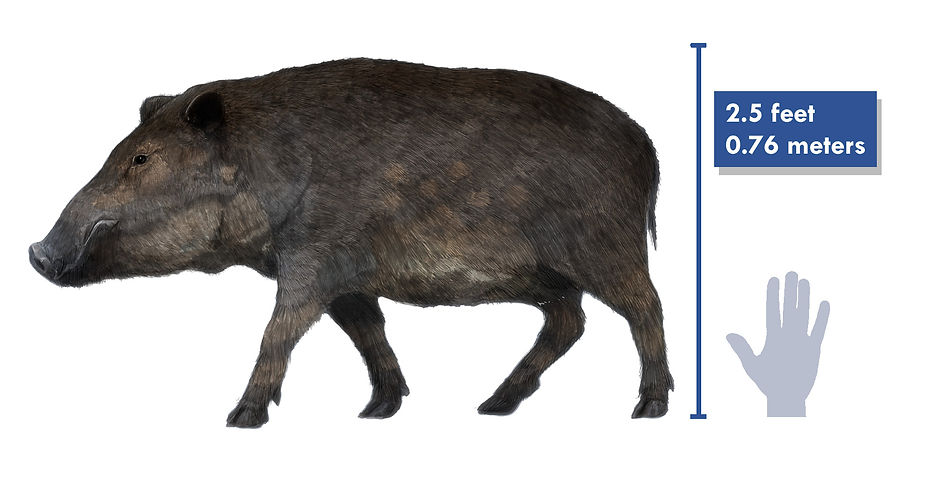
Flat-headed peccary
Platygonus compressus
Temporal Range: 10.3 million years ago to approximately 11,000 years ago
Geographic Range: Found throughout North and South America
Species: P. compressus, P. brachirostris, P. chapadmalensis, P. cinctus,
P. kraglievichi, P. marplatensis, P. narinoensis, P. oregonensis, P. pearcei, P. pollenae,
P. scagliae, P. setiger, P. striatus, P. texanus, P. vetus
Diet: Omnivorous, roots, tubers, leaves, invertebrates, carrion
Platygonus was the most widespread genus of North American peccaries from the Pleistocene epoch but its evolutionary history goes back all the way to the Miocene. In terms of its general appearance, it was similar in size and shape to today’s collared peccaries. The name “flat-headed peccary” refers to the shape of the animal’s forehead, which was smooth with no sharp differences in the angles between the slope of the bones of the forehead and the slope of the nasal bones. Relative to their body sizes, Platygonus peccaries had smaller skulls than their contemporaries like Mylohyus. Fossil assemblages of the remains of large groups of Platygonus are often found in caves, suggesting that they may have used these areas as a source of shelter. They also seem to have been very social animals, with perhaps dozens of animals living together in herds.
Peccaries in the genus Platygonus were particularly common in eastern North America, but ranged much further south as well, with other species of Platygonus known from fossils found as far away as Argentina.
(BELOW) Skeleton of Platygonus compressus. Note that the skulls of these animals are much shorter and deeper than those of Mylohyus peccaries. Fossil is on display at the Harvard Museum of Natural History. Photo accessed via Wikimedia Commons, photo by David Starner, CC BY-SA 3.0


Prosthennops
Temporal Range: 15 - 5 million years ago
Geographic Range: Southern US, Central America
Species: P. condoni, P. haroldcooki, P. kernensis, P. niobrarensis, P. rex, P. serus, P. xiphodonticus, P. ziegleri
Diet: Omnivorous, roots, tubers, leaves, invertebrates, carrion
Prosthennops was a medium-sized genus of peccaries. The skulls of these animals show that they had flattened muzzles and skulls with eye sockets positioned toward the rear of their heads. The front of the upper jaws of these animals held two pairs of incisors, although the second pair seem to have been reduced in many specimens. Their large canines on both the upper and lower jaws had an elliptical cross-section and pointed downward rather than forward while the premolars of these animals were highly molarized, meaning they had developed shapes similar to the grinding teeth found at the back of the mouths of many mammals. The true molars at the very back of the mouth were low-crowned and were coated in a thick protective layer of enamel. The chewing surfaces of these molars were covered in simple, rounded cusps suited to crushing food, and not built for grinding up grassy vegetation. Compared with living peccaries, Prosthennops would have had a more heavily reinforced skull and much larger cheek projections. Its snout was also shorter than that of long-faced fossil peccaries such as the genus Mylohyus. Unlike extinct peccaries with sharply ridged teeth, Prosthennops had relatively simple, rounded grinding chewing surfaces. Some fossils historically placed within the genus also show slender lower jaws and remarkably long, blade-like canines. However, some paleontologists have questioned whether all these specimens belong to the genus Prosthennops.

Protherohyus
Temporal Range: Late Miocene
Geographic Range: Great Plains, Florida, Indiana, Mexico, Costa Rica
Species: P. brachydontus
Diet: Omnivorous, roots, tubers, leaves, invertebrates, carrion
Protherohyus was an extinct North American peccary from the Neogene period. These animals had the same kinds of heavily-built pig like bodies seen in most types of peccaries, although the structure of the cheek teeth seen in the skulls of animals in this genus would have been somewhat unusual. Instead of the simple, rounded cusps which we find in many related peccaries, Protherohyus would have had molars and premolars with pronounced ridges connecting their cusps. Together, these ridges created grinding surfaces which were well suited to breaking down tough and fibrous plants. Fossils from Florida suggest that these animals ate a comparatively high proportion of C4 vegetation, probably including grasses as well as softer leaves. This diet differed from that of the contemporary long-snouted peccary Mylohyus, which consumed more hard, woody browse. The dental anatomy of Protherohyus is also one of the features which can be used to differentiate between these animals and closely related peccaries in the genus Prosthennops. The latter had low-crowned molars with simpler, rounded cusps, along with premolars that closely resembled molars. Some types of living peccaries generally feed on food items which they find in forest environments, but Protherohyus appears to preferred to eat vegetation from more open habitats, somewhat similar to the diet of the living javelina.

Skinnerhyus
Temporal Range: 13.6 - 10.3 million years ago
Geographic Range: Nebraska
Species: S. shermerorum
Diet: Omnivorous, roots, tubers, leaves, invertebrates, carrion
Skinnerhyus was an extinct genus of peccaries with long wing-shaped growths positioned along the outer edges of their cheekbones. These flanges of bone are somewhat shorter than those of animals like Mckennahyus but still quite large. These flanges of bone were one of the key anatomical features which was used to separate this genus from other types of Neogene peccaries such as the genera and living peccaries, none of which would have had such large flange-like projections. The biological purpose of these enlarged structures remains unknown. The textures on the outsides of the bones may indicate that they supported or could have been covered over by layers of additional soft tissues and/or functioned as visual display structures, but currently available fossils cannot confirm either explanation. The genus was described in 2013 based on Miocene fossils found in Nebraska.

Stirtonhyus
Temporal Range: Middle Miocene
Geographic Range: Nebraska
Species: S. xiphodonticus
Diet: Omnivorous, roots, tubers, leaves, invertebrates, carrion
Stirtonhyus was an extinct North American peccary closely related to animals like Prosthennops. These animals had lower jaws which were unusually narrow and lightly built compared with the deep, powerful mandibles seen in many other fossil peccaries. Their lower canines were relatively long and thin. Their swordlike appearance inspired the species name “xiphodonticus” (sword-toothed). There was also a small gap in front of each of their canines, and the gap between the canines and the rear chewing teeth, known as the diastema, was very long in the skulls of animals in the genus Stirtonhyus.
Musk Deer (Moschidae)

Deer-Like Artiodactyls With Long Canine Teeth
Musk deer are small even-toed hoofed mammals who are only distantly related to true deer in the family Cervidae. These animals do not grow antlers and instead, male musk deer have very long upper canine teeth that extend downward like tusks. These canines look similar to the saber teeth seen in some types of carnivorous mammals but in musk deer they are used as display structures rather than as tools for hunting. North American fossil musk deer from the Ogallala formation belong to an extinct group called the blastomerycines, which were common in many Miocene mammal communities. Some of these animals had much longer muzzles than their living relatives. The fossils of these animals are found in the main ash layer at the Ashfall Fossil Beds.

Blastomeryx
Temporal Range: 20.4 - 10.3 million years ago
Geographic Range: Found across the Great Plains, Florida
Species: B. cursor, B. gemmifer, B. vigoratus
Diet: Herbivorous browser, leaves
Blastomeryx was a small genus of Miocene musk deer and the namesake of the family Blastomerycinae. Their bodies were gracile and lightly built when compared with the more sturdy and well-built frames associated with true deer. Its upper canine teeth were very large as is the case for most musk deer, and would have formed prominent tusks that may have served as defensive weapons and/or as displays of fitness, maturity and health. One particularly unique feature found in these animals is that some Blastomeryx fossils have small bony projections on their skulls. These knobs have been interpreted as early hornlike structures and is an unusual characteristic for musk deer, which generally do not have any sort of antlers.

Longirostromeryx
Temporal Range: Miocene - Late Pliocene
Geographic Range: Nebraska, Kansas, Texas, New Mexico
Species: L. wellsi, L. clarendoniensis, L. novomexicanus
Diet: Herbivorous browser, leaves
Longirostromeryx was an extinct genus of musk deer named for its elongated snout. The name of the genus translates roughly to “long-faced deer”. This long skull shape was quite different from the shorter muzzle seen in many other musk deer, including the living members of this family. Like other members of the moschid family Longirostromeryx would not have had any antlers. They had mouths with saber-shaped canine teeth and these canines were longer and more curved in males than in females. Research on the well-preserved species L. wellsi tells us that its forelimbs and upper hind limbs were not specialized entirely for rapid running. Most other types of musk deer which tend/tended to be adapted exclusively to either open environments or dense vegetation have proportionally longer legs relative to the sizes of their bodies. Anatomical comparisons suggest that Longirostromeryx most closely resembled other closely related members of the extinct musk deer subfamily Blastomerycidae.
Oreodonts (Merycoidodontoidea)

Sheep-Like Artiodactyls With Short Snouts
Oreodonts are a now extinct group of hoofed mammals which were common in North America during the Oligocene and Miocene epochs. These animals had pig-like bodies and tall skulls with short snouts. Many of these animals also had long tails. Over the course of their evolutionary history oreodonts occupied many types of ecological niches. Some earlier animals were capable tree-climbers, while others would have spent a lot of time in the water like miniature hippos. The Oreodont fossils found in the Ogallala Formation come from animals who were terrestrial generalists who had teeth which seem to have been adapted to feeding on woody browse.

Merychyus
Temporal Range: 20.4 - 10.3 million years ago
Geographic Range: Texas, California, Oregon, Nebraska, South Dakota, North Dakota, Idaho, Louisiana, Oklahoma, Wyoming, Saskatchewan
Species: M. elegans, M. arenarum, M. calaminthus, M. minimus, M. relictus
Diet: Herbivorous browser, leaves
Merychyus was a mid-sized genus of oreodonts with fairly short faces. They would have had reinforced tusklike canine teeth and broad cheek teeth that were low and flattened for grinding vegetation. Like other oreodonts, Merychyus walked on four-toed hooves, but its legs were short, which would have given it a torso which sat relatively close to the ground when compared with other oreodonts. Like many of their relatives, this genus would have had a long tail. Species of Merychyus could vary quite a bit in size: Merychyus calaminthus was small-bodied, whereas forms historically assigned to Merychyus major were much larger.
(BELOW) Skeleton of Merychyus elegans collected from the Miocene of Nebraska, on display at the Royal Ontario Museum. Photo accessed via Wikimedia Commons, Public Domain.


Ticholeptus
Temporal Range: 16.0 - 13.6 million years ago
Geographic Range: Found across North America
Species: T. zygomaticus
Diet: Herbivorous mixed feeder, grass, leaves
Ticholeptus was a North American oreodont genus from the Middle Miocene. Like most other oreodonts, it had a heavy, piglike body, four functional toes, fang-like canines, and cheek teeth with crescent-shaped ridges used for grinding up plant matter. Its premolars and molars were closely packed together and increased in size toward the rear of the jaw. The cheek teeth were somewhat high-crowned which would have allowed them to sustain more wear than the lower-crowned teeth of earlier browsing oreodonts, although they were still less specialized than the extremely tall teeth developed by animals like Ustatochoerus. Some skulls also show partial retraction of the nasal bones, which may be a sign that these animals had a flexible muscular upper lip.

Ustatochoerus
Temporal Range: 23 - 7.2 million years ago
Geographic Range: Found across the Great Plains and western North America
Species: U. calaminthus, U. californicus, U. leptoscelus, U. major, U. medius, U. profundus, U. tedfordi.
Diet: Herbivorous mixed feeder, grass, leaves
Ustatochoerus was one of the last surviving North American oreodonts. It would have been built along the same lines as the typical oreodont body plan, with a short muzzle, enlarged canines, a heavy torso, a long tail, compact feet, and four functional toes. However, successive species of this genus became considerably larger over time. The occipital region at the rear of the skull also became increasingly flared, which would have given these animals a broader head than those seen in many earlier types of oreodonts.
Over the course of the Miocene, some species of Ustatochoerus developed increasingly high-crowned cheek teeth. The taller molars of later species were able to withstand greater wear. In some specimens of U. major, the unworn crown of the third lower molar measured approximately three and a half times its width, the highest degree of hypsodonty (crown-height) recorded among oreodonts. The premolars of these animals also became more molar-like over time, which would have increased the number of chewing surfaces available for grinding up vegetation. Most other oreodonts had lower-crowned, less specialized teeth with crescent-shaped ridges. Their unique tooth structure may be a sign that oreodonts of the genus Ustatochoerus were increasingly adapting to feed more on grass as the Miocene progressed and forest habitats covered less area in central North America.
Suggested References: Artiodactyls
Chen, Katheryn. (2015). Ecology and Morphology of the Late Miocene Musk Deer, Longirostromeryx wellsi (Artiodactyla: Moschidae: Blastomerycinae).
Frick, C. (1937). "Horned ruminants of North America". Bulletin of the American Museum of Natural History. 69: 1–669.
Janis, Christine M.; Theodor, Jessica M.; Boisvert, Bethany (2002). "Locomotor evolution in camels revisited: a quantitative analysis of pedal anatomy and the acquisition of the pacing gait". Journal of Vertebrate Paleontology. 22 (1): 110–121
Marriott, Katherine; Prothero, Donald R.; Lukowski, Stephanie M.; Forcellati, Meghan R. (2026). "CHAPTER 10: VAMPYROCAMELUS WELSHI, A NEW GENUS AND SPECIES OF GIRAFFE-LIKE CAMEL (ARTIODACTYLA: CAMELIDAE)". New Mexico Museum of Natural History and Science Bulletin. 104: 221–233.
Lander, B. (1998). "Oreodontoidea". In Janis, C.M.; Scott, K.M.; Jacobs, L.L. (eds.). Evolution of Tertiary mammals of North America. Cambridge: Cambridge University Press. pp. 402–425
Prothero, Donald (2007). The Evolution of Artiodactyls. Johns Hopkins University Press.
Sánchez, Israel M.; Cantalapiedra, Juan L.; Ríos, María; Quiralte, Victoria (2015). "Systematics and Evolution of the Miocene Three-Horned Palaeomerycid Ruminants (Mammalia, Cetartiodactyla)". PLoS One. 10 (12)
Semprebon, Gina; Janis, Christine; Solounias, Nikos (2004). "The Diets of the Dromomerycidae (Mammalia: Artiodactyla) and Their Response to Miocene Vegetational Change". Journal of Vertebrate Paleontology. 24 (2): 427–444
Semprebon, G.M.; Rivals, F. (September 2007). "Was grass more prevalent in the pronghorn past? An assessment of the dietary adaptations of Miocene to Recent Antilocapridae (Mammalia: Artiodactyla)". Palaeogeography, Palaeoclimatology, Palaeoecology. 253 (3–4): 332–347.
Sowls, Lyle K. (1997). Javelinas and Other Peccaries: Their Biology, Management, and Use (2nd ed.). Texas A&M University Press. pp. 67–68.
Stevens, M.S.; Stevens, J.B. (1996). "Merycoidodontinae and Miniochoerinae". In Prothero, D.R.; Emry, R.J. (eds.). The terrestrial Eocene-Oligocene transition in North America. Cambridge: Cambridge University Press. pp. 498–573.