
Ammonoids

Prehistoric Cephalopods with Coiled Shells
Ammonoids were a diverse group of extinct marine cephalopods that were found all throughout the world’s oceans for millions of years before their extinction at the end of the Cretaceous Period. They are best known from fossils of their coiled external shells, which were filled with a series of gas-filled chambers separated by internal partitions known as septa. The intricate suture patterns created where the septa intersected the shell wall are one of the most distinctive features of ammonoids and are commonly used to distinguish between species. Although they shared similarities with modern squids and octopods, ammonoids had external shells that aided in flotation and protection. Some ammonoids could even grow to enormous sizes, with animals like Parapuzosia known to grow to be the size of a small car.
Anatomy

Internal Anatomy
Ammonoids have shells whose internal structures are often well preserved in the fossil record. The soft body parts of the ammonoid, including most of the animal’s internal organs, were housed in the outermost portion of the shell known as the living chamber. The remaining chambers of the shell formed the phragmocone which was a structure responsible for buoyancy regulation. These internal shell chambers were separated by curved walls called septa and linked by a narrow tube called a siphuncle that controlled the movement of fluids and gases within the shell and allowed the ammonoid to control its ascent or descent as it moved through the water.
Fossils of the soft tissues of ammonoids have only recently been found but based on these limited remains we know that they would have differed quite a bit from the soft tissue anatomy of nautiloids. The animal itself likely would have had a well-developed head with large complex eyes, a beak-like pair of jaws and a specialized feeding organ lined with tiny teeth called a radula, a feature found in most types of mollusks outside of bivalves. Surrounding the mouth was a set of 8-10 arms and tentacles that were probably used for capturing prey and handling food. This differs from the soft tissue anatomy seen in nautiloids, which tend to have simple eyes and dozens of smaller arms. Some fossils preserve the position of a digestive tract inside the body chamber of the ammonoid that would have included an esophagus, stomach, intestine, and anus. Beneath the stomach, esophagus and liver sat the mantle cavity, gills for respiration, muscles for locomotion, and reproductive organs. The mantle enclosed much of the body and was responsible for secreting the shell. Like their modern relatives, ammonoids most likely traveled through the ocean by jet propulsion. They would force water through a funnel-like structure called a hyponome to generate movement.

External Anatomy
Ammonoid shells could vary a lot between species and life stages. These animals had spirally coiled shells made up of successive whorls that increased in size during growth. The degree of coiling differed considerably between ammonoid families, with some shells being tightly wound so that only the outer whorl was visible, while others displayed a more open coil that revealed much of the inner shell. The shell surface was often decorated with ornamental features such as ribs, ridges, grooves, and growth lines. Many ammonoids also developed nodes, tubercles, or spines along the outsides of their shells which would create distinctive patterns that would have given them extra protection from predation and strengthened the shell structure. The aperture, or opening of the shell, represented another important external feature. Its shape varied among ammonoid groups and reflected differences in growth form and ecology. As the shell expanded throughout the animal’s life, growth lines marked the former positions of the aperture which left behind a record of shell development which we can still see in their fossils to this day. Another notable feature was the central area around which the shell coiled, known as the umbilicus. The size and shape of the umbilicus varied a lot between species and their exact shapes are commonly used in classification.

Sutures
Suture patterns are the best way to classify different groups of ammonoids at a glance. A suture represents the line where an internal chamber wall, or septum, joined the outer parts of the shell. Over millions of years of evolution, these patterns became progressively more elaborate, leading to the development of three principal suture types: goniatitic, ceratitic, and ammonitic. Because these patterns changed through time, they are widely used by paleontologists to classify ammonoids and correlate the ages of sedimentary rocks. The goniatitic suture is the least complex of the three forms and is typically seen in many early ammonoids. These sutures have smooth, undivided lobes and rounded saddles that create a relatively simple wavy or zigzag pattern along the shell. The ceratitic suture represents a more advanced condition. In this type, the saddles remain smooth, but the lobes are finely serrated, giving them a distinctive saw-toothed appearance. The most complex pattern and the only one found in Cretaceous ammonoids from the Interior Sea is the ammonitic suture, which is characteristic of many later ammonoids. In this form, both the lobes and saddles are deeply folded and intricately subdivided, producing highly ornate, branching patterns. The increasing complexity of these sutures may have given the shell extra strength and resistance to stress.

Shell Shapes
Ammonoid shells came in a lot of different shapes with involute, evolute, and criocone forms representing some of the most distinctive morphologies. These shell types are differentiated by the way the whorls are arranged and by the extent to which earlier coils remain visible. The degree of coiling is an important feature used by paleontologists to classify ammonoids and study patterns of evolutionary change.
Involute shells are tightly coiled such that each successive whorl covers most of the preceding one. This overlap conceals the inner whorls, leaving only the outermost coil visible and producing a small, narrow umbilicus. As a result, involute shells have a compact and streamlined appearance. Evolute shells on the other hand, are more loosely coiled. Because the outer whorls do not completely cover the earlier ones much of the inner shell remains exposed. This produces a broad, open umbilicus and allows multiple whorls to be visible, giving the shell a less compact form.

Criocone shells represent a more unusual coiling style. Unlike either involute or evolute forms, the whorls are completely detached and do not make contact with one another. The shell therefore forms an open spiral with spaces between successive coils. Criocone ammonoids are considered heteromorphic forms.

(BELOW) In addition to the more standard evolute, involute and criocone shell shapes, some ammonite shells can be further classified based on more specific aspects of their spirals and external accessory features. Scaphicone shells, for instance, are almost exclusively found within the family scaphitidae and are known for having a unique lobed section near their apertures which overlaps the lower portion of the umbilicus. Other shell types include turricone shells, baculicone shells and toxocone shells. Most of these shell types can broadly be classified as heteromorph shells, in contrast to the more typical spiral-shaped monomorph shells seen in animals whose shells form the classic ammonoid spiral.

(BELOW) Ammonoid shells don't just vary between species and growth stages. Some ammonoid families contain shell types which can be divided into microconch and macroconch varieties. The microconchs are typically much smaller than macroconchs and sometimes present unique features such as spur-like apophyses situated beneath their apertures. Microconch shells seem to be the shells of males while macroconch shells come from female ammonoids. Not all types of ammonoids have such a strong case of dimorphism and in some families of ammonoids the males and females are very similar in terms of general shape and size.
(Browse by family)
Acanthoceras
Burroceras
Calycoceras
Conlinoceras
Cunningtoniceras
Dunveganoceras
Eucalycoceras
Mammites
Morrowites
Neocardioceras
Paraconlinoceras
Plesiacanthoceras
Plesiacanthaceratoides
Pseudaspidoceras
Spathites
Tarrantoceras
Watinoceras
Allocrioceras
Baculites
Sciponoceras
Borissiakoceras
Mortoniceras
Oxytropidoceras
Coilopoceras
Collignoniceras
Menabites
Prionocyclus
Texanites
Moremanoceras
Parapuzosia
Hystoceras
Engonoceras
Metengonoceras
Forbesiceras
Anagaudryceras
Stomohamites
Hamites
Tragodesmoceras
Cirroceras
Didymoceras
Exiteloceras
Eubostrychoceras
Eopachydiscus
Pachydiscus
Placenticeras
Proplacenticeras
Clioscaphites
Desmoscaphites
Discoscaphites
Haresiceras
Hoploscaphites
Jeletzkytes
Scaphites
Trachyscaphites
Yezoites
Schloenbachia
Sphenodiscus
Mariella
Ostlingoceras
Turrilites
Vascoceras


Acanthoceratidae
Temporal Range: 100 million years ago - 66 million years ago
Diet: Active predator, fish, invertebrates
Genera in the Western Interior Sea: Acanthoceras, Burroceras, Calycoceras, Conlinoceras, Cunningtonoceras, Dunveganoceras, Eucalycoceras, Kanabiceras, Mammites, Metoicoceras, Morrowites, Neocardioceras, Paraconlinoceras, Plesiacanthoceras, Plesiacanthoceratoides, Pseudaspidoceras, Spathites, Tarrantoceras, Watinoceras
Acanthoceratidae is a family of ammonites who were mostly restricted to the Late Cretaceous, with some material also possibly dating to the Albian stage. Their shells are often covered in a wide array of tubercles, ribs and/or rows of rounded bumps and knobs. Note that these are not universal features and some acanthoceratids had smoother shells, often with fairly simple sutures. Some acanthoceratid shells are preserved with large protruding spiny projections with rounded tips. Their shells were coiled in an open spiral which allowed the earlier whorls to remain visible as the animals grew.
(ABOVE) The genus Acanthoceras from the Late Cretaceous, Cenomanian and Campanian stages, possible Maastrichtian record. Found in Texas, New Mexico, Wyoming, Colorado. Species: A. adkinsi, A. amphibolum, A. barcusi,
A. bellense, A. cuspidum

(ABOVE) The genus Burroceras from the Late Cretaceous, Cenomanian stage. Found in Colorado, Arizona.
Species: B. clydense

(ABOVE) The genus Calycoceras from the Late Cretaceous, Cenomanian and Turonian stages. Found in Kansas, Texas, New Mexico, Oregon?, Colorado, Wyoming. Species: C. canitaurinum, C. naviculare

(ABOVE) The genus Conlinoceras from the Late Cretaceous, Cenomanian stage. Found in New Mexico, Texas.
Species: C. tarrantense

(ABOVE) The genus Cunningtoniceras from the Late Cretaceous, Cenomanian stage. Found in Texas. Species: C. inerme,
C. johnsonanum, C. lonsdalei

(ABOVE) The genus Dunveganoceras from the Late Cretaceous, Cenomanian-Coniacian stages. Found in Wyoming, Montana, Iowa, Kansas. Species: D. pondi

(ABOVE) The genus Eucalycoceras from the Late Cretaceous, Cenomanian stage. Found in Texas, New Mexico, Colorado.
Species: E. dentonense, E. gothicum, E. pentagonum, E. collignoni, E. templetonense, E. pseudobaylei

(ABOVE) The genus Mammites from the Late Cretaceous, Cenomanian to Turonian stage. Found in New Mexico, Wyoming, Colorado, Kansas, Texas. Species: M. bellsanus, M. nodosoides

(ABOVE) The genus Metoicoceras from the early and Late Cretaceous, Albian to Turonian stage. Found in New Mexico, Wyoming, Colorado, Kansas, Texas, Arizona, Montana, South Dakota. Species: M. crassiocostae, M. frontierense, M. geslinianum, M. latoventer, M. mosbyense, M. ornatum, M. praecox, M. swallovi, M. whitei

(ABOVE) The genus Morrowites from the Late Cretaceous, Turonian stage. Found in New Mexico, Wyoming, Colorado, Kansas, Texas. Species: M. bellsanus, M. nodosoides

(ABOVE) The genus Neocardioceras from the Late Cretaceous, Cenomanian stage. Found in Texas, New Mexico, Colorado, Arizona, Utah. Species: N. judii, N. densicostatum, N. uptonense, N. laevigatum, N. minutum, N. woodwardi

(ABOVE) The genus Plesiacanthoceras from the Late Cretaceous, Cenomanian to Turonian stage. Found in Kansas, Wyoming, Texas, Montana, New Mexico. Species: P. bellsanum, P. wyomingense

(ABOVE) The genus Plesiacanthoceratoides from the Late Cretaceous, Cenomanian stage. Found in Texas, Wyoming.
Species: P. vetula

(ABOVE) The genus Paraconlinoceras from the Late Cretaceous, Cenomanian stage. Found in Texas, Wyoming, Colorado.
Species: P. leonensis, P. barcusi
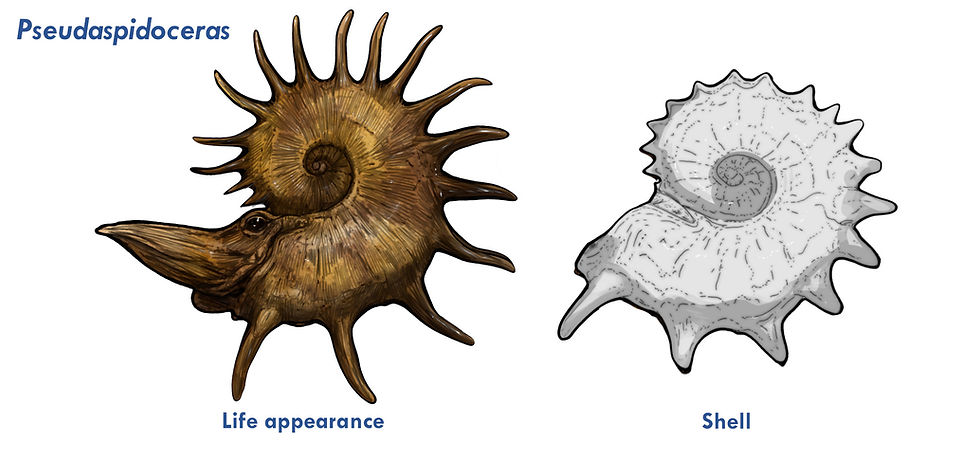
(ABOVE) The genus Pseudaspidoceras from the Late Cretaceous, Cenomanian to Turonian stage. Found in New Mexico, Texas.
Species: P. footeanum, P. paganum, P. pseudonodosoides, P. flexuosum, P. reesidei, P. armatum, P. cornucostale

(ABOVE) The genus Spathites from the Late Cretaceous, Turonian stage. Found in New Mexico.
Species: S. rioensis, S. coahuilaensis, S. puercoensis, S. obliquus, S. combesi

(ABOVE) The genus Tarrantoceras from the Late Cretaceous, Cenomanian to Turonian stage. Found in New Mexico, Colorado, Texas, Wyoming. Species: T. cuspidum, T. exile, T. multicostatum, T. sellardsi, T. proteus

(ABOVE) The genus Watinoceras from the Late Cretaceous, Cenomanian to Turonian stage. Found in New Mexico, Texas, Colorado, Kansas, Minnesota, South Dakota. Species: W. coloradensis, W. hattini, W. reesidei, W. amudariense
Gallery: Acanthoceratidae - click to expand images


Anisoceratidae
Temporal Range: ~110 million years ago - 90 million years ago
Diet: Active predator, fish, invertebrates
Genera in the Western Interior Sea: Allocrioceras
A family of ammonites whose shells do not form a full spiral. Bumps and tubercles are commonly found on the sides of their shells, some genera also have these tubercles lower down towards the ventral portions of their shells. Sutures are usually simple. Most genera also have shells with tight or loose ribs. Usually thin in cross-section.

(ABOVE) The genus Allocrioceras from the Late Cretaceous, Turonian - Coniacian stages. Found in Wyoming, Texas, Utah, Colorado. Species: A. angustum, A. hazzardi, A. larvatum, A. pariense, A. cuvieri
Gallery: Anisoceratidae - click to expand images



Baculitidae
Temporal Range: ~110 million years ago - 66 million years ago
Diet: Active predator, fish, invertebrates
Genera in the Western Interior Sea: Baculites, Sciponoceras
A family of heteromorph ammonites, usually with mostly straight shells. Most genera have a small spiraling section composed for the first 1-2 whorls at the tips of their shells. Immature individuals can have fully spiral-shaped shells. Shells are usually smooth but some genera have repeating ridges, wave-like patterns or tubercles on the lateral surfaces of their shells. They are usually oval-shaped in cross-section.

(ABOVE) The genus Baculites from the Late Cretaceous, Cenomanian - Maastrichtian stages. Found in Wyoming, Texas, Utah, Colorado, Montana, Kansas, Mississippi, New Jersey, Tennessee, Arkansas. Species: B. anceps, B. vertebralis, B. compressus, B. bailyi, B. asper, B. asperformis, B. baculus, B. calamus, B. claviformis, B. clinolobatus, B. codyensis, B. cuneatus, B. grandis, B. meeki, B. jenseni, B. haresi, B. ovatus

(ABOVE) The genus Sciponoceras from the Late Cretaceous, Cenomanian - Turonian stages. Found in Wyoming, Texas, New Mexico, Kansas, Colorado. Species: S. gracile, S. baculoides, S. cucullatum
Gallery: Baculitidae - click to expand images


Binneyitidae
Temporal Range: Albian stage - Santonian stage
Diet: Active predator, fish, invertebrates
Genera in the Western Interior Sea: Borissiakoceras
A family of ammonites with somewhat involute spiral shells. Their shells do not have any ridges or tubercles. Very thin shells in cross-section.

(ABOVE) The genus Borissiakoceras from the Late Cretaceous, Cenomanian - Turonian stages. Found in Wyoming, Texas, Kansas, Colorado. Species: B. reesidi, B. auriculatum, B. desmoceratoides, B. inconstans
Brancoceratidae
Temporal Range: Albian stage - Cenomanian stage
Diet: Active predator, fish, invertebrates
Genera in the Western Interior Sea: Mortoniceras, Oxytropidoceras
Family of ammonites with evolute spiral shells. Shells usually have ribs, some have tubercles along the inner or outer edges of their spirals. Their cross sections vary from rectangular to oval-shaped depending on the genus but their shells are usually fairly wide.

(ABOVE) The genus Mortoniceras from the Early Cretaceous, Albian stage. Images are of a microconch. Found in Texas. Species: M. albense, M. australis, M. barbouri, M. bondanti. M. texanum, M. wintoni

(ABOVE) The genus Oxytropidoceras from the Early Cretaceous, Albian stage. Found in Texas, Oklahoma. Species: O. howei,
O. carbonarium, O. hubbardi, O. acutocarinatum
Gallery: Brancoceratidae - click to expand images


Coilopoceratidae
Temporal Range: Albian stage - Turonian stage
Diet: Active predator, fish, invertebrates
Genera in the Western Interior Sea: Coilopoceras
Family of ammonites with involute shells, usually fairly tall. The shells of some genera change shape as they age, immature individuals have flatter sides than adults. Unique sutures with a narrow first saddle and wide first lobe. Sutures are usually fairly narrow.

(ABOVE) The genus Coilopoceras from the early and Late Cretaceous, Albian - Turonian stages. Found in Texas, New Mexico, Colorado. Species: C. colleti, C. springeri, C. inflatum
Collignoniceratidae
Temporal Range: Turonian stage - Campanian stage
Diet: Active predator, fish, invertebrates
Genera in the Western Interior Sea: Collignoniceras, Menabites,
Prionocyclus, Texanites
Family of ammonites with involute spiral shells with often very pronounced tubercles on their sides. Their cross sections are rectangular or oval-shaped. Shells are taller than they are wide.

(ABOVE) The genus Collignoniceras from the Late Cretaceous, Turonian stage. Found in Texas, Kansas, South Dakota, Nebraska, Wyoming, New Mexico, Colorado. Species: C. casperi, C. hiltensis, C. woolgari, C. praecox, C. hyatti, C. caurinus,

(ABOVE) The genus Menabites from the Late Cretaceous. Found in Texas. Species: M. belli, M. campaniense, M. walnutensis

(ABOVE) The genus Prionocyclus from the Late Cretaceous, Turonian stage - Santonian. Found in Texas New Mexico, Kansas, Wyoming, South Dakota. Species: P. hyatti, P. macombi, P. wyomingensis

(ABOVE) The genus Oxytropidoceras from the Late Cretaceous, Campanian stage. Found in Texas, Mississippi.
Species: T. americanus, T. soutoni, T. lonsdalei, T. texanus, T. shiloensis
Gallery: Collignoniceratidae - click to expand images


Suggested References: Ammonoids
Brinster, K. F. (1970). “Molluscan Paleontology of the Pierre Shale (Upper Cretaceous), Bowman County, North Dakota (MS).” University of North Dakota.
Chirat, R., Goriely, A. & Moulton, D., E. (2021) “The physical basis of mollusk shell chiral coiling”
in Proceedings of the National Academy of Sciences of the United States of America - Vol. 118, No 48 - National Academy of Sciences
Clark, D., L. (1965) “Heteromorph Ammonoids from the Albian and the Cenomanian of Texas and Adjacent Areas” in Memoirs of Geological Society of America: 95 - The Geological Society of America, Inc.
Digital Atlas of Ancient Life. “Ammonoidea”. Cretaceous Atlas of Ancient Life | Ammonoidea. https://www.cretaceousatlas.org/orders/ammonoidea/
Everhart, M.J. (2017). “Oceans of Kansas - A Natural History of the Western Interior Sea”, Second Edition. Indiana University Press, 460 pp.
Furnish, W. M., Zuren, Z., & Glenister, B. F. (2009). Part L, Mollusca 4 (Revised), vol. 4, Complete Volume. Treatise on Invertebrate Paleontology.
Hoffmann, René; Slattery, Joshua S.; Kruta, Isabelle; Linzmeier, Benjamin J.; Lemanis, Robert E.; Mironenko, Aleksandr; Goolaerts, Stijn; De Baets, Kenneth; Peterman, David J.; Klug, Christian (2021). "Recent advances in heteromorph ammonoid palaeobiology". Biological Reviews. 96 (2): 576–610.
Ifrim, C. & Stinnesbeck, W. (2010) “Migration pathways of the late Campanian and Maastrichtian shallow facies ammonite Sphenodiscus in North America” Palaeo (Palaeogeography, Palaeoclimatology, Palaeoecology): 292
Inoue, S., Kondo, S. (2016). “Suture pattern formation in ammonites and the unknown rear mantle structure”. Sci Rep 6, 33689.
Kauffman, E.G. (2004). “Mosasaur predation on Upper Cretaceous nautiloids and ammonites from the United States Pacific Coast.” Palaios 19(1):96-100.
Kennedy, W.J., Landman, N.H., Cobban, W.A. and Scott, G.R. (2000). “Late Campanian (Cretaceous) heteromorph ammonites from the Western Interior of the United States”. Bulletin of the American Museum of Natural History 251, 88 pp
Klug, C., Schweigert, G., Lauer, R. et al. (2025) “Reproductive biology and anatomy of ammonites”. Sci Rep 15, 39621.
Kruta, I.; Landman, N.; Rouget, I.; Cecca, F.; Tafforeau, P. (2011). "The Role of Ammonites in the Mesozoic Marine Food Web Revealed by Jaw Preservation". Science. 331 (6013): 70–72.
Kulicki, C., Tanabe, K. and Landman, N.H. (2007). Primary structure of the connecting ring of ammonoids and its preservation. Acta Palaeontologica Polonica 52(4):823-827.
Musick, Glenn (2008). "Utah Ammolite". Rock & Gem. Vol. 38, no. 8. pp. 34–38.
Neal L. Larson; Steven D. Jorgensen; Robert A. Farrar & Peter L. Larson (1997).” Ammonites and the Other Cephalopods of the Pierre Seaway.” Geoscience Press, Inc. p. 44
Stephenson, L.W., & Stenzel, H.B. (1952). Larger invertebrate fossils of the Woodbine formation (Cenomanian) of Texas, with Decapod Crustaceans from the Woodbine formation of Texas.
Ward, P., D., Haggart, J., W., Mitchell, R., Kirschvink, J., L. & Tobin, T. (2012) “Integration of macrofossil biostratigraphy and magnetostratigraphy for the Pacific Coast Upper Cretaceous (Campanian-Maastrichtian) of North America and implications for correlation with the Western Interior and Tethys.” Geological Society of America Bulletin - v. 124, no 5/6 - The Geological Society of America
Westermann, G. E. G. (1996). “Ammonoid life and habitat. In N. H. Landman, K. Tanabe, and R. A. Davis (editors), Ammonoid Paleobiology, pp. 607–707. New York: Plenum Press.
Westermann, Gerd E. G. (1996), "Ammonoid Life and Habitat", in Landman, Neil H.; Tanabe, Kazushige; Davis, Richard Arnold (eds.), Ammonoid Paleobiology, Topics in Geobiology, vol. 13, Boston, MA: Springer US, pp. 607–707
Wright, C. W., (1996). Ammonoidea, in Kaesler, R. L., ed., Treatise on Invertebrate Paleontology, Part L, Mollusca 4, Volume 4. The University of Kansas and Geological Society of America. 362 pp.