
Ammonoids (continued)

List of Ammonoids
Not all ammonoids are listed on this page. See the list below for the order in which ammonoid entries are listed
Previous page
Family Acanthoceratidae
Acanthoceras
Burroceras
Calycoceras
Conlinoceras
Cunningtoniceras
Dunveganoceras
Eucalycoceras
Mammites
Morrowites
Neocardioceras
Paraconlinoceras
Plesiacanthoceras
Plesiacanthaceratoides
Pseudaspidoceras
Spathites
Tarrantoceras
Watinoceras
Family Anisoceratidae
Allocrioceras
Family Baculitidae
Baculites
Sciponoceras
Family Binneyitidae
Borissiakoceras
Family Brancoceratidae
Mortoniceras
Oxytropidoceras
Family Coilopoceratidae
Coilopoceras
Family Collignoniceratidae
Collignoniceras
Menabites
Prionocyclus
Texanites
This page
Family Desmoceratidae
Moremanoceras
Parapuzosia
Family Dipoloceratidae
Hystoceras
Family Engonoceratidae
Engonoceras
Metengonoceras
Family Forbesiceratidae
Forbesiceras
Family Gaudryceratidae
Anagaudryceras
Family Hamitidae
Stomohamites
Hamites
Family Municericeratidae
Tragodesmoceras
Family Nostoceratidae
Cirroceras
Didymoceras
Exiteloceras
Eubostrychoceras
Family Pachydiscidae
Eopachydiscus
Pachydiscus
Family Placenticeratidae
Placenticeras
Proplacenticeras
Family Scaphitidae
Clioscaphites
Desmoscaphites
Discoscaphites
Haresiceras
Hoploscaphites
Jeletzkytes
Scaphites
Trachyscaphites
Yezoites
Family Schloenbachiidae
Schloenbachia
Family Sphenodiscidae
Sphenodiscus
Family Turrilitidae
Mariella
Ostlingoceras
Turrilites
Family Vascoceratidae
Vascoceras
Desmoceratidae
Temporal Range: Hauterivian stage - Maastrichtian stage
Diet: Active predator, fish, invertebrates
Genera in the Western Interior Sea: Moremanoceras, Parapuzosia
Family of ammonites with smooth shells, sometimes with faint ribs. Narrow cut-like bands running across the shells show up frequently in some species. Shells are round, about as tall as they are wide. Round, oval-shaped in cross section.

(ABOVE) The genus Moremanoceras from the Late Cretaceous, Cenomanian stage. Found in New Mexico, Texas.
Species: M. elgini, M. costatum, M. straini, M. bravoense

(ABOVE) The genus Parapuzosia from the Late Cretaceous, Cenomanian - Campanian stages. Found in Montana.
Species: P. americana, P. bradyi, P. seppenradensis
Dipoloceratidae
Temporal Range: Turonian stage - Maastrichtian stage
Diet: Active predator, fish, invertebrates
Genera in the Western Interior Sea: Hystoceras
Family of ammonites with slightly involute shells, often loosely spiral in shape. Many genera have a series of small bumps and ridges forming in pairs along the margins of the ventral sides of their shells. Some genera have very pronounced spiny tubercles. Oval-shaped in cross-section

(ABOVE) The genus Hystoceras from the Late Cretaceous. Found in New Mexico. Species: H. puercoensis
Engonoceratidae
Temporal Range: Albian stage - Cenomanian stage
Diet: Active predator, fish, invertebrates
Genera in the Western Interior Sea: Engonoceras, Metengonoceras
Family of ammonites with involute shells, often with very pronounced and well-spaced ribs. Tubercles are present on many sides of the shell depending on the genus. Some shell ribs branch into two forks as they move towards the outside of the shell. Shallow and usually simple sutures.

(ABOVE) The genus Engonoceras from the Early Cretaceous, Albian stage. Found in Kansas, Colorado, Texas.
Species: E. stolleyi, E. hilli, E. belviderense, E. subjectum

(ABOVE) The genus Metengonoceras from the Early and Late Cretaceous, Albian - Cenomanian stages. Found in Texas, Colorado, Iowa. Species: M. bravoense, M. dumbli, M. aspenanum, M. acutum
Forbesiceratidae
Temporal Range: Albian stage - Cenomanian stage
Diet: Active predator, fish, invertebrates
Genera in the Western Interior Sea: Forbesiceras
A family of ammonites with involute shells which are usually taller than they are wide. They have fairly complex sutures with leaf-shaped saddles. Tubercles are rare in most genera from this family. Their shells are thin in cross-section.

(ABOVE) The genus Forbesiceras from the Late Cretaceous, Cenomanian stage. Found in Texas. Species: F. conlini, F. baylissi, F. obtectum, F. varicostatum
Gaudryceratidae
Temporal Range: Barremian stage - Maastrichtian stage
Diet: Active predator, fish, invertebrates
Genera in the Western Interior Sea: Anagaudryceras
Family of ammonites with tall, rather evolute shells. Outside of the shell is smooth or with very faint ribs. Usually no prominent ornamentation. The shells are wide and oval-shaped in cross-section.

(ABOVE) The genus Anagaudryceras from the Late Cretaceous, Cenomanian stage. Found in Texas. Species: A. involvulum, A. aurarium, A. subtilineatum, A. sacya
Hamitidae
Temporal Range: Albian stage - Turonian stage
Diet: Active predator, fish, invertebrates
Genera in the Western Interior Sea: Hamites, Stomohamites
A family of ammonites with loosely coiled or open-spiral shaped shells. No tubercles on the outsides of their shells. Shells are often covered in closely packed narrow ribs. These sides of their shells are round and convex. Wide and oval-shaped in cross-section.

(ABOVE) The genus Stomohamites from the Early and Late Cretaceous, Albian - Turonian stages. Found in Colorado, Kansas, New Mexico, Wyoming. Species: S. virgulatus, S. simplex

(ABOVE) The genus Hamites from the Late Cretaceous, Cenomanian- Turonian stages. Found in New Mexico, Colorado, South Dakota, Oklahoma, Texas. Species: S. cimmaronensis
Muniericeratidae
Temporal Range: Turonian stage - Campanian stage
Diet: Active predator, fish, invertebrates
Genera in the Western Interior Sea: Tragodesmoceras
Family of ammonites with fairly involute shells with shallow, slightly S-shaped ribs. Tubercles and projections are found in some genera along the inner margins of the shells. Some small tubercles or spines are found in some genera on the lateral-ventral parts of their shells. Roughly round in cross-section.

(ABOVE) The genus Tragodesmoceras from the Late Cretaceous, Cenomanian - Turonian stages. Found in Kansas, Colorado. Species: T. bassi, T. carlilensis, T. scotti
Nostoceratidae
Temporal Range: Turonian stage - Maastrichtian stage
Diet: Active predator, fish, invertebrates
Genera in the Western Interior Sea: Cirroceras, Didymoceras, Exiteloceras
A family of heteromorph ammonites. Their shells are not bilaterally symmetrical and their spirals are not mirrored along a single plane. Most genera have shells with a horizontally-aligned spiral on the sections furthest away from the shell opening, others form in a sort of corkscrew. They are often covered in prominent ribs and/or sets of tubercles, usually on the lateral portions of the shells. Some of their shells end in a tapering pointed hook-shaped tip.

(ABOVE) The genus Cirroceras from the Late Cretaceous, Campanian stage. Found in Texas. Species: C. reevesi

(ABOVE) The genus Didymoceras from the Late Cretaceous, Campanian- Maastrichtian stages. Found in South Dakota, Montana, Wyoming. Species: D. beecheri, D. cheyennense, D. cochleatum, D. nebrascense, D. stevensoni

(ABOVE) The genus Exiteloceras from the Late Cretaceous, Campanian stage. Found in South Dakota, Colorado, Wyoming. Species: E. jenneyi

(ABOVE) The genus Exiteloceras from the Late Cretaceous, Turonian-Campanian stage. Found in South Dakota, New Mexico, Wyoming. Species: E. perplexum, E. valdelaxum
Pachydiscidae
Temporal Range: Albian stage - Maastrichtian stage
Diet: Active predator, fish, invertebrates
Genera in the Western Interior Sea: Pachydiscus, Eopachydiscus
Family of ammonites with evolute spiral shells. Shells usually have ribs, some have tubercles along the inner or outer edges of their spirals. Their cross sections vary from rectangular to oval-shaped depending on the genus but their shells are usually fairly wide.

(ABOVE) The genus Pachydiscus from the Late Cretaceous, Campanian - Maastrichtian stages. Found in Colorado, New Mexico. Species: P. catarinae, P. bruneti, P. complanatus, P. albuquerquei

(ABOVE) The genus Eopachydiscus from the Early Cretaceous, Albian stage. Found in Texas, Oklahoma, New Mexico, Colorado. Species: E. marcianus
Placenticeratidae
Temporal Range: Albian stage - Maastrichtian stage
Diet: Active predator, fish, invertebrates
Genera in the Western Interior Sea: Placenticeras, Proplacenticeras
A family of ammonites with involute shells, some genera have wavy ribs along their shells. Tubercles are present in some genera, usually on the ventro-lateral parts of the shells or on the inward-facing parts of the spiral. Thin and somewhat oval-shaped in a cross-section. Some genera have a concave area on their ventral surfaces.

(ABOVE) The genus Placenticeras from the Late Cretaceous, Cenomanian - Maastrichtian stages. Found in Texas, New Mexico, New Jersey, Alabama, Wyoming, Delaware South Dakota. Species: P. adkinsi, P. intercalare, P. meeki, P. placenta, P. planum, P. whitfieldi

(ABOVE) The genus Proplacenticeras from the Late Cretaceous, Turonian - Campanian stages. Found in Kansas, New Mexico, Texas. Species: P. pseudoplacenta
Scaphitidae
Temporal Range: Albian stage - Maastrichtian stage
Diet: Active predator, fish, invertebrates
Genera in the Western Interior Sea: Clioscaphites, Desmoscaphites, Discoscaphites, Haresiceras, Hoploscaphites, Jelekytes, Scaphites, Trachyscaphites
A large family of ammonites with loosely coiled shells. Ribs are present in many genera. The areas on some shells just above their openings becomes wide enough to encase other parts of the coiled spirals on their shells, similar to what is seen in more typical involute ammonite shells. Tubercles or spines are present in the shells of some genera. Unlike in many genera, the largest tubercles on the shells of scaphitid ammonites are not always the ones closest to the shell’s opening. Shells are round in a cross-section.

(ABOVE) The genus Clioscaphites from the Late Cretaceous, Coniacian to Santonian stages. Found in Texas, Kansas, South Dakota, Nebraska, Wyoming, New Mexico, Colorado, Montana. Species: C. choteauensis, C. montanensis, C. vermiformis
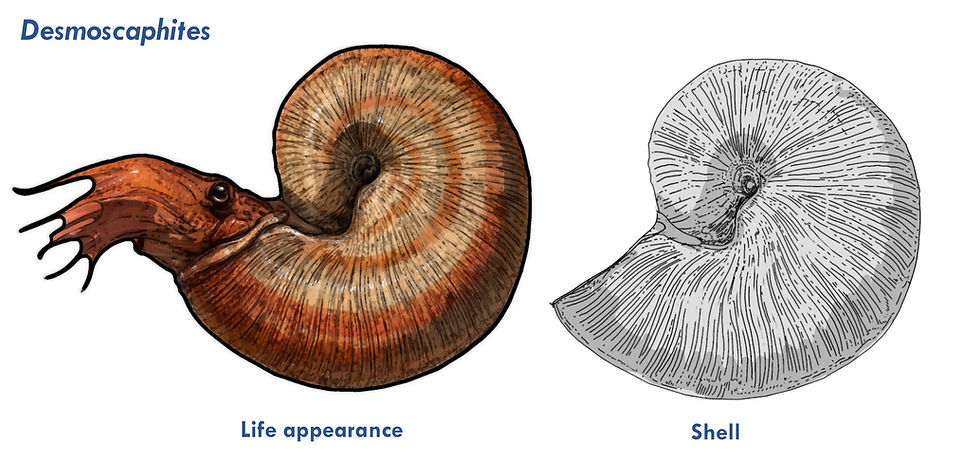
(ABOVE) The genus Desmoscaphites from the Late Cretaceous, Santonian to Campanian stages. Found in New Mexico, Colorado, Kansas. Species: D. bassleri, D. erdmanni

(ABOVE) The genus Discoscaphites from the Late Cretaceous, Campanian to Maastrichtian stages. Found in Texas New Mexico, Kansas, Wyoming, South Dakota, Alabama, Mississippi. Species: D. abyssinus, D. conradi, D. gulosus, D. nebrascensis, D. rossi

(ABOVE) The genus Haresiceras from the Late Cretaceous. Found in Wyoming, Montana. Species: C. casperi, C. hiltensis, C. woolgari, H. placentiforme

(ABOVE) The genus Hoploscaphites from the Late Cretaceous, Campanian to Maastrichtian stages. Found in Texas, Wyoming, Kansas, South Dakota, North Dakota. Species: H. birkelundi, H. brevis, H. cheyennensis, H. comprimus, H. dorfi, H. gilberti, H. melloi, H. nebrascensis, H. nicolleti, H. nodosus, H. plenus, H. spedeni

(ABOVE) The genus Jeletzkytes from the Late Cretaceous, Campanian to Maastrichtian stages. Found in Colorado, Wyoming, South Dakota, Nebraska, North Dakota. Species: J. dorfi, J. nebrascensis, J. spedeni

(ABOVE) The genus Scaphites from the Late Cretaceous, Turonian- Campanian stages. Found in Texas, Kansas, South Dakota, Nebraska, Wyoming, New Mexico, Colorado. Species: S. carlilensis, S. ferronensis, S. hippocrepis, S. inflexus, S. kansiensis, S. leei, S. mariasensis. S. mitchellensis, S. patulus, S. pygmaeus, S. venticosus, S. warreni, S. whitfieldi

(ABOVE) The genus Trachyscaphites from the Late Cretaceous, Campanian stage. Found in Texas. Species: T. densicostatus

Schloenbachiidae
Temporal Range: Cenomanian stage
Diet: Active predator, fish, invertebrates
Genera in the Western Interior Sea: Schloenbachia
A family of ammonites whose members have varying spiral shapes. Includes both evolute and subinvolute forms. Ribbing is present in most genera, some types also have low tubercles projecting outwards from their ribs. Oval-shaped in cross-section.

(ABOVE) The genus Schloenbachia the Late Cretaceous, Cenomanian stage. Found in Texas. Species: S. trinodosa
Sphenodiscidae
Temporal Range: Coniacian stage - Maastrichtian stage
Diet: Active predator, fish, invertebrates
Genera in the Western Interior Sea: Sphenodiscus
A family of ammonites which usually have smooth shells or shells with very low tubercles. No spines present in these genera. Shells are involute and broadly similar to those seen in other involute groups like the coliopoceratids. Thin shells in cross section are usually rounded or teardrop shaped with a pointed tapering edge on the ventral side.

(ABOVE) The genus Sphenodiscus from the Late Cretaceous. Found in Wyoming, Texas, Kansas, Colorado, South Dakota, Wyoming, . Species: S. beecheri, S. dumbi, S. lenticularis
Turrilitidae
Temporal Range: Turonian stage - Maastrichtian stage
Diet: Active predator, fish, invertebrates
Genera in the Western Interior Sea: Cirroceras, Didymoceras, Exiteloceras
Ammonites with helix-shaped spiral shells. Many of them often have a pointed tip, usually have ribs along the outsides of the shells. Lateral tubercles or spines are present on the sides of the shells of many genera. Most turrilitids have tightly coiled spiral helixes but a few genera have looser coils with most space in between different elements of their spirals. Smaller turrilitids can sometimes be confused with certain gastropod shells. Round, oval-shaped in a cross-section.

(ABOVE) The genus Mariella from the Late Cretaceous, Albian–Cenomanian stages. Found in California, Texas.
Species: M. cenomanensis, M. asper, M. bicarinata, M. davidense

(ABOVE) The genus Ostlingoceras from the Early and Late Cretaceous, Albian-Cenomanian stage. Found in Texas.
Species: O. brandi

(ABOVE) The genus Exiteloceras from the Late Cretaceous, Cenomanian–Turonian stages. Found in Colorado, Texas, New Mexico. Species: T. acutus, T. brazoensis, T. dearingi
Vascoceratidae
Temporal Range: Turonian stage - Maastrichtian stage
Diet: Active predator, fish, invertebrates
Genera in the Western Interior Sea: Vascoceras
Shells are highly variable. Some are evolute and others are fairly strongly involute. Shells can be smooth or wavy. The members of this family have relatively few ribs or tubercles.

(ABOVE) The genus Vascoceras from the Late Cretaceous, Cenomanian - Turonian stages.
Suggested References: Ammonoids
Brinster, K. F. (1970). “Molluscan Paleontology of the Pierre Shale (Upper Cretaceous), Bowman County, North Dakota (MS).” University of North Dakota.
Chirat, R., Goriely, A. & Moulton, D., E. (2021) “The physical basis of mollusk shell chiral coiling”
in Proceedings of the National Academy of Sciences of the United States of America - Vol. 118, No 48 - National Academy of Sciences
Clark, D., L. (1965) “Heteromorph Ammonoids from the Albian and the Cenomanian of Texas and Adjacent Areas” in Memoirs of Geological Society of America: 95 - The Geological Society of America, Inc.
Digital Atlas of Ancient Life. “Ammonoidea”. Cretaceous Atlas of Ancient Life | Ammonoidea. https://www.cretaceousatlas.org/orders/ammonoidea/
Everhart, M.J. (2017). “Oceans of Kansas - A Natural History of the Western Interior Sea”, Second Edition. Indiana University Press, 460 pp.
Furnish, W. M., Zuren, Z., & Glenister, B. F. (2009). Part L, Mollusca 4 (Revised), vol. 4, Complete Volume. Treatise on Invertebrate Paleontology.
Hoffmann, René; Slattery, Joshua S.; Kruta, Isabelle; Linzmeier, Benjamin J.; Lemanis, Robert E.; Mironenko, Aleksandr; Goolaerts, Stijn; De Baets, Kenneth; Peterman, David J.; Klug, Christian (2021). "Recent advances in heteromorph ammonoid palaeobiology". Biological Reviews. 96 (2): 576–610.
Ifrim, C. & Stinnesbeck, W. (2010) “Migration pathways of the late Campanian and Maastrichtian shallow facies ammonite Sphenodiscus in North America” Palaeo (Palaeogeography, Palaeoclimatology, Palaeoecology): 292
Inoue, S., Kondo, S. (2016). “Suture pattern formation in ammonites and the unknown rear mantle structure”. Sci Rep 6, 33689.
Kauffman, E.G. (2004). “Mosasaur predation on Upper Cretaceous nautiloids and ammonites from the United States Pacific Coast.” Palaios 19(1):96-100.
Kennedy, W.J., Landman, N.H., Cobban, W.A. and Scott, G.R. (2000). “Late Campanian (Cretaceous) heteromorph ammonites from the Western Interior of the United States”. Bulletin of the American Museum of Natural History 251, 88 pp
Klug, C., Schweigert, G., Lauer, R. et al. (2025) “Reproductive biology and anatomy of ammonites”. Sci Rep 15, 39621.
Kruta, I.; Landman, N.; Rouget, I.; Cecca, F.; Tafforeau, P. (2011). "The Role of Ammonites in the Mesozoic Marine Food Web Revealed by Jaw Preservation". Science. 331 (6013): 70–72.
Kulicki, C., Tanabe, K. and Landman, N.H. (2007). Primary structure of the connecting ring of ammonoids and its preservation. Acta Palaeontologica Polonica 52(4):823-827.
Musick, Glenn (2008). "Utah Ammolite". Rock & Gem. Vol. 38, no. 8. pp. 34–38.
Neal L. Larson; Steven D. Jorgensen; Robert A. Farrar & Peter L. Larson (1997).” Ammonites and the Other Cephalopods of the Pierre Seaway.” Geoscience Press, Inc. p. 44
Ward, P., D., Haggart, J., W., Mitchell, R., Kirschvink, J., L. & Tobin, T. (2012) “Integration of macrofossil biostratigraphy and magnetostratigraphy for the Pacific Coast Upper Cretaceous (Campanian-Maastrichtian) of North America and implications for correlation with the Western Interior and Tethys.” Geological Society of America Bulletin - v. 124, no 5/6 - The Geological Society of America
Westermann, G. E. G. (1996). “Ammonoid life and habitat. In N. H. Landman, K. Tanabe, and R. A. Davis (editors), Ammonoid Paleobiology, pp. 607–707. New York: Plenum Press.
Westermann, Gerd E. G. (1996), "Ammonoid Life and Habitat", in Landman, Neil H.; Tanabe, Kazushige; Davis, Richard Arnold (eds.), Ammonoid Paleobiology, Topics in Geobiology, vol. 13, Boston, MA: Springer US, pp. 607–707
Wright, C. W., (1996). Ammonoidea, in Kaesler, R. L., ed., Treatise on Invertebrate Paleontology, Part L, Mollusca 4, Volume 4. The University of Kansas and Geological Society of America. 362 pp.