
Chimaeras and Batomorphs

Rays, Ratfishes and Hybodonts of the Cretaceous Seas
The seas of the Cretaceous period were home to many types of cartilaginous fishes besides sharks. These included rays, skates, guitarfishes and chimaeras, all of which had skeletons made up mostly of cartilage rather than bone. Because cartilage rarely fossilizes these animals are typically represented in the fossil record by their teeth, tooth plates, fin spines, and tiny dermal denticles.
Just as in today’s oceans many flat-bodied cartilaginous fishes lived in a range of habitats from shallow coastal waters to deeper parts of the seaway. The broad, flattened bodies of Cretaceous rays, skates and guitarfishes were well suited for life on the sea floor where they preyed on shellfish, crustaceans, and other benthic organisms. Chimaeras, often referred to as ghost sharks or ratfishes, formed another distinctive group within this marine ecosystem. These animals are part of a very ancient lineage which has survived to the present day. They have mouths filled with powerful crushing tooth plates and also specialize in feeding on hard-shelled animals. Some extinct groups of cartilaginous fishes could also be found in the waters of the Western Interior Sea who have no direct living descendents. The rajiform order of fishes included the extinct sclerorhynchoidei, a line of fishes who closely resembled today’s sawfishes with their long spiny rostrums despite not being particularly related to living sawfishes or sawsharks. The seas of the Cretaceous period were also home to hybodonts. Although they outwardly would have closely resembled sharks, hybodonts are usually considered to be part of their own separate order which disappeared at the end of the Cretaceous.
Anatomy
(BELOW) A labeled diagram of the skeleton of an eagle ray, Myliobatis, showing the positions of the various cartilages which support the bodies of these animals in life. Some of the shapes of the ceratotrichia have been simplified for this diagram

Skeletal Anatomy
Rays and other non-shark cartilaginous fishes have skeletal systems composed primarily of cartilage rather than bone. In rays and guitarfishes, the skeleton supports a flattened body plan, with greatly expanded pectoral fins which are connected to the sides of the head. The skull and jaw apparatuses are supported by specialized arch-shaped cartilaginous structures that also connect to the gills and sensory organs. Stingrays and skates generate most of their forward movement by flapping their pectoral fins whereas animals like guitarfishes and presumably extinct sclerorhynchoid fishes still had small tail flukes which they could use to push themselves forward.
Many of these animals have flattened teeth that are very good for crunching down on hard-shelled prey. Some groups even independently developed saw-like rostral organs covered in long tooth-like denticles used to slash at soft-bodied prey animals. Chimaeras have an even more specialized condition. Instead of having separated individual teeth these animals have large, durable tooth plates that grow continuously throughout their lifespans. They also differ from rays and sharks since they have a single external gill opening on each side of the head and an upper jaw that is permanently fused to the rest of the skull. Because cartilage rarely fossilizes, the fossil record of these fishes is mostly composed of durable elements such as teeth, tooth plates, fin spines, vertebral centra, and dermal denticles, although some exceptional fossils do exist which preserve the entire bodies of extinct cartilaginous fishes.
Stingrays (Myliobatiformes)
Temporal Range: ~130 million years ago - Present
Diet: Some genera are durophagous, others are filter feeders
Genera in the Western Interior Sea: Rhombodus, Dasyatis, Brachyrhizodus, Myliobatis
The order Myliobatiformes includes stingrays, manta rays, devil rays and eagle rays. These fishes have flattened bodies with large pectoral fins which make up a large portion of the tissues of the sides of their bodies. Many members of this group also have smaller pelvic fins further to the rear of their bodies. These large fins are the main source of forward propulsion for these animals. Many species live on or near the seafloor where they use highly sensitive electroreceptors, known as the ampullae of Lorenzini, to locate prey hidden beneath sand or mud. Others are pelagic animals who live in open water and act as filter feeders who strain through the water in order to capture microscopic plankton. Most myliobatiform fishes have long, narrow tails which sometimes end in venomous barbs used for protection against predators.

(ABOVE) The genus Rhombodus from the Late Cretaceous and early Paleogene. Found in North Dakota, South Dakota, New Jersey. Species: R. laevis, R. microdon

(BELOW) The genus Dasyatis, a genus of stingrays found from the Cenomanian stage to the present day. Species in the Interior Sea: D. northdakotaensis. Found in North Dakota

(BELOW) The genus of cownose ray Brachyrhizodus from the Late Cretaceous. Species in the Western Interior Sea: B. wichitaensis, B. ellipsis. Found in New Jersey, Alabama, Mississippi, Texas, Kansas, South Dakota

(BELOW) The genus Myliobatis from the Maastrichtian stage of the Late Cretaceous to the present day. Species in the Western Interior Sea: M. foxhillsensis. Found in North Dakota

(BELOW) A pair of Myliobatis eagle ray teeth. These animals became particularly common in the marine fossil record starting in the Paleogene period but their first fossils are found at the very end of the Cretaceous period.

Skates (Rajiformes)
Temporal Range: ~190 million years ago - Present
Diet: Some genera are durophagous, others are soft prey specialists
Genera in the Western Interior Sea: Walteraja, Onchopristis, Ptychotrygon, Ischyrhiza, Texatrygon
The order Rajiformes includes skates and their extinct relatives the sclerorhynchoids, also known as the sawskates. These animals have different tail anatomies than the long thin tails seen in myliobatiform fishes. Skates instead have sturdy tails that lack venomous stinging barbs. Their tails are sometimes covered in a row of short spines. This feature is taken a step further in the case of the sclerorhynchoids. These extinct fishes who were very common during the middle and Late Cretaceous developed long, flattened snouts lined with rows of tooth-like denticles along their edges, producing a distinctive saw-like appearance. Species such as Onchopristis and Ischyrhiza most likely used their elongated rostra to slash at prey or to search through layers of sediment for hidden animals. Many of these animals also seem to have had several sets of spiny denticles along their backs and on the edges of their pectoral fins. Skates and their closest relatives reproduce by laying soft egg cases known as “mermaid’s purses.”
(BELOW) The genus Walteraja from the Late Cretaceous, Maastrichtian stage. Found in North Dakota. Species: W. exigua

(BELOW) The genus Onchopristis from the early and Late Cretaceous, Barremian stage - Cenomanian stage. Species found in the Western Interior Sea: O. dunklei. Found in Texas.

(BELOW) The genus Ptychotrygon from the early and Late Cretaceous, Albian stage - Maastrichtian stage. Found in Texas, Alabama, North Dakota. Species found in the Western Interior Sea: P. greybullensis, P. winni

(BELOW) A Ptychotrygon oral tooth. This particular genus seems to have undergone a process called "depristification" where their rostra do not seem to have had large outward-facing spiny denticles

(BELOW) The genus Ischyrhiza from the late Cretaceous, Cenomanian - Maastrichtian stages. Species found in the Western Interior Sea: I. avonicola. Found in Texas, North Dakota, Wyoming, Montana

(BELOW) The genus Texatrygon from the Late Cretaceous. Found in Georgia, Alabama, Mississippi, Texas, Utah
Species: T. brycensis

Chimaeras (Chimaeriformes)
Temporal Range: ~350 million years ago - Present
Diet: Durophagous, hard-shelled prey
Genera in the Western Interior Sea: Ischyodus, Edaphodon
The order Chimaeriformes is a group within the larger subclass of cartilaginous fishes called the holocephali. This is a very old group of fishes and the fossil record of their relatives goes back as far as the Devonian period. These fishes have a single external gill opening on each side of their heads which is covered by a fleshy operculum. Most other types of cartilaginous fishes have multiple gill slits behind or below their heads. The upper jaws of chimaeras are usually fused to the rest of their skulls which gives these animals a more solid anchor for their crushing tooth plates. Living chimaeras tend to live deep in the ocean and as a result often have large eyes which allow them to see even in low light conditions. This feature may have been present in extinct North American Cretaceous chimaeras as well since the deepest parts of the Western Interior Sea would have been far enough below the surface that only a limited amount of light would have reached the seafloor.
(BELOW) The genus Ischyodus from the Jurassic period to the middle Miocene epoch. Species found in the Western
Interior Sea: I. rayhassi. Found in North Dakota.

(BELOW) The genus Edaphodon from the Early Cretaceous to the Pliocene epoch. Species found in the Western
Interior Sea: E. hesperis. Found in British Columbia

Hybodonts (Hybodontiformes)
Temporal Range: 360 - 66 million years ago
Diet: Carnivorous, soft prey specialists
Genera in the Western Interior Sea: Meristodonoides, Lonchidion
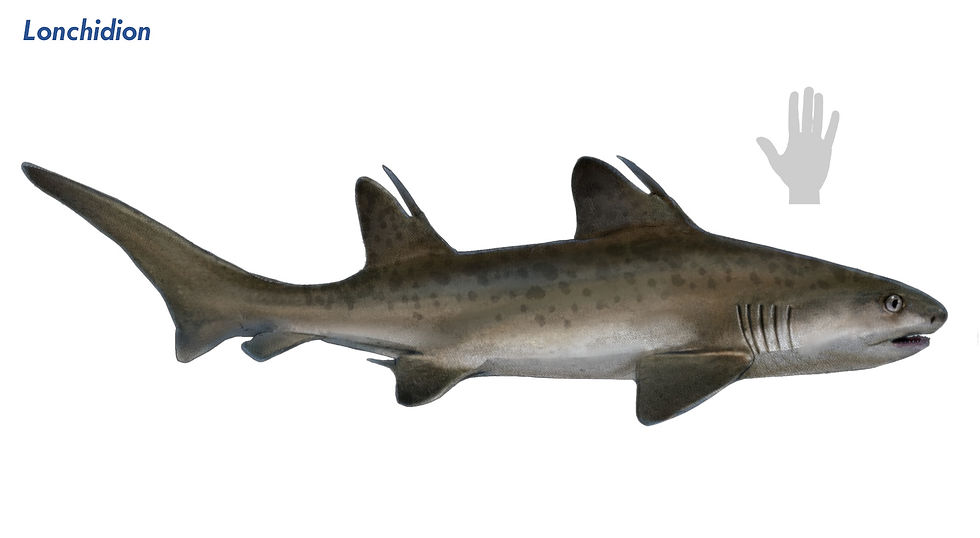
The order Hybodontiformes is an extinct group of shark-like cartilaginous fishes who persisted through to the end of the Mesozoic but ultimately became extinct at the end of the Cretaceous. Although they are often referred to as sharks, hybodonts do not fall within the division selachii and are therefore not true members of the shark group. These animals had very tall spines on each of their dorsal fins. These spines are often covered in ridges or groove-like markings. These spines probably helped ward off potential attacks from other marine predators. Male hybodonts had two small cephalic spines on their head, a feature thought to have played a role in reproduction although their exact purpose remains unclear. Fossils of different types of hybodonts have been recovered from saltwater, freshwater and brackish environments.
(BELOW) The genus Meristodonoides from the Early and Late Cretaceous, Aptian - Maastrichtian stages. Found in New Jersey, Texas, Montana, Wyoming, Minnesota, Mississippi. Species: M. butleri, M. montanensis, M. novojerseyensis,
M. rajkovichi, M. multiplicatus

(BELOW) The genus Lonchidion from the Triassic to the Late Cretaceous period.
Electric Rays (Torpediniformes)
Temporal Range: 90 million years ago - Present
Diet: Carnivorous, fishes, benthic invertebrates
Genera in the Western Interior Sea: Proplatyrhina
The order Torpediniformes is the order which contains the living electric rays. These animals are unique for having large electric organs situated on either side of the head which can generate electrical discharges used to stun prey and deter predators. The front parts of the bodies of electric rays are usually oval shaped and formed from a wide pair of pectoral fins. Their bodies are typically thicker and more muscular than those of many other rays and their tails sometimes end in a fluke. These animals often also have a pair of distinct dorsal fins with rounded tips located along the upper surfaces of their tails. Instead of depending on their eyesight, electric rays usually rely on picking up the electrical signals of prey species which they are able to detect even through layers of oceanic substrate on the seafloor. They tend to feed on small benthic vertebrates.
(BELOW) The genus Proplatyrhina from the Late Cretaceous period

Guitarfishes (Rhinopristiformes)
Temporal Range: 150 million years ago - Present
Diet: Carnivorous, fishes, invertebrates
Genera in the Western Interior Sea: Rhinobatos, Pseudohypolophus
The order Rhinopristiformes is the group which contains guitarfishes, sawfishes, and their relatives. The members of this order have long bodies with flattened heads and forebodies, while the rear portion of the body is similar to the rear halves of sharks, ending in a well-developed tail. Most rhinopristiform fishes are benthic predators that use their mouths which are positioned on the ventral surfaces of their bodies to feed on invertebrates and small fishes hiding in the seafloor sediment. Like many types of rays they have electroreceptors that help them to detect prey concealed beneath layers of sand or mud.
(BELOW) The genus Rhinobatos from the late Jurassic period - Present. Species found in the Western Interior Sea: R.incertus. Found in Colorado, Kansas, Texas, Montana

(BELOW) The genus Pseudohypolophus from the Late Cretaceous. Unclear affinities, some studies recover it as a member of Myliobatiformes. Found in Texas, Utah, Montana, Kansas

(BELOW) The genus Myledaphus from the Late Cretaceous, Turonian-Maastrichtian stages. Species found in the Western Interior Sea: M. bipartitus, M. pustulosus. Found across southern and central North America, from Alberta to Alabama

Suggested References: Chimaeras, Batomorphs
Case, G.R. (1965). “An occurrence of the sawfish, Onchopristis dunklei, in the Upper Cretaceous of Minnesota”. Journal, Minnesota Academy of Science, 32(3):183.
Cicimurri, D., (2000). “Cretaceous elasmobranchs of the Greenhorn Formation (Middle Cenomanian-Middle Turonian), western South Dakota”. 6th Fossil Conference Proceedings volume. :27-43.
Duffin, C. J., (2001). “A chimaerid (Holocephali, Chimaeriformes) vomerine toothplate from the Upper Cretaceous of Belgium”. Palaeontology, 44(6)1179-1188.
Everhart, M.J. (2017). “Oceans of Kansas - A Natural History of the Western Interior Sea, Second Edition”. Indiana University Press, 460 pp.
Everhart, M. J. (2005). “New stratigraphic records (Albian-Coniacian) of the guitarfish, Rhinobatos incertus (Chondrichthyes; Rajiformes), from the Cretaceous of central and western Kansas”. Journal of Vertebrate Paleontology, 25(Supplement to 3): 55A.
Lucas, Spencer G.; Sullivan, Robert M. (2006). “Late Cretaceous Vertebrates from the Western Interior: Bulletin 35”. New Mexico Museum of Natural History and Science.
McNulty, C. L. Jr. and B. H. Slaughter. (1964). “Rostral teeth of Ischyrhiza mira Leidy from northeast Texas.” Texas Jour. Sci. 16:107-112.
McNulty, C. L. Jr. and B. H. Slaughter. (1972). “The Cretaceous selachian genus, Ptychotrygon Jaekel 1894”. Eclog. Geol. Helvetiae 65(3):647-656.
Shimada, K. (1993). “Upper Cretaceous elasmobranchs from the Blue Hill Shale Member of the Carlile Shale, Western Kansas”. Kansas Academy of Science Abstracts, 12(78).
Villalobos-Segura, Eduardo; Underwood, Charlie J.; Ward, David J.; Claeson, Kerin M. (2019). "The first three-dimensional fossils of Cretaceous sclerorhynchid sawfish: Asflapristis cristadentis gen. et sp. nov., and implications for the phylogenetic relations of the Sclerorhynchoidei (Chondrichthyes)". Journal of Systematic Palaeontology. 17 (21): 1847–1870.
Welton, B. J., and R. F. Farish (1993). "The Collector's Guide to Fossil Sharks and Rays from the Cretaceous of Texas." Before Time, Lewisville, Texas, 204 pp.