
Squamata

Lizards, Snakes and Mosasaurs
Squamates form a group of reptiles which includes all of today’s snakes, lizards and their closest relatives. During the Late Cretaceous, the Western Interior Sea was home to a variety of marine squamates, including mosasaurs and dolichosaurids. Mosasaurs were large, fully aquatic reptiles that evolved from lizard-like ancestors and became the dominant marine predators of the seaway. They had streamlined bodies, paddle-shaped limbs, powerful tails, and flexible jaws that allowed them to hunt a wide range of prey, including fish, sharks, turtles, seabirds, and other marine reptiles. By the Late Cretaceous, mosasaurs were the largest carnivorous animals found in the world’s seas and oceans
Dolichosaurids were smaller elongated marine lizards that retained many terrestrial features, including functional limbs. They likely swam by undulating their bodies and tails and fed on small fish and invertebrates in shallow coastal waters. Both of these squamate groups seem to have been close relatives of today’s monitor lizards and snakes.
Anatomy

(ABOVE) A labeled diagram of the skeleton of the medium-sized mosasaur Platecarpus
Skeletal Anatomy
Although they originated from terrestrial lizard ancestors, mosasaurs underwent significant evolutionary changes in order to move into fully marine environmental niches and become effective swimmers. The backbones of these animals were heavily built yet fairly flexible which would have allowed their bodies to move in powerful lateral waves as they swam. In contrast to land-dwelling lizards, mosasaurs had limb bones modified to support broad flippers. The bones of the arms and legs became shortened and flattened over millions of years while the phalanges of the front and back feet grew longer in fully aquatic species who no longer had to support their own weight on land. Many species also developed more finger and toe bones than their terrestrial ancestors which increased the surface areas of their flippers.
The skulls of mosasaurs were built similarly to those of living monitor lizards but with a few added features which helped them survive at sea. Their heads were long and thin and were lined with sharp, cone-shaped teeth ideal for seizing slippery prey. Much like many of today’s snakes, mosasaurs had an extra set of pterygoid teeth on the roofs of their mouths which helped them hold onto prey and guide it into the throat during swallowing. The tails of mosasaurs also became increasingly specialized in order to give these animals more propulsion when swimming. Their tail bones ended in a downward bend which may have supported a crescent-shaped fin which was somewhat similar to that of a shark or an ichthyosaur. The extent of this tail fluke in different mosasaur genera and their exact shapes remain uncertain however, since fossils preserving these tail flukes are very rare. Some mosasaurs may have had a more paddle-like tail instead of a full fluke.

(BELOW) The bones of the skull of the mosasaur Platecarpus. The pterygoid bone which supports the extra set of teeth at the back of the mosasaur's mouth is somewhat obscured in this drawing but it extends all the way to the back of the skull.

(BELOW) The bones of the forelimbs and hindlimbs of a mosasaur. Many bones in the skeletons of mosasaurs were connected with extensive amount of cartilage instead of bone, a feature seen in many types of marine tetrapods.
External Anatomy
Mosasaurs had a sleek, streamlined body shape that was well suited for movement through the water. Their bodies became more narrow toward the tail, while their necks remained relatively short. This would have given these animals a smooth, torpedo-like profile. Their limbs were transformed into sturdy flippers, which were used to help with steering and balance rather than propulsion. Their primary driving force for swimming came from their large tails.
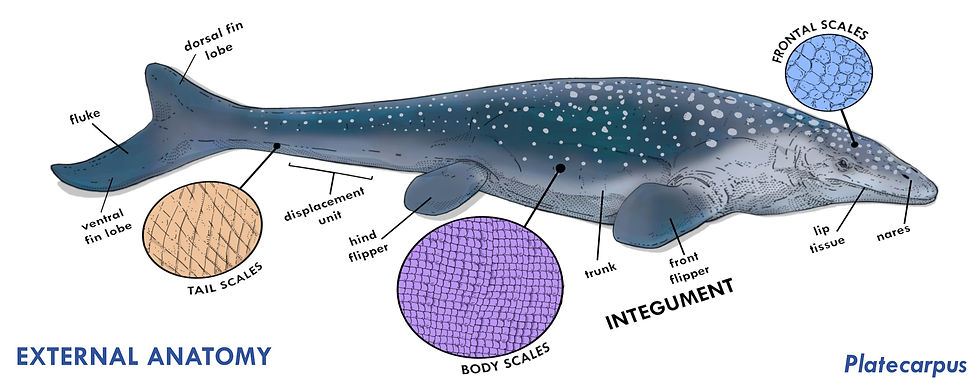
Rare soft-tissue fossils have provided valuable insights into the skin covering of mosasaurs. These remains tell us that the bodies of mosasaurs were covered in small, closely packed scales that created a smooth outer surface and likely helped reduce water resistance. Most scales were rhomboidal or diamond-shaped and overlapped one another in a pattern similar to those seen in many modern reptiles. In certain specimens, slightly enlarged scales are found along the back, creating a shallow ridge that may have improved stability while swimming. Fossilized skin impressions also indicate that scale size and shape varied across different regions of the body, with smaller scales found around joints and other areas that might have needed more flexibility
(BELOW) Features of the external anatomy of the mosasaur Platecarpus. Fossils from this particular genus which preserve patches of skin tell us that different areas on the bodies of these animals had their own specific scale types and textures.
(BELOW) A fossil on display at the KU Natural History Museum preserves a patch of scales from a Tylosaurus. Note the small ridges, or keels, running along the middle of each of these small scales, similar to those seen in some living snakes.

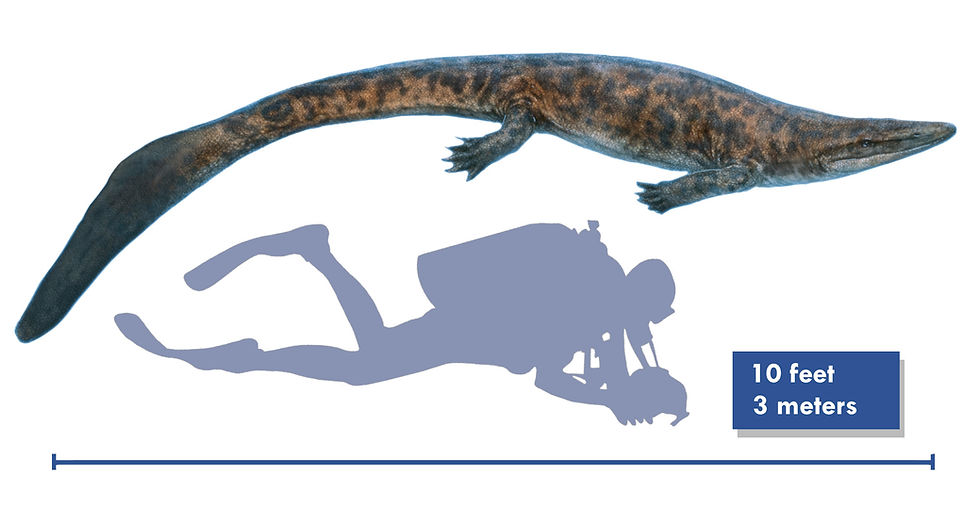
(BELOW) Artistic reconstructions of a mosasaur with two types of tail structures. The evidence in favor of the approach in illustration A is a fossil of Prognathodon which shows what appears to be the outline of a soft tissue tail lobe situated above the caudal vertebrae at the end of the tail. However, it is not clear from this fossil alone just how common this feature would have been within the mosasaur family tree. Some mosasaurs may have had a more paddle like tail as in illustration B.

Mosasaurs (Mosasauroidea)

Giant Ocean Lizards
Mosasaurs were a group of large marine reptiles that lived during the Late Cretaceous. These sea reptiles were descended from terrestrial animals related to living monitor lizards and they evolved a suite of adaptations for life in the water. Their bodies were long and streamlined, reducing drag as they swam and their limbs transformed over millions of years into broad, paddle-like flippers used for steering. A powerful tail, which may have ended in a crescent-shaped fluke would have helped push them through the water.
Some of the best known features of mosasaurs have to do with characteristics found in their skulls. They had strong jaws lined with sharp, backward-curving teeth designed to grasp slippery prey. Flexible joints in the skull and lower jaw may have allowed them to swallow large animals whole, much like many of today's snakes. They had a second set of teeth behind their palates which helped them keep ahold of their food. Some mosasaur species only grew to be around 5 feet long while others were behemoths who could measure over 50 feet in length.

Clidastes
Temporal Range: 85 - 70 million years ago
Geographic Range: Central and eastern North America, parts of Europe and Asia
Species: C propython, C. iguanavus?
Diet: Carnivorous, fish, squid, seabirds
Clidastes was a mosasaur genus which lived in the Late Cretaceous seas that covered much of North America, including the Western Interior Sea. Although it belonged to the same broader lineage as later giants such as Mosasaurus, Clidastes was much lighter and more streamlined in build, generally reaching lengths of around 10-20 feet. Its slender body was ideally suited for speed and agility in the water. One of the defining characteristics of Clidastes was the specialized structure of its vertebral column. The genus' name translates roughly to “locked vertebrae” which refers to the way adjacent vertebrae interlocked with one another. This would have given this genus a backbone that was both strong and flexible. This arrangement gave Clidastes extra stability while swimming without hampering the side-to-side motion needed for effective propulsion through the water.
Compared with many later mosasaurs, Clidastes had a more gracile physique. These mosasaurs had narrow skulls, elongated bodies, and powerful tails. The rear portion of the tail was reinforced by enlarged neural spines and lower chevrons that anchored strong swimming muscles. Its jaws were equipped with numerous sharp, recurved teeth designed to seize and hold slippery prey. Rather than crushing large animals, Clidastes likely specialized in catching fish, soft-bodied cephalopods, and other small marine organisms.


(BELOW) A skull of Clidastes on display at the KU Natural History Museum. The skull is positioned upside-down with the mandibles on either side of the cranium. The shapes of the palate and the pterygoid teeth are visible in center frame
(BELOW) A fossil Clidastes tooth. Original photo taken by Dylan Falkner/Prehistoric Alabama


Dallasaurus
Temporal Range: 93.9 - 89.8 million years ago
Geographic Range: Northern Texas
Species: D. turneri
Diet: Carnivorous, fish, squid
Dallasaurus is an important animal for those studying mosasaurs because it preserves a rare glimpse into the early stages of mosasaur evolution. Unlike the giant, fully aquatic mosasaurs that dominated the oceans later in the Cretaceous, Dallasaurus retained a mix of basal and derived features that reveal how these reptiles transitioned from life on land to life at sea. Fossils of this small predator were discovered in Turonian-aged rocks near Dallas County, Texas, giving the genus its name. One of the most distinctive characteristics of Dallasaurus was its limb structure. Rather than having fully developed flippers like later mosasaurs, it retained relatively unspecialized limbs with recognizable digits and joints. These limbs were better suited for movement on land than those of more derived mosasaurs, suggesting that Dallasaurus occupied a transitional stage between terrestrial lizards and fully marine reptiles.
At the same time, Dallasaurus already displayed adaptations for life in the water. Its body and tail were already deeper than those of its terrestrial relatives, a feature which is sometimes seen in animals who are moving into an aquatic niche. This would suggest that aquatic adaptations evolved in mosasaurs before the complete transformation of the limbs into flippers. Dallasaurus is also notable for its relatively small size. At approximately 3 feet long, Dallasaurus was tiny compared with later mosasaur giants such as Mosasaurus and Tylosaurus. Its diminutive size likely allowed it to hunt in shallow coastal environments and pursue smaller prey.


Ectenosaurus
Temporal Range: 85.8 - 82 million years ago
Geographic Range: Kansas, northern Texas, Alabama
Species: E. clidastoides, E. everhartorum, E. tlemonectes, E. shannoni
Diet: Carnivorous, fish, squid
Ectenosaurus was an animal whose name means “drawn-out lizard,” a name which refers to its elongated snout and jaws. This long skull is one of the genus’s defining traits. Unlike the broader skulls of many mosasaurs, Ectenosaurus had a narrow, streamlined snout that likely allowed it to capture small, fast-moving prey with precision. This skull shape is one of the key features used to differentiate Ectenosaurus from close relatives such as Platecarpus.
Perhaps the most important fossil discoveries associated with Ectenosaurus are the rare traces of its skin and associated soft-tissue impressions. These fossils revealed that these animals were covered in tightly anchored scales supported by an intricate network of fiber bundles within the skin. The arrangement of these tissues suggests that the front portion of the body was relatively rigid rather than highly flexible. This evidence somewhat changed our view of mosasaur locomotion. Early reconstructions often portrayed mosasaurs swimming like giant eels or sea snakes by undulating their entire bodies. The preserved soft tissues of Ectenosaurus indicate instead that much of the body remained stiff during swimming, with propulsion generated primarily by the tail. This swimming style, which was likely used by most types of mosasaurs, would have been more efficient and hydrodynamic than simple undulation and would have echoed the swimming styles of modern sharks and other fast marine predators.

Eonatator
Temporal Range: 84 - 72 million years ago
Geographic Range: North America, parts of South America, northern Europe
Species: E. sternbergii, E. coellensis
Diet: Carnivorous, small fish, squid, sea turtles
Eonatator was a relatively small mosasaur that lived in the oceans of the Late Cretaceous and belonged to the specialized halisaurine branch of the mosasaur family. Adults were only about 9 feet long, making them one of the smaller members of the mosasaur group. The name Eonatator, means “dawn swimmer,” which reflects its status as an early representative of the halisaurines. The femurs of these animas were unusually long and narrow, while the vertebral column contained fewer pygal vertebrae than is seen in many other mosasaurs. Their skulls also had a somewhat rounded process on its quadrate bone, a distinctive characteristic that separates Eonatator from closely related genera such as Halisaurus. These differences were significant enough that paleontologists ultimately classified Eonatator as a separate genus.

Globidens
Temporal Range: 85 - 66 million years ago
Geographic Range: Parts of the US, Colombia, Angola, Brazil, Jordan
Species: G. alabamensis, G. dakotensis, G. phosphaticus, G. simplex
Diet: Durophagous: ammonites, turtles
Globidens was among the most highly specialized mosasaurs of the Late Cretaceous and stood apart from most of its relatives because of its globe-shaped dentition. Whereas many mosasaurs had long, sharp teeth adapted for seizing fish and other soft-bodied prey, Globidens had distinctive rounded teeth shaped like small domes or spheres. This unusual dental arrangement was so characteristic that it inspired the genus name, which translates to “globe tooth.”
Globidens' teeth gave it the ability to feed on hard-shelled animals. Its rounded teeth were designed for crushing rather than piercing which would have made them less likely to break during feeding. Instead of impaling prey, the teeth acted much like heavy-duty crushing tools capable of breaking shells and armor. This specialized feeding strategy allowed Globidens to consume organisms such as ammonites, nautiloids, clams, and marine turtles that many other mosasaurs would have struggled to break open. Globidens also had a heavily constructed skull and powerful jaw apparatus. The skull was built to withstand repeated high-pressure bites, while the strongly articulated jaws generated the force necessary to crack open durable shells.
(BELOW) A fossil Globidens tooth shown from above (A) and below (B). Original photo taken by Dylan Falkner


Gnathomortis
Temporal Range: 81 - 79 million years ago
Geographic Range: Colorado
Species: G. stadtmani
Diet: Carnivorous, fish, sharks, marine reptiles
Gnathomortis was a large mosasaur that lived during the Late Cretaceous in the ancient seaway that covered parts of Colorado. Although it was originally classified as a species of Prognathodon, in 1999 it was moved into its own new genus. Gnathomortis' name means “jaws of death.” The most impressive feature of Gnathomortis would have been its massive jaw apparatus. Its lower jaws measured roughly 4 feet long and were supported by extremely powerful muscles. Evidence for these muscles comes from a depression on the outer surface of the mandible, a feature also seen in some modern lizards. This feature suggests that Gnathomortis was capable of generating a particularly strong bite, enabling it to tackle very large prey.

Jormungandr
Temporal Range: 80 million years ago
Geographic Range: North Dakota
Species: J. walhallaensis
Diet: Carnivorous, fish, sharks, marine reptiles
Jormungandr is among the most recent mosasaurs to be described in the twenty-first century. This marine reptile was recovered from the Pierre Shale deposits of North Dakota and its remains date back to roughly 80 million years ago during the Late Cretaceous. It was described and named in 2023. The genus takes its name from Jörmungandr, the legendary sea serpent of Norse mythology. Because the fossil material includes an almost complete skull along with portions of the rest of the skeleton, scientists have been able to study its anatomy in a great deal of detail.
The most distinctive aspect of Jormungandr is its combination of anatomical traits that link different stages of mosasaur evolution. Its skeleton has features associated with both early and more advanced mosasaurine species. For instance, it retained the relatively large number of teeth characteristic of more basal forms such as Clidastes, but it also would have had thickened skull elements that resemble those of later genera such as Mosasaurus. Because of these similarities, researchers initially suspected that the specimen belonged to an early member of the genus Mosasaurus before determining that it was distinct enough to represent an entirely new genus.

Latoplatecarpus
Temporal Range: 80 - 79 million years ago
Geographic Range: Central North America, western Russia
Species: L willistoni, L. nichollsae
Diet: Carnivorous, fish, sharks, marine reptiles
Latoplatecarpus was a plioplatecarpine mosasaur whose fossils have been discovered in several regions, including the Western Interior Seaway of North America, the Gulf Coast, and parts of Russia. It was also one of the larger plioplatecarpine mosasaurs, with some individuals exceeding 25 feet in length.
The name Latoplatecarpus translates to “wide flat wrist” which highlights the animal’s unique broad foreflippers. These paddle-like limbs were not used for propulsion alone but also played an important role in steering and maintaining stability in the water. Their expanded shape suggests that Latoplatecarpus could make quick turns and precise movements while pursuing prey. Its body design suggests that it was a predator that relied on speed, agility, and quick reactions to capture its food. Latoplatecarpus fossils were originally assigned to the genus Plioplatecarpus before being later recognized as belonging to a separate genus,

Mosasaurus
Temporal Range: 82.7 - 66 million years ago
Geographic Range: Central North America, parts of Europe and Africa
Species: M. missouriensis, M. hoffmani, M. conodon, M. lemonnieri
Diet: Carnivorous, fish, sharks, marine reptiles
Mosasaurus missouriensis was one of the largest Interior Sea mosasaurs, likely hunting for sharks, sea turtles, and other marine reptiles living within the waters of its shallow ocean habitat. These animals were close relatives of the european species Mosasaurus hoffmani, one of the most massive known species of mosasaurs.
The history of the discovery of Mosasaurus missouriensis is closely tied to the early development of American paleontology. Fossils attributed to this species were among the earliest mosasaur remains discovered in North America. As early as 1804, members of the Lewis and Clark Expedition reported finding the remains of a large aquatic animal along the Missouri River in what is now South Dakota. Additional fossils were collected during the 1830s from the same general region, attracting the attention of scientists and naturalists. The species was formally described in 1834 and initially named Ichthyosaurus missouriensis because its true identity was not yet understood. Later discoveries and comparisons with other marine reptiles revealed that the animal was actually a mosasaur. Subsequent studies reassigned the species to the genus Mosasaurus, where it remains to this day.

Platecarpus
Temporal Range: 84 - 81 million years ago
Geographic Range: Worldwide distribution
Species: P. tympaniticus, P. coryphaeus?
Diet: Carnivorous, fish, sharks, marine reptiles
Platecarpus was a medium-sized genus of mosasaur. Its fossils are particularly common in the Niobrara Chalk deposits of central and western Kansas, where it was one of the most successful mosasaurs of its time. Platecarpus grew to be about 19 feet long. Its skull was more lightly built than the skulls of giant mosasaurs such as Tylosaurus. It had a wider body than many other more gracile mosasaurs like Mosasaurus and Tylosaurus.
Fossil evidence suggests that Platecarpus primarily fed on moderate-sized fish and may also have consumed squid. Some fossils of Platecarpus are found with the remains of fish bones still inside of their abdominal cavities. Exceptional fossil discoveries have alsp preserved rare soft-tissue details from these animals, most notably fossilized skin impressions, which show that they had different shapes of scales on different parts of their bodies. Platecarpus would later evolve into larger and more heavily built mosasaurs like Plioplatecarpus which show up in rock layers from later in the Cretaceous period.

(BELOW) A skull of a Platecarpus on display at the KU Natural History Museum. In this particular mount the bones of the sclerotic ring are visible in the orbit. In life these rings of small bony plates would encircle the outside of the animal's eyes.
.jpg)
(BELOW) A skeleton of Platecarpus on display at the Sternberg Museum of Natural History. The forelimb bones of this animal are shown at the bottom of the photo. Note the truncated humerus and forearm bones.

Plesioplatecarpus
Temporal Range: 88 - 84 million years ago
Geographic Range: Central and western North America
Species: P. planifrons
Diet: Carnivorous, fish, sharks, marine reptiles
Plesioplatecarpus was a mid-sized mosasaur that was found the seas of the Late Cretaceous. For many years, its fossils were assigned first to the genus Clidastes and later to Platecarpus, but subsequent research revealed enough anatomical differences to justify the creation of a separate genus. Its name, meaning “similar to Platecarpus,” acknowledges its close relationship to that genus. It was most likely a slender and quick swimmer like many of the other plioplatecarpine mosasaurs.

Plioplatecarpus
Temporal Range: 82 - 66 million years ago
Geographic Range: Central North America, parts of Europe and Africa
Species: P. marshi, P. depressus, P. primaevus, P. peckensis
Diet: Carnivorous, fish, sharks, marine reptiles
Plioplatecarpus was a highly specialized mosasaur that lived during the late Cretaceous period. Although not as large as famous giants such as Mosasaurus or Tylosaurus, it was a successful marine predator in its own right that lived in shallow seas across North America and Europe. Most species reached lengths of about 19 feet, making them medium-sized members of the mosasaur family. One of the most distinctive features of Plioplatecarpus was its relatively short skull combined with fairly large eyes. The enlarged eyes may have been an adaptation for hunting in dimly lit environments, possibly allowing it to forage at greater depths than many other mosasaurs. Its broad geographic distribution suggests that it was well adapted to life in open waters rather than being limited to shallow coastal habitats.
These mosasaurs were probably comparatively fast and maneuverable, with body proportions that differed from those of the larger predators of the Late Cretaceous. Some researchers have even compared their swimming style and agility to those of modern pinnipeds like seals and sea lions. Their tooth structure suggests that, like Platecarpus, they specialized in feeding on soft-bodied animals like fish and squid.

Prognathodon
Temporal Range: 83.6 - 66 million years ago
Geographic Range: Found in North America, Europe, western Asia, Africa
Species: P. overtoni, P. solvayi, P. giganteus, P. hashimi, P. hudae, P. lutugini, P. primus
Diet: Carnivorous, fish, sharks, marine reptiles
Prognathodon was one of the most heavily-built mosasaurs of the Late Cretaceous oceans. While many mosasaurs were built for catching fish and other soft-bodied prey, Prognathodon evolved a skull and dentition designed to deliver a much more powerful bite. Its name means “forejaw tooth” and refers to the massive jaws and prominent teeth that made it somewhat unique among mosasaurs. Fossils of Prognathodon have been discovered in Europe, North America, Africa, the Middle East, and even New Zealand.
One of the characteristic features of the genus Prognathodon was its extremely deep skull. Its jaw muscles were heavily developed, allowing it to generate a powerful bite force compared to many other mosasaurs. Its teeth were large, thick, and strongly built, with heavily striated crowns and a shape suited for gripping, crushing, and tearing prey. Another unusual trait was the curvature and arrangement of the front teeth, which were more strongly curved than those of most other mosasaurs. Unlike the slender teeth of fish-eating mosasaurs, Prognathodon’s teeth could withstand a lot of stress which suggests that it was capable of hunting and tearing apart very large prey.
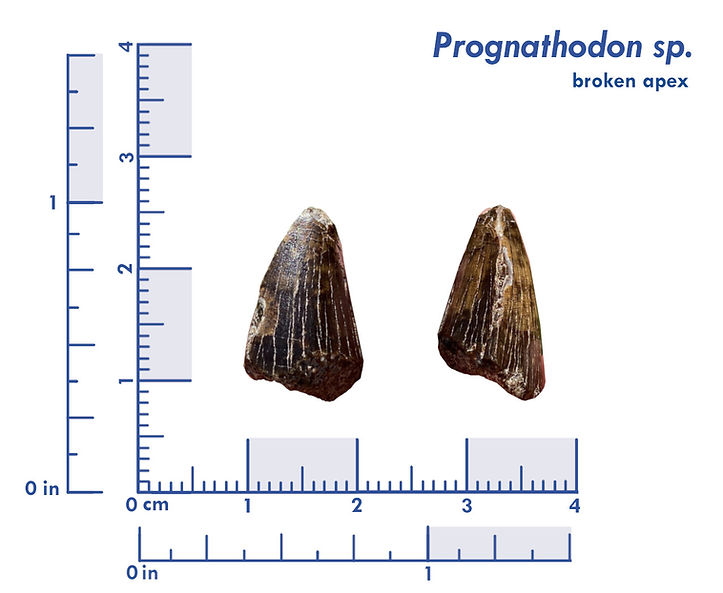
(BELOW) A Prognathodon tooth apex from the Campanian Ozan Formation of Texas. Fossil collected and original photo taken by Jared Cooke/ jcookepaleo
Russellosaurus
Temporal Range: ~90 million years ago
Geographic Range: Northern Texas
Species: R. coheni
Diet: Carnivorous, fish, squid
Russellosaurus was a small and gracile mosasaur that lived during the Turonian stage of the Late Cretaceous. Although it lacked the enormous size of later mosasaurs such as Mosasaurus and Tylosaurus, it is one of the most scientifically important early members of the group. Fossils recovered from Texas represent some of the oldest well-preserved mosasaur remains known from North America and add a valuable insight into the early evolution of these marine reptiles.
The skull of Russellosaurus was relatively narrow and slender in its construction. It had sixteen teeth in both the upper and lower jaws, a broad snout tip, and delicate cranial bones that created a streamlined appearance. Rather than being adapted for crushing large prey, its skull structure suggests it would have been an animal built for making quick turns while pursuing small animals. Russellosaurus is the namesake of the Russellosaurina, a group that includes several basal mosasaurs and helps bridge the evolutionary gap between early forms and later lineages such as the tylosaurines and plioplatecarpines.

Selmasaurus
Temporal Range: 86.3 - 84 million years ago
Geographic Range: Kansas, Alabama
Species: S. johnsoni, S. russelli
Diet: Carnivorous, fish, sharks, marine reptiles
Selmasaurus was a relatively small mosasaur whose fossils have been discovered in Alabama and Kansas. The genus is represented by two species, S. russelli and S. johnsoni. Selmasaurus had an unusualy well-fused skull. Unlike most mosasaurs who had flexible skulls capable of widening to accommodate large prey, many of the bones of the Selmasaurus' head were very strongly connected to one another and lacked the extensive cranial flexibility seen in other members of the group. As a result, it likely focused on smaller prey that could be swallowed whole. This is also supported by its relatively low tooth count. For a long time it was considered to be the mosasaur genus with the fewest teeth.

Tylosaurus
Temporal Range: 92.1 - 66 million years ago
Geographic Range: Central North America, parts of Europe and Africa
Species: T. proriger, T. rex, T. nepaeolicus, T. kansasensis, T. ivoensis, T. iembeensis
Diet: Carnivorous, fish, sharks, marine reptiles
Tylosaurus was among the largest and most powerful marine reptiles of the Late Cretaceous and could grow to be over 43 feet long. One of its most distinctive features was a blunt, toothless snout extension whose purpose remains mysterious. This cranial feature gives Tylosaurus its genus name, translating approximately to “knob reptile”. As a top predator in the seas of western North America, Tylosaurus hunted a wide variety of animals, including fish, sharks, sea turtles, seabirds, plesiosaurs, and even other mosasaurs.
Tylosaurus is one of the best known animals from the Western Interior Seaway. It would have occupied the highest level of the food chain and played a role similar to that of modern large toothed whales. Tylosaurus has even been designated the state ocean fossil of Kansas
(BELOW) A skeleton of Tylosaurus on display at the Sternberg Museum of Natural History. Despite the large size of this particular skeleton this animal had not reached maximum size at the time of its death
.jpg)
(BELOW) A closeup view of the skull of Tylosaurus on the skeleton in Hays. In this mount the pterygoid teeth at the back of the jaw are visible just below the cheekbones and the orbit. These teeth were used to hold prey in place before swallowing
(BELOW) An illustrated panel about Tylosaurus made for our Instagram account
.jpg)
(BELOW) A Tylosaurus skull on display at the KU Natural History Museum. This particular skull is very large. Its crushed appearance is a result of taphonomic processes which changed the shape of the bones while it was in the ground

.jpg)
(BELOW) A skull of a smaller species of Tylosaurus, Tylosaurus kansasensis, on display at the Sternberg Museum

(BELOW) A Tylosaurus tooth from the Campanian of Texas. Fossil collected and original photo taken by Jared Cooke/ jcookepaleo
Dolichosaurs (Dolichosauridae)
Snake-like Swimming Lizards
Dolichosaurids were a group of small to medium-sized marine lizards that were related to mosasaurs and possibly closely related to the evolutionary lineage leading to modern snakes. They had elongated, snake-like bodies with reduced limbs and flexible necks. Despite their aquatic adaptations, they retained many features of their terrestrial lizard ancestors such as feet with small toes. Fossils of dolichosaurids such as Coniasaurus have been recovered from marine sediments in Kansas, confirming their presence within the seaway's diverse faunal communities. They preyed primarily on fish, crustaceans and other small aquatic organisms.

Coniasaurus
Temporal Range: 100 - 84 million years ago
Geographic Range: Kansas, Germany, parts of the UK
Species: C. crassidens, C. gracilodens
Diet: Carnivorous, small fish, squid
Coniasaurus was a small marine lizard that lived during the Late Cretaceous. These animals measured only about 3 feet in length, far smaller than later marine reptiles, yet they occupied a key evolutionary position near the base of the mosasaur lineage. Fossils of Coniasaurus have been found in Europe and North America, including deposits from the Western Interior Seaway of Kansas. One of the most distinctive features of Coniasaurus was its elongated body plan. It had a long neck, an extended trunk, and a slender tail which would have given it a serpentine appearance. Its skull was relatively long and narrow, and its dentition was highly specialized. The species Coniasaurus crassidens would have had enlarged hind teeth that differed markedly from those of many living lizards. These teeth may have allowed it to process tougher prey items, while its slender jaws were well suited for capturing fast moving food.
Media Gallery


Suggested References: Squamata
Augusta, B.G.; Zaher, H.; Polcyn, M.J.; Fiorillo, A.R.; Jacobs, L.L. (2022). "A Review of Non-Mosasaurid (Dolichosaur and Aigialosaur) Mosasaurians and Their Relationships to Snakes". In Gower, D.J.; Zaher, H. (eds.). The Origin and Early Evolutionary History of Snakes. Cambridge University Press. pp. 157–179.
Caldwell M.W. & Cooper J.A. (1999). "Redescription, palaeobiogeography and palaeoecology of Coniasaurus crassidens Owen, 1850 (Squamata) from the Lower Chalk (Cretaceous; Cenomanian) of SE England" (PDF). Zoological Journal of the Linnean Society. 127 (4): 423–452.
Evans, S.E. (2022). "The Origin and Early Diversification of Squamates". In Gower, D.J.; Zaher, H. (eds.). The Origin and Early Evolutionary History of Snakes. Cambridge University Press. pp. 5–110.
Everhart, M. J. (2002). “New data on plesiosaur remains found as stomach contents of a Tylosaurus proriger (Squamata; Mosasauridae) from the Niobrara Formation of western Kansas”. (Abstract) Transactions of the Kansas Academy of Science
Everhart, M. J. (2002). “Remains of immature mosasaurs (Squamata; Mosasauridae) from the Niobrara Chalk (Late Cretaceous) argue against nearshore nurseries”. Journal of Vertebrate Paleontology 22(suppl. to 3):52A.
Everhart, M. J. and S. E. Johnson. (2001). “The occurrence of the mosasaur, Platecarpus planifrons, in the Smoky Hill Chalk (Upper Cretaceous) of western Kansas”. Journal of Vertebrate Paleontology 21
Everhart, M.J. (2005). “Tylosaurus kansasensis, a new species of tylosaurine (Squamata: Mosasauridae) from the Niobrara Chalk of western Kansas, U.S.A.” Netherlands Journal of Geosciences, p. 231-240.
Everhart, M. J. (2002). "New data on Cranial Measurements and Body Length of the Mosasaur, Tylosaurus nepaeolicus (Squamata; Mosasauridae), from the Niobrara Formation of Western Kansas". Transactions of the Kansas Academy of Science. 105 (1–2): 33–43.
Everhart, M. J. (2002). "New data on Cranial Measurements and Body Length of the Mosasaur, Tylosaurus nepaeolicus (Squamata; Mosasauridae), from the Niobrara Formation of Western Kansas". Transactions of the Kansas Academy of Science. 105 (1–2): 33–43.
Geist, N. R., Carpenter, S., and Stewart, J. D. (2002). “Chemical and morphological analysis of soft tissue preservation in a mosasaur”. Journal of Vertebrate Paleontology 22
Hattin, D. E. (1982). “Stratigraphy and depositional environment of Smoky Hill Chalk Member, Niobrara Chalk (upper Cretaceous) of the type area, western Kansas”. Kansas Geol. Survey Bull. 225, 108 pp.
Holmes, R., M. W. Caldwell, and S. L. Cumbaa. (1999). “A new specimen of Plioplatecarpus (Mosasauridae) from the lower Maastrichtian of Alberta: Comments on allometry, functional morphology, and paleoecology”. Canadian Journal of Earth Science 36: 363-369.
Kass, M. S. (1999). “Prognathodon stadtmani (Mosasauridae): A new species from the Mancos Shale (Lower Campanian) of western Colorado”. In Gillette, D. D. (ed.), Vertebrate Paleontology in Utah, Utah Geological Survey, Miscellaneous Publication 99-1: 275-294.
Kiernan C.R., (2002). “Stratigraphic distribution and habitat segregation of mosasaurs in the Upper Cretaceous of western and central Alabama, with an historical review of Alabama mosasaur discoveries”. Journal of Vertebrate Paleontology 22 (1): 91–103.
Lindgren J, Caldwell MW, Konishi T, Chiappe LM (2010), “Convergent Evolution in Aquatic Tetrapods: Insights from an Exceptional Fossil Mosasaur”. PLoS ONE 5(8): e11998.
Mekarski, M.M. (2017). “The Origin and Evolution of Aquatic Adaptations in Cretaceous Squamates”. University of Alberta.
Polcyn, M. J., and Everhart, M. J., (2008), “Description and phylogenetic analysis of a new species of Selmasaurus (Mosasauridae: Plioplatecarpinae) from the Niobrara Chalk of western Kansas: In: Proceedings of the Second Mosasaur Meeting”.Fort Hays Studies, Special Issue number 3, p. 13-28.
Russell, D. A. (1988). “A check list of North American marine Cretaceous vertebrates including fresh water fishes.” Royal Tyrrell Museum
Zietlow, Amelia R.; Boyd, Clint A.; Van Vranken, Nathan E. (2023). "Jormungandr walhallaensis: A New Mosasaurine (Squamata: Mosasauroidea) from the Pierre Shale Formation (Pembina Member: Middle Campanian) of North Dakota". Bulletin of the American Museum of Natural History. 464 (1).