
Sea Turtles

Sea Turtles of the Great Plains
Testudines, the order that includes all turtles, tortoises, and terrapins, have one of the most unusual body plans among vertebrates. Members of this order have a protective shell formed from modified ribs and vertebrae that is permanently fused to their skeletons. Their shell consists of an upper carapace and a lower plastron, while their keratin-covered beaks fill a similar function as teeth. Many terrestrial and semi-aquatic species can retract their heads into their shells, although this ability is not present in sea turtles.
The layers of rock deposited by the Western Interior Sea preserve fossils of several types of prehistoric marine turtles, including car-sized giants like Protostega and Archelon. Although many of these animals appear superficially similar to today’s sea turtles, some of these animals do not seem to be part of groups of turtles which were the direct ancestors of living sea turtles. Others, like Prionochelys and Ctenochelys, seem to have been close relatives of the superfamily which would eventually lead to all seven of today’s living sea turtle species.
Anatomy
Skeletal Anatomy
Sea turtles descend from animals who once lived on land and as a result, most features of their skeletons are derived from structures which originally helped their ancestors move around in terrestrial habitats. The bones found in their flippers are the same bones found in the legs and feet of other turtles. In sea turtles the phalanges supporting the outer parts of each flipper are longer than those of their terrestrial relatives, while their other leg bones are proportionally shorter. The skulls of some types of Cretaceous sea turtles, namely the protostegids, grew to be very large and were equipped with long hooked beaks. The shell structures of the carapaces of these ancient turtles were linked to their ribs. The lower section of the shell, known as the plastron, was formed from wide, somewhat flattened bony plates. In protostegid sea turtles the bony shell structure of the carapace was reduced and the only remaining sets of scute bones were those found along the margins of the shell. The shells of protostegid sea turtles were covered in a thick layer of skin instead of the scutes seen in most turtles.
(BELOW) Features of the skeletal anatomy of the Cretaceous sea turtle Protostega. As a member of the protostegid lineage, the bones of the carapace are reduced in this genus. The edges of the bones of the plastron have a distinctive saw-toothed shape in protostegids and the central part of the plastron is unfused beneath the bones of the pectoral girdle.

Shell Plates
Turtle shells are composed of a bony inner layer covered by a series of plates called scutes. The bony core of the shell is connected to the turtle's ribs. Although the shapes of the outer layers of scutes can vary wildly between different types of turtles, they all tend to be organized in a similar way. There is a series of five central scutes along the turtle's spine. In front of the first central scute at the base of the neck there is an additional plate called the precentral scute, while a pair of postcentral scutes sits at the rear of the shell just above the position of the tail. The central scutes are flanked on each side by five pairs of lateral scutes. The edges of a turtle's shell are marked by a line of smaller marginal scutes.
(BELOW) The arrangement of scutes found on a turtle's carapace. Some sea turtles do not have central or lateral scutes along the upper parts of their carapaces, although the ribs of these animals are still somewhat wider and more heavily built than those of most types of tetrapods in order to support an outer covering of soft tissue.

External Anatomy
The shell of a sea turtle is composed of two halves. The dorsal half of the shell is called the carapace while the ventral side is known as the plastron. Sea turtles have four flippers. Along the front edge of the fore flippers there is often a spur of tougher material called a claw. Some sea turtle genera have more than one of these claws on each of their fore flippers. In some genera, such as Ctenochelys, the hind flippers can be rather large, which is thought to be a feature which would let these animals push themselves along the seafloor or the bottoms of rivers. Sea turtles tend to have very robust beaks, although the exact shape of these structures can vary markedly between families of sea turtles. Protostegids, for instance, have very long hook-shaped beaks while Toxochelys and its relatives have shorter triangular beaks.

(ABOVE) External antomical features of the Cretaceous sea turtle Ctenochelys, a distant relative of the sea turtle groups found in today's oceans. Some Cretaceous sea turtles had ridges running along the central scutes of their carapaces.

Archelon
Temporal Range: 80 million years ago - 74 million years ago
Geographic Range: South Dakota
Species: A. ischyros
Diet: Carnivorous, soft-shelled prey, fish, cephalopods, jellyfish
Archelon was the largest known turtle to have ever lived and could grow to be the size of a small truck. In contrast to many other Cretaceous sea turtles it did not have a fully solid, heavily ossified shell. Instead, its body was supported by a lighter skeletal framework covered by leathery tissue. It would have had very large front flippers used to push itself through the water, as well as a long skull ending in a powerful, hooked beak suited for handling a variety of prey. These animals probably preferred to feed on soft-shelled prey in open waters, much in the same way that living sea turtles feed on jellyfish today. With a body length exceeding 12 feet, Archelon dwarfed most contemporary sea turtles. Fossils of Archelon first turned up in 1895 when a rather complete skeleton was found in the Pierre Shale formation of South Dakota. The following year the species Archelon ischyros would be officially described based on those remains. Owing to their large size, Archelon has remained one of the most famous prehistoric turtles throughout the ensuing years all the way up until the present.

(BELOW) An Archelon skeleton on display at the Natural History Museum of Vienna. The skull of the animal is in the center of the photo. The saw-toothed edges of the plates of the plastron are visible through the ribs and bones of the carapace. Photo by Paul Hermans, accessed via Wikimedia Commons, distributed under a CC BY-NC-SA 4.0 license

(BELOW) A photo of an Archelon skull which appeared in the American Journal of Science, volume 9, in 1900. Note the very long hook-shaped beak which is characteristic of protostegid sea turtles. accessed via Wikimedia Commons, public domain image
_(18155231621).jpg)

Chelosphargis
Temporal Range: 94.3 million years ago - 89.3 million years ago
Geographic Range: Kansas, Alabama
Species: C. advena
Diet: Carnivorous, soft-shelled prey, fish, cephalopods, jellyfish
Chelosphargis was a sea turtle which was unique amongst its relatives because it had a well-developed keel extending along the center of its carapace. This feature has been used by paleontologists to differentiate Chelosphargis from closely related genera, particularly Calcarichelys, which exhibits a similar overall body plan but differs in the details of its shell morphology. These turtles also seem to have had a very deep shell, which would have made the animals appear much more rounded in profile than many other types of Cretaceous sea turtles. Their shells are usually found disarticulated and somewhat crushed so exact measurements of the range of shell shapes found in this genus are not entirely known. It is currently considered to be a member of the protostegid sea turtle family, along with animals like Archelon and Desmatochelys.

(BELOW) A sketch of the holotype fossil of Chelosphargis advena from Oliver Hay's "Fossil turtles of North America" (1908), which refers to the animal as "Protostega advena". The holotype is composed of a partial plastron, a series of marginal scutes and some other shell and skull fragments. Public domain image


Ctenochelys
Temporal Range: 89 million years ago - 70 million years ago
Geographic Range: Central North America, Alabama
Species: C. stenoporus, C. acris
Diet: Carnivorous, soft-shelled prey, fish, cephalopods, jellyfish
Ctenochelys was a fairly small turtle whose name means "comb turtle" after the series of spine-like projections on the scutes running along the back of its shell. Unlike the enormous protostegid turtles which would have been some of its contemporaries, Ctenochelys belonged to a lineage more closely aligned with the ancestors of modern sea turtles. It is currently recovered as one of the earliest close relatives of the Chelonioids, part of the lineage that leads to all seven of today’s sea turtle species. When fossils of this animal were first found in 1904, the species now known as Ctenochelys stenoporus was initially placed within Toxochelys before being given its own classification years later.
(BELOW) A photograph of a Ctenochelys shell and a diagram of its components. Photo is from "The life of a fossil hunter", by Charles H. Sternberg and refers to the animal as "Toxochelys bauri". The diagram appeared in the American Journal of Science, volume 20 in 1905. Note the raised area along the midline of the shell. Public domain images

_(.jpg)
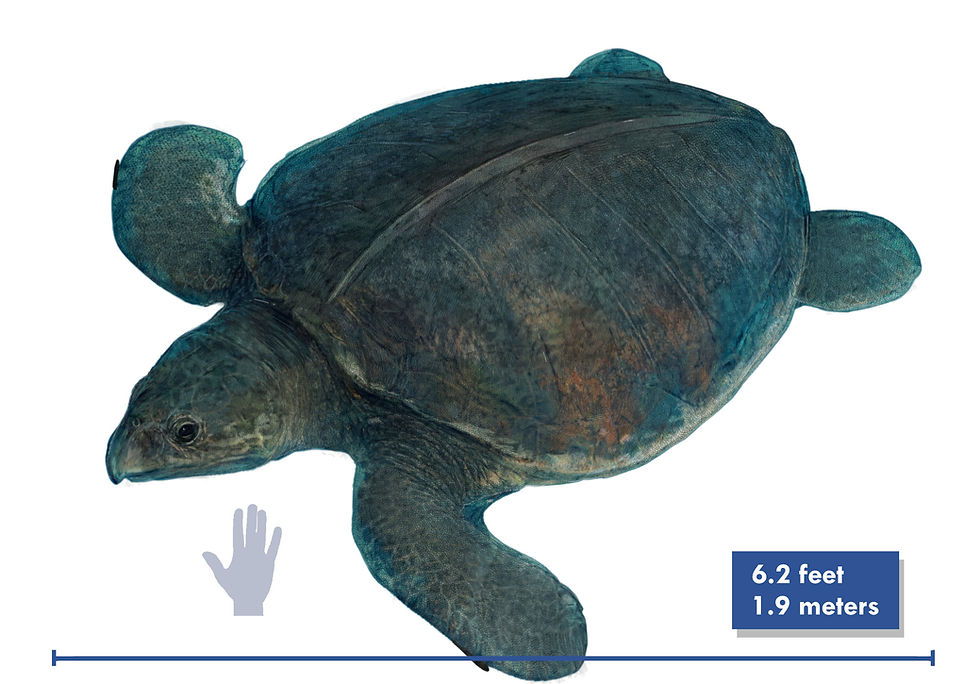
Desmatochelys
Temporal Range: 120 million years ago - 83.5 million years ago
Geographic Range: North America, Japan, Columbia
Species: D. lowi, D. padillai
Diet: Carnivorous, soft-shelled prey, fish, cephalopods, jellyfish
Desmatochelys was among the earliest known sea turtles and part of the protostegid turtle family. In contrast to later giant sea turtles such as Protostega and Archelon, Desmatochelys retained a number of more basal anatomical characteristics seen in the shells of many types of semi-aquatic and terrestrial turtles. Despite these more basal features, Desmatochelys also had modified paddle-like limb bones adapted for life in marine environments. The genus includes two recognized species, Desmatochelys lowii and Desmatochelys padillai. The latter is particularly important because it is considered to be the oldest known sea turtle, with fossils dating to more than 120 million years ago. Fossil discoveries of these animals found all around the world show us that Desmatochelys occupied a broad geographic range and inhabited coastal and marine ecosystems associated with the Western Interior Sea and other Cretaceous oceans.
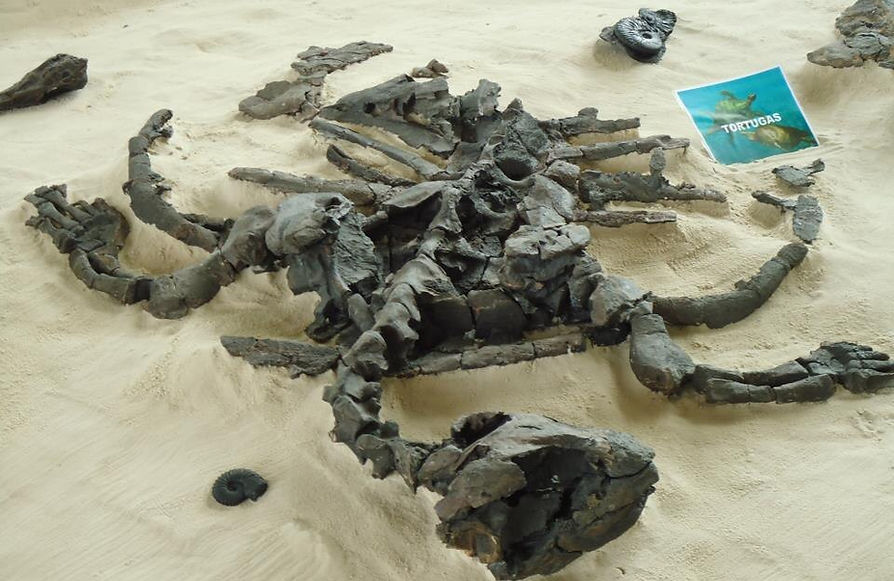
(BELOW) A skeleton of Desmatochelys padillai, a species from the Early Cretaceous of Columbia. These animals would have been some of the earliest animals we would recognize as sea turtles. Photo accessed via Wikimedia Commons and uploaded by user Sernapi, distributed under a CC BY-SA 3.0 license

Kansastega
Temporal Range: ~84 million years ago
Geographic Range: Kansas
Species: K. copei
Diet: Carnivorous, soft-shelled prey, fish, cephalopods, jellyfish
Kansastega was a protostegid sea turtle which was at various times classified within the genera Protostega and Archelon. Later research showed that it had distinctive shell features that warranted recognition as a separate genus. One of the most important differences is that Kansastega did not have the highly reduced costal plates along the sides of the shell that are found in both Protostega and Archelon. Fossils belonging to Kansastega were first described in 1909 under the name Protostega copei. Later studies reassigned it to Archelon, and in 1998 it was given its own genus, Microstega, after it was found that these animals showed significant anatomical differences from other protostegids. However, because the name Microstega had already been assigned to a genus of moths it could not be retained. To correct this problem the replacement name Kansastega was given to it in 2023.

Lophochelys
Temporal Range: ~75 million years ago
Geographic Range: Central North America
Species: L. natatrix
Diet: Carnivorous, soft-shelled prey, fish, cephalopods, jellyfish
Lophochelys was a marine turtle from the Late Cretaceous that belonged to the family Toxochelyidae, a group which also includes animals like Toxochelys. Within this family, Lophochelys is considered to be a part of its own subfamily, Lophochelyinae. While fossil material has suggested that Lophochelys was adapted to life in marine environments, many aspects of its anatomy remain incompletely understood because the available fossil material for this animal is relatively limited. Paleontological research and taxonomic reviews have generally continued to recognize Lophochelys as a member of the Toxochelyidae since its discovery and have retained several species within the genus. It seems to have been a rather small animal, comparable to other smaller toxochelyids rather than the huge sizes reached by some contemporary protostegid turtles. These animals may have been hunted by durophagous sharks such as Ptychodus, as well as shell-crushing mosasaurs.

Porthochelys
Temporal Range: Santonian stage
Geographic Range: Kansas
Species: P. laticeps
Diet: Carnivorous, soft-shelled prey, fish, cephalopods, jellyfish
Porthochelys was among the earlier representatives of the sea turtle lineage and was well adapted to life in the shallow marine environments of the Western Interior Sea. Its shell was broad and roughly circular, a little over three feet across. This shell was sturdy and composed of highly fused plates. This makes its shell much more similarly built to living sea turtles than to those of other Cretaceous marine turtles who tended to have much more lightly-built shell bones. Its fossil remains were found in Kansas and to date it is only known from a very limited number of specimens, although we are lucky enough to have a shell for this animal which is more than half complete and gives us a sense of the general form of these animals.


(BELOW) The remains of the shell, skull and a limb bone of Porthochelys. This genus is known from limited material and this particular fossil at the KU Natural History Museum gives us our best picture of the shape of the shell and skull of this animal.

Prionochelys
Temporal Range: 84 million years ago - 73 million years ago
Geographic Range: Kansas, Alabama
Species: P. matutina, P. galeotergum
Diet: Carnivorous, soft-shelled prey, fish, cephalopods, jellyfish
Prionochelys is an extinct sea turtle which would have had a series of small bony structures, called epineurals, positioned along the dorsal midline of its carapace, a characteristic rarely observed in other turtle groups. These spiny structures give this genus its name, which translates to “saw turtle”. Its fossils are best known from the Mooreville Chalk of Alabama but its remains also turn up in deposits from the Western Interior Sea. Its fossils were first found in 1953 and for many years it was considered to be a close relative of animals like Toxochelys and placed within the family Toxochelyidae. More recent work conducted in the last decade has shown that Prionochelys was actually more closely related to Ctenochelys and Peritresius, leading to its placement within the family Ctenochelyidae. This would make Prionochelys a closer relative of today’s sea turtles than we had previously thought.

Protostega
Temporal Range: 89 million years ago - 80 million years ago
Geographic Range: Kansas, Alabama, central Canada, Russia
Species: P. gigas
Diet: Carnivorous, soft-shelled prey, fish, cephalopods, jellyfish
Protostega was among the largest marine turtles of all time, exceeded only by Archelon. The remains of these turtles were first found in 1871 in a chalk deposit in western Kansas. The species was formally described and named Protostega gigas in 1872 by Edward Drinker Cope. Because the earliest specimens were incomplete, researchers initially struggled to reconstruct the animal accurately. Over time we learned more about the particular shell structures found in many types of Cretaceous sea turtles as well as the extent of skin coverings on the shells of some of these animals. Protostega gave its name to the family Protostegidae, which also includes animals like Archelon and Desmatochelys. These turtles were initially considered close relatives of today’s leatherback sea turtles but further research suggests that they were part of a separate branch of the turtle family tree. Rather than having a heavily ossified carapace like many turtle species, Protostega had a reduced shell structure that likely improved its mobility in the water. The animal also had large forelimbs adapted into powerful flippers, a rather wide shoulder girdle, a very large head and a long hook-shaped beak
(BELOW) A fossil Protostega shell on display at the Sternberg Museum of Natural History. The bones of the plastron are visible on the other side of the ribs. The shell bones of protostegids were less heavily built than those of today's sea turtles.


(BELOW) The fossils of the hind limb bones of a Protostega. In life the femur would be tucked below the animal's shell. Photo taken at the KU Natural History Museum in Lawrence, Kansas

Toxochelys
Temporal Range: 89 million years ago - 66 million years ago
Geographic Range: Central North America, Alabama
Species: T. latiremis, T. moorevillensis
Diet: Carnivorous, soft-shelled prey, fish, cephalopods, jellyfish
Toxochelys was a fairly small Cretaceous sea turtle and by far the most common prehistoric turtle whose fossils are found in deposits from the Western Interior Sea. It would have measured only a little over 3 feet in length, which made it much smaller than giant sea turtles such as Archelon and Protostega. What makes Toxochelys particularly important is its position in sea turtle evolution. It is considered to be a transitional animal that combined ancestral turtle characteristics with adaptations for life in the ocean. Its limbs had already evolved into short swimming paddles, yet the structures of the toe bones within those paddles closely resemble those of earlier semi-aquatic turtles. Toxochelys is considered to be closely related to the common ancestor of most Cretaceous sea turtle genera. Compared with other sea turtles these animals had rather small heads and broad, flat shells. Its plastron is mostly composed of two hourglass-shaped bones fused along the animal’s midline.

(BELOW) A replica skeleton of Toxochelys on display at the Indianapolis Childrens Museum. The digits of the hands and feet of these animals still appear rather similar to those of more basal semi-aquatic turtles despite being encased within flippers
Media Gallery


Suggested References: Sea Turtles
Carrino, M.H. (2007). “Taxonomic comparison and stratigraphic distribution of Toxochelys(Testudines: Cheloniidae) of South Dakota”. pp. 111-132 in Martin, J.E. and Parris D.C. (eds.), The Geology and Paleontology of the Late Cretaceous Marine Deposits of the Dakotas. Geological Society of America, Special Paper 427.
Derstler, K. (1994). “Evolutionary history of sea turtles”. Journal of Vertebrate Paleontology 15(suppl. to no. 3):23A.
Gentry, Andrew D. (2018). "Prionochelys matutina Zangerl, 1953 (Testudines: Pan-Cheloniidae) from the Late Cretaceous of the United States and the evolution of epithecal ossifications in marine turtles". PeerJ. 6 e5876.
Hirayama, R. (1997). “Distribution and diversity of Cretaceous cheloniids”. pp. 225-241 in Callaway, J.M. and Nicholls, E.L. (eds.), Ancient Marine Reptiles, Academic Press, San Diego.
Hooks, G. E., III. (1998). “Systematic revision of the Protostegidae, with a redescription of Carcarichelys gemma” Zangerl, 1957. Journal of Vertebrate Paleontology, 18(1):85-98.
Kear, B.P. (2006). “First gut contents in a Cretaceous sea turtle”. Biological Letters 2:113-115.
Lucas, Spencer G.; Sullivan, Robert M. (2006). “Late Cretaceous Vertebrates from the Western Interior: Bulletin 35”. New Mexico Museum of Natural History and Science.
Matzke, A.T. (2007). “An almost complete juvenile specimen of the cheloniid turtle Ctenochelys stenoporus (Hay, 1905) from the Upper Cretaceous Niobrara Formation of Kansas, USA”. Palaeontology 50(3):669-691.
Matzke, A.T. (2009). “Osteology of the skull of Toxochelys (Testudines, Chelonioidea) (with 25 text-figures). Palaeontographica Abteilung A 288(4):93-150.
McDavid, S. N., & Hooks, G. E. (2023). “Kansastega, nom. nov., a replacement name for Microstega Hooks, preoccupied by Meyrick”. Journal of Vertebrate Paleontology, 43(1).
McIntosh, A. P.; Shimada, K.; Everhart, M. J. (2016). "Late Cretaceous marine vertebrate fauna from the Fairport Chalk Member of the Carlile Shale in southern Ellis County, Kansas, U.S.A." Transactions of the Kansas Academy of Science.