
Plesiosauria

Plesiosaurs in the Great Plains
The plesiosaurs were one of the dominant groups of marine reptiles found in the world’s oceans during the Mesozoic. Their ancestry is somewhat mysterious but they seem to have been related to many other types of marine reptiles who independently became aquatic during the Mesozoic era. It should be noted that plesiosaurs were not closely related to the mosasaurs, another group of marine reptiles who became very successful during the Late Cretaceous and whose fossils are also found in rocks in central North America.
The Western Interior Sea supported a diverse range of plesiosaurs during the Late Cretaceous. The best known members of this group of ocean reptiles are the elasmosaurids, known for their extremely long necks, small heads, cone-shaped teeth and powerful flippers. Species such as Elasmosaurus likely used their long necks to approach schools of fish and squid from below with minimal disturbance. Another important group was the family polycotylidae, which had short necks, long crocodile-like heads, and streamlined bodies. Predators like Dolichorhynchops were adapted for speed and active pursuit of prey, occupying a different ecological niche from the elasmosaurs. The Interior Sea was also home to members of older plesiosaur lineages, such as some of the latest surviving examples of the short-necked pliosaurs. These families filled multiple roles within the ecosystem, from giant hunters with bone-crushing bites to fast-swimming predators.
Anatomy
(BELOW) A labeled diagram of the skeleton of the polycotylid short-necked plesiosaur Dolichorhynchops from Kansas

Skeletal Anatomy
Plesiosaurs came in many different shapes and sizes and their skeletons varied quite a bit depending on their specific ecological roles. Despite this variation many shared broad characteristic features can be seen in the remains of most types of plesiosaurs. Their bodies tended to be wide, streamlined and supported by a sturdy rib cage and a relatively rigid vertebral column that helped give them extra stability while swimming. Plesiosaurs also had a very distinctive neck structure. Their necks were built from dozens of short interlocking cervical vertebrae and the number of neck vertebrae in an animal's neck could vary wildly between species even within a single taxonomic family. Some plesiosaurs had short, muscular necks, while others evolved long and flexible ones. These animals are often shown in older media with coiled snake-like necks but this degree of flexibility does not actually seem to have been attainable for these animals. Even animals with 50 or more cervical vertebrae would have had fairly rigid necks,
The skulls of plesiosaurs were typically equipped with an array of sharp, conical teeth well suited for capturing fish, cephalopods, and other marine prey. Openings at the back of their skulls and along their cheekbones provided attachment points for strong jaw muscles. The pectoral and pelvic girdles around the hip and shoulder regions were heavily built and served as strong anchors for the limbones. All four limbs had developed over time into large, paddle-shaped flippers composed of elongated and flattened bony blocks formed from the bones of the arms and wrists. These limb bones can be generally sorted into two types; propodials (humeri and femurs) and podials (forearm bones, lower leg bones, leg and manus bones). The exact swimming motion that would have been used by these ancient animals is still something of a mystery but they are often shown in media as flapping their foreflippers and hindflippers up and down at opposite intervals.
(BELOW) Some plesiosaurs had skeletons which included dozens of cervical vertebrae in their very long necks.

(BELOW) The waters of the Western Interior Sea were home to both long-necked and short-necked plesiosaurs. The pliosaurs went extinct not long after the Interior Sea first spanned across North America

External Anatomy
Late Cretaceous plesiosaurs included both animals who had very long necks and others who had extremely large skulls and short necks. The top predators of the seas of the early Cretaceous period were the Pliosaurs, a group of plesiosaurs whose heads measured up to a quarter of their entire body length. Elasmosaurids on the other hand tended to have longer necks and fairly small heads while Polycotylid plesiosaurs had medium-sized necks and long toothy snouts.
Pliosaurs (Pliosauroidea)

Large Skulls and Crushing Bites
Pliosaurs were among the most formidable marine reptiles to inhabit the Western Interior Seaway. Unlike their long-necked plesiosaur relatives, pliosaurs had short, powerful necks, massive skulls, and large conical teeth designed for seizing and crushing prey. Their streamlined bodies and four strong flippers made them fast and agile swimmers capable of pursuing large prey. One notable pliosaur from North America was Brachauchenius, an ancient predator from the middle Cretaceous that represented one of the last surviving members of its group. Its robust jaws and strong bite allowed it to occupy the role of an apex predator within the marine ecosystem. Large eyes and keen senses likely helped pliosaurs locate prey in a variety of underwater conditions.

Brachauchenius
Temporal Range: 100 million years ago - 90 million years ago
Geographic Range: Kansas, Morrocco
Species: B. lucasi
Diet: Carnivorous, large prey, fish, sharks, marine reptiles
Brachauchenius was one of the final representatives of the pliosaur lineage. These animals retained many of the adaptations that had made their ancestors successful ocean predators for millions of years during the Jurassic and early Cretaceous periods. Its most notable feature was its large, heavily built head, armed with powerful jaws and sharp, cone-shaped teeth ideal for restraining its prey. Compared to many plesiosaurs, its head was proportionally larger, emphasizing its macropredatory lifestyle.
The history of the discovery of Brachauchenius in the Great Plains began in 1884 when a large marine reptile fossil was uncovered near Delphos, Kansas. The specimen was excavated by fossil collector Charles H. Sternberg with support from paleontologist Othniel Charles Marsh and later preserved in museum collections. In 1903, Samuel W. Williston formally described and named the animal Brachauchenius lucasi, identifying it as a short-necked pliosaur based on its skull, vertebrae, and ribs. This animal seems to have been closely related to another pliosaur, Megacephalosaurus.


(BELOW) A Brachauchenius tooth from the upper Cenomanian Britton Formation of Texas. Fossil collected and original photo taken by Jared Cooke/ jcookepaleo
(BELOW) A photo of the holotype specimen of Brachauchenius lucasi, preserving a skull, cervical and thoracic vertebrae as well as ribs, accessed via Wikimedia Commons, public domain image by the Smithsonian Institute
_p.png)
(BELOW) A view of the holotype specimen of Brachauchenius lucasi in which the lower parts of the skull and the palate are visible. Accessed via Wikimedia Commons, public domain image by the Smithsonian Institute
.png)

Megacephalosaurus
Temporal Range: 93.9 million years ago - 92.9 million years ago
Geographic Range: Kansas
Species: M. eulerti
Diet: Carnivorous, large prey, fish, sharks, marine reptiles
Megacephalosaurus was a genus of pliosaurs whose name translates to “large-headed lizard.” The skull of Megacephalosaurus is among the largest known for a North American pliosaur and would have made up around a fifth of the animal’s total body length
Fossils of Megacephalosaurus were first discovered in 1950 when Frank and Robert Jennrich found a large fossil skull while collecting shark teeth near Fairport, Kansas. The specimen was excavated with the help of paleontologist George F. Sternberg and later donated to the Sternberg Museum of Natural History. Initially, scientists believed the fossil belonged to the pliosaur Brachauchenius lucasi and it remained classified as that species for many years.
Further study revealed important anatomical differences between the skull and known specimens of Brachauchenius. In 2013 paleontologists Bruce Schumacher, Kenneth Carpenter, and Michael Everhart formally described the fossil as a new genus and species, naming it Megacephalosaurus eulerti.
(BELOW) The original holotype skull of Megacephalosaurus eulerti on display at the Sternberg Museum of Natural History, FHSM VP-321. This is the largest skull known for a North American plesiosaur.
.jpg)
(BELOW) A three-dimensional model of the shape of the skull of Megacephalosaurus accounting for taphonomic compression, on display near the entryway of the Sternberg Museum. Model produced by the Rocky Mountain Dinosaur Resource Center
.jpg)
Elasmosaurs (Elasmosauridae)

Plesiosaurs with Extremely Long Necks
Elasmosaurids were some of the most easily recognizable reptiles that inhabited the Western Interior Sea during the Late Cretaceous. Their best known defining feature was an extremely long neck composed of dozens of vertebrae which often made up more than half of the animal’s total body length. This adaptation allowed elasmosaurs to approach prey with their small heads while keeping their large bodies at a distance and hidden in the darkness of the water below, potentially reducing the chance of alarming schools of fish and squid. Unlike the powerful, short-necked pliosaurs that hunted through brute force, elasmosaurs relied on agility and precision. Their four strong, paddle-like flippers provided efficient propulsion, enabling them to swim gracefully through the seaway’s waters. Species such as Elasmosaurus, Styxosaurus, and Thalassomedon were among the most notable members of this family. Although nearly all members of the group had very long necks, fossils show us that they still had a great deal of variation between genera in size and neck proportions, which may have allowed different animals to exploit their own separate niches.

Albertonectes
Temporal Range: 73.5 million years ago
Geographic Range: Alberta
Species: A. vanderveldei
Diet: Carnivorous, small fish, squid
Albertonectes is known from fossils found in Alberta, Canada. This marine reptile is well known for having one of the longest necks ever documented in a plesiosaur. With roughly seventy-six cervical vertebrae, its neck was even more elongated than those of many other well-known elasmosaurids.
The first fossil of Albertonectes was discovered in 2007 during ammolite mining near the town of Lethbridge, Alberta, when workers uncovered the remains of a large marine reptile in layers of rocks falling within the Bearpaw Formation. Although part of the fossil was accidentally damaged during excavation, most of the skeleton was preserved and later transferred to the Royal Tyrrell Museum for study. The specimen consisted of an almost complete skeleton, including 132 vertebrae, portions of the shoulder and pelvic girdles, nearly complete limbs, and numerous gastroliths. In 2012, paleontologists Tai Kubo, Mark Mitchell, and Donald Henderson formally described the fossil as a new species.
(BELOW) A photo of a cluster of stomach stones, or gastroliths, found in association with a skeleton of Albertonectes near the inside of the animal's right, dorsal ribs. Photo by Donald M. Henderson, Sue Sabrowski, accessed via Wikimedia Commons, distributed under a CC BY-NC-SA 4.0 license
.png)

Elasmosaurus
Temporal Range: 80 million years ago - 77 million years ago
Geographic Range: Kansas, possible material known from Germany, Japan
Species: E. platyurus
Diet: Carnivorous, small prey, fish
Elasmosaurus is the namesake of the family elasmosauridae and was one of the first members of this group to be discovered in the 19th century. Although it grew to impressive lengths, Elasmosaurus possessed a relatively small head armed with numerous slender, sharp teeth. These teeth were well suited for gripping fish, squid, and other small marine creatures. Rather than overpowering prey with force it probably relied on swift and accurate strikes to capture its meals. Four large flippers gave these animals the propulsion they needed for efficient swimming and allowed them to maneuver through the waters of the ancient seaway with ease. It may have also had a small diamond-shaped fluke along its tail.
Elasmosaurus was first discovered in 1867 near Fort Wallace, Kansas, by Army surgeon Dr. Theophilus H. Turner. The fossil was excavated and transported to Philadelphia, where it was studied by paleontologist Edward Drinker Cope. In 1868, Cope named the animal Elasmosaurus platyurus but mistakenly reconstructed the skeleton with the head attached to the tail. This famous error was later corrected and became a well-known episode in the rivalry between Cope and Othniel Charles Marsh during the Bone Wars.

Libonectes
Temporal Range: 93 million years ago
Geographic Range: Northern Texas, Morocco
Species: L. morgani, L. atlasense
Diet: Carnivorous, small fish, squid
Libonectes was a genus of elasmosaurid plesiosaur whose remains are found in parts of Texas and Morocco. It seems to have been a close relative of Thalassomedon. When compared with related genera such as Thalassomedon, Libonectes had taller neural spines on the back of its vertebrae and more elongated supporting structures. It also had nostrils positioned slightly farther forward on its skull. Another noteworthy feature of Libonectes is the preservation of gastroliths, or stomach stones, within some fossil specimens. These stones are fairly common in well-preserved fossil skeletons of elasmosaurs and they may have been used to regulate the animal’s buoyancy as it swam through the water.

(BELOW) A photo of the holotype skull of Libonectes morgani from the Late Cretaceous of Texas. Photo by Kenneth Carpenter, accessed via Wikimedia Commons, distributed under a CC BY-NC-SA 4.0 license
.jpg)
(BELOW) A photo of the skull of the Moroccan species Libonectes atlasense, which has a full set of interlocked teeth. Photo by Benjamin P. Kear, Dennis Larsson, Johan Lindgren, Martin Kundrát, accessed via Wikimedia Commons, distributed under a CC BY 2.5 license


Nakonanectes
Temporal Range: 73 million years ago
Geographic Range: Montana
Species: N. bradtii
Diet: Carnivorous, small fish, squid
Nakonanectes an elasmosaurid that lived towards the end of the Late Cretaceous. Fossils discovered in Montana's Bearpaw Formation indicate that it was among the last known elasmosaurids to live in North America. Nakonanectes is especially distinctive because of its relatively short neck. The animal’s neck contained only about 39 to 42 cervical vertebrae. This is considerably fewer than the number found in many classic long-necked elasmosaurids, some of which had 60 cervical vertebrae. This shortened neck would have given it a noticeably different body profile and probably hints at a different type of ecological niche for this animal.
Nakonanectes was also fairly small when compared to some of its relatives. It would have only reached an estimated length of roughly 5 to 6 meters, half as long as other elasmosaurids. The species is also known from an unusually well-preserved skull, allowing scientists to study several unique characteristics of its head and jaws which most famously include its distinctive shortened snout.
(BELOW) A photo of the holotype skull of Nakonanectes from the Bearpaw Shale. Photo accessed via Wikimedia Commons, uploaded by user Montanaceratops, distributed under a CC BY-NC-SA 4.0 license


Plesioelasmosaurus
Temporal Range: 94.3 million years ago - 89.3 million years ago
Geographic Range: Kansas
Species: P. walkeri
Diet: Carnivorous, small prey, fish
Plesioelasmosaurus was an elasmosaurid that lived in the Western Interior Seaway during the Late Cretaceous. Fossils discovered in Kansas suggest that these would have been a type of marine reptile with a body plan that blended features seen in both early and more specialized elasmosaurids. Although it had the long neck typical of the group, its neck was a bit shorter in proportion than those of highly specialized forms such as Elasmosaurus. The first fossils belonging to this animal were found in 1931 near Holyrood, Kansas. It was informally known as the “Holyrood elasmosaur” for many years before it was finally assigned to its own new genus and species in 2022.

Styxosaurus
Temporal Range: 100 million years ago - 72 million years ago
Geographic Range: Kansas, South Dakota, Nebraska
Species: S. snowii, S. brownii, S. rezaci
Diet: Carnivorous, small fish, squid
Styxosaurus is a famous member of the elasmosaurid family of plesiosaurs. Despite the fact that elongated necks were a defining feature of many elasmosaurids, Styxosaurus belonged to a lineage that developed some of the longest necks known among vertebrates. In addition to its remarkable neck length, it would have had a unique shape to its skull, including forms of ridges and jaw structures that help separate it from closely related elasmosaurs. In 1890, Samuel W. Williston described the original fossils of Styxosaurus, which consisted of a skull and associated neck vertebrae from Kansas, under the name “Cimoliasaurus snowii”. The species was later reassigned to Elasmosaurus before Samuel P. Welles erected the genus Styxosaurus in 1943. Additional fossils from across the area once covered by the Western Interior Sea were subsequently attributed to the genus. A lot of what we know about more famous animals like Elasmosaurus itself is based on knowledge gained from the study of far more complete fossils of Styxosaurus.

(BELOW) The holotype skull of Styxosaurus snowii, KUVP 1301, on display at the KU Natural History Museum

Terminonatator
Temporal Range: 72 million years ago
Geographic Range: Saskatchewan
Species: T. ponteixensis
Diet: Carnivorous, small fish, squid
Terminonatator was one of the last of the elasmosaurids. Its name translates to “last swimmer,” which reflects its position among the later representatives of the long-necked plesiosaur lineage. Although it shared the characteristic elongated neck of other elasmosaurids, it would have had some anatomical features that made it unique within the group, namely having slightly fewer teeth at the front of its mouth. It also had an unusually long femur which may have extended the length of its flippers. This may have helped it navigate both coastal and open-water environments. Like other elasmosaurids, it had a small skull and slender, sharp teeth well suited for capturing fish and soft-bodied prey.
Terminonatator’s first fossils were discovered in the Bearpaw Formation of Alberta, Canada, a rock unit famous for preserving marine reptiles from the final stages of the Western Interior Sea as it began to retreat again at the very end of the Cretaceous period.
Thalassomedon
Temporal Range: 99.6 million years ago - 93.5 million years ago
Geographic Range: Colorado
Species: T. haningtoni
Diet: Carnivorous, small fish, squid
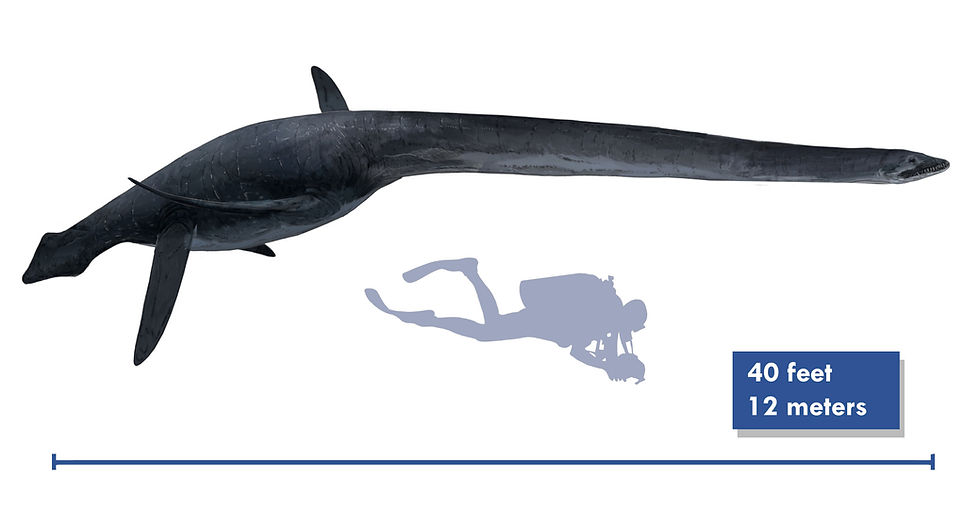
Thalassomedon was among the largest members of the elasmosaurid family to live in the Western Interior Sea. Its name means “sea ruler,” and adults of this genus could reach lengths of more than 40 feet. One of its most distinctive traits was that it had a long neck even for an elasmosaurid, composed of roughly 60 vertebrae.
Thalassomedon was discovered in 1939 when fossil bones were exposed by erosion in a layer of shale in a cliff near Pritchett, Colorado. The remains were first spotted by a man named Fred Roth, who called in local paleontologists and geologists to look at his find. Although some bones had been disturbed before scientists arrived, a large portion of the skeleton was successfully recovered from the surrounding rocks, which fell within the Graneros Shale formation. The fossil was later studied by paleontologist Samuel P. Welles, who described and named the new species Thalassomedon haningtoni in 1943.

Wapuskanectes
Temporal Range: 112 million years ago
Geographic Range: Alberta
Species: W. betsynichollsae
Diet: Carnivorous, small fish, squid
Wapuskanectes was one of the earliest known members of the elasmosaurid group on the North American continent. Fossils of these animals were discovered in the Early Cretaceous rocks of the Clearwater formation in Alberta, Canada where it would have lived long before famous later elasmosaurids such as Elasmosaurus, Albertonectes, and Libonectes. It is known from fossils of parts of its spine, shoulder bones and flippers. Like many other types of elasmosaurids from the Western Interior Sea it was found in association with stomach stones, or gastroliths.
(BELOW) A photo of a Wapuskanectes skeleton found near the town of Ft. McMurray, Alberta. Photo credit: Sue Sabrowski, Donald Henderson, Royal Tyrrell Museum of Palaeontology. accessed via Wikimedia Commons, distributed under a CC BY-NC-SA 4.0 license
.png)
Leptocleidids (Leptocleididae)
Early Cretaceous Plesiosaurs
The leptocleidids were a family of plesiosaurs that lived in parts of the Western Interior Sea during the early Cretaceous. Unlike the giant long-necked elasmosaurids, leptocleidids were generally smaller and more compact in build. They had relatively short necks and robust muscular bodies. One of the most unusual aspects of leptocleidids was their apparent adaptation to shallow coastal environments. Rather than living exclusively in open oceans, they may have moved through estuaries, bays, and nearshore waters. Their strong flippers and streamlined bodies would have allowed them to maneuver efficiently in these habitats while hunting fish and other smaller aquatic prey.

Nichollssaura
Temporal Range: 110 million years ago
Geographic Range: Alberta
Species: N. borealis
Diet: Carnivorous, small fish, squid
Nichollssaura was a member of the family leptocleididae, a more basal family of plesiosaurs than animals like the elasmosaurids. While some plesiosaur groups evolved into large, long-necked marine reptiles, Nichollssaura remained relatively compact at only about 9.5 feet long. Its body proportions also differed from those of the famous elasmosaurids. Nichollssaura had a shorter neck and a proportionally larger head, giving it a more heavily-built appearance. Another characteristic that sets Nichollssaura apart is its geological age. These animals lived during the early part of the Cretaceous period, when the Western Interior Sea had yet to span across the entire North American continent as it would a few million years later. Nichollsaurua is also known from a rather complete fossil specimen containing around 160 gastroliths, or stomach stones, a very high number even for a Cretaceous plesiosaur, whose fossils are often found with associated gastroliths.
Polycotylids (Polycotylidae)

Polycotylids in the Western Interior Sea
Polycotylid plesiosaurs were highly specialized marine reptiles that inhabited the Western Interior Sea during the Late Cretaceous. Unlike the classic long-necked plesiosaurs, they typically had short necks, large heads, long snouts and streamlined bodies that made them efficient swimmers and active predators. Their four powerful flippers provided them with a great deal of speed and maneuverability which would have allowed them to pursue fast-moving prey such as fish and cephalopods. Long narrow jaws lined with sharp, conical teeth helped them capture slippery animals in open-water environments. Fossils of important genera, including Dolichorhynchops and Polycotylus, have been found in the chalk deposits of Kansas and nearby regions. One of the most significant discoveries was a Polycotylus specimen containing an embryo, providing evidence that these reptiles gave birth to live young. This rare fossil added a lot to scientists’ understanding of plesiosaur reproduction and suggests that polycotylids were fully adapted to a marine lifestyle.

Dolichorhynchops
Temporal Range: 87 million years ago - 72 million years ago
Geographic Range: Kansas, Saskatchewan, possible material from Russia
Species: D. osborni, D. herschelensis
Diet: Carnivorous, fish, squid
Dolichorhynchops is probably the best known genus of polycotylid. The history of Dolichorhynchops research began around 1900, when George F. Sternberg discovered the holotype specimen in the Smoky Hill Chalk of Kansas. The fossil was collected with the assistance of his father, Charles H. Sternberg, and was later described and named by Samuel W. Williston in 1902. These animals were mid-sized members of the polycotylid family and examples of their fossils can be seen on display at the KU Natural History Museum and the Sternberg Museum of Natural History.
(BELOW) A skeleton of Dolichorhynchops on display at the KU Natural History Museum. The skull on the mount is a model but the original skull is displayed next to the skeletal mount. See below for a more detailed image.
.jpg)
(BELOW) The skull of Dolichorhynchops which is connected to the skeleton in the picture above, photo taken at the KU Natural History Museum. The skull has been somewhat compressed while it was fossilized within a layer of chalk.


Edgarosaurus
Temporal Range: 100 million years ago
Geographic Range: Montana
Species: E. muddi
Diet: Carnivorous, fish, squid
Edgarosaurus was one of the earliest known members of the polycotylid family. While it shared the characteristic short neck and large skull of polycotylids, its head and neck together accounted for an unusually large percentage of its overall body length. The fused front section of the lower jaw contained only six pairs of teeth, fewer than in many related polycotylids and its teeth were large, sturdy and fang-like. This suggests it would have had a feeding strategy different from that of some of its relatives, although the exact implications of these differences in dentition are not certain. Additional distinguishing features included a small pineal opening near the rear of the skull, a nearly vertical back of the cranium, and unusually short, broad bones in its forelimbs.
Our understanding of Edgarosaurus comes from a single well-preserved specimen discovered in 1993 in the Thermopolis Shale of Montana. The fossil included a complete skull, a series of neck vertebrae, parts of the backbone, and most of one front paddle. After careful study, paleontologist Patrick Druckenmiller determined that the specimen represented a previously unknown genus and formally named Edgarosaurus muddi in 2002. The genus was named after the nearby town of Edgar, Montana. Because no additional specimens have been described, the holotype remains the primary source of information about this important early polycotylid.

Martinectes
Temporal Range: 80.5 million years ago - 78 million years ago
Geographic Range: Wyoming
Species: M. bonneri
Diet: Carnivorous, fish, squid
Martinectes was a large and distinctive polycotylid plesiosaur that differed from many of its relatives through its robust build and considerable size. Although it shared the short neck and elongated skull common among advanced polycotylids, it was larger than many related genera and possessed strong, interlocking conical teeth adapted for catching fish and other slippery prey. It was initially thought to have been a species of either Dolichorhynchops or Trinacromerum.
The fossils of Martinectes have undergone a complex history of classification. Specimens from the Pierre Shale of Wyoming were first described as “Trinacromerum bonneri”. Later research reassigned the species to Dolichorhynchops in 2008 after comparisons with other polycotylids. Continued study of the skull and skeleton revealed additional unique features eventually leading to the establishment of the new genus Martinectes in 2023.

Pahasapasaurus
Temporal Range: 90 million years ago
Geographic Range: South Dakota
Species: P. haasi, P. gillettei
Diet: Carnivorous, fish, squid
Pahasapasaurus was a polycotylid whose fossils were discovered in South Dakota, as well as a second species recognized from Utah. The scientific history of Pahasapasaurus traces back to 1934, when Charles Haas and his son Arthur uncovered a plesiosaur skeleton in the Black Hills of South Dakota while searching for shark teeth. The specimen was excavated and eventually donated to the local museum in the town of Deadwood. For many years, researchers identified the fossil as part of a different genus, Trinacromerum. However, renewed study during a restoration project in the 1990s revealed important anatomical differences. Paleontologists subsequently determined that the specimen represented a previously unknown genus and formally described Pahasapasaurus haasi in 2007. The name honors both the Black Hills region and the discoverer of the fossil, Charles Haas.

Plesiopleurodon
Temporal Range: 98 million years ago
Geographic Range: Wyoming
Species: P. wellesi
Diet: Carnivorous, fish, squid, ocean reptiles
Plesiopleurodon was a type of polycotylid which was originally thought to have been a part of the pliosaur group owing to its strange proportions which differed significantly from those of other polycotylids. The skulls of these animals were huge and their necks were very short. It also had fewer teeth in the front portion of the lower jaw than many related plesiosaurs. In addition, the skull preserved several ancestral features, including a robustly attached quadrate bone and a backward-sloping profile. These characteristics initially led paleontologists to note similarities with the Jurassic pliosaur Liopleurodon although this has since been determined to be a case of convergent evolution. The scientific history of Plesiopleurodon is based on a very limited number of fossil remains. The genus was established by paleontologist Kenneth Carpenter in 1996 from a specimen discovered in Cretaceous-aged rocks of Wyoming. The material known from this animal includes a nearly complete skull and lower jaws, associated vertebrae, and a part of the shoulder elements.

Polycotylus
Temporal Range: 83.6 million years ago
Geographic Range: Kansas, Alabama, Russia
Species: P. latipinnis
Diet: Carnivorous, fish, squid
Polycotylus is among the most thoroughly studied of all polycotylids. While it shared many characteristics with other polycotylids, including a streamlined body, large skull, and strong flippers, Polycotylus had a greater number of neck vertebrae than many of its kin which is a trait associated with earlier long-necked plesiosaurs. It is also distinguished by its elongated hip bones, robust teeth marked by a unique banded texture, a narrow upper palate, and a low sagittal crest along the top of the skull behind the eyes. These characteristics allow paleontologists to differentiate Polycotylus from other members of its family.
Scientific investigation of Polycotylus began in 1869 when Edward Drinker Cope described the genus from fragmentary remains discovered in the Niobrara Chalk of Kansas. Additional and more complete specimens found later helped researchers develop a clearer understanding of its anatomy and evolutionary relationships. One key discovery was that of a Polycotylus specimen preserving a fetus within the body cavity of an adult. The developing animal was quite large compared with the size of the parent, which would suggest a long gestation period similar to those of today’s whales.
(BELOW) A photo of a Polycotylus skeleton preserved with the remains of a fetal skeleton in its abdominal cavity, marked with a white triangle. Fossil on display at the LA County Museum. Photo credit: Jonathan Chen. accessed via Wikimedia Commons, distributed under a CC BY-NC-SA 4.0 license


Serpentisuchops
Temporal Range: 70 million years ago
Geographic Range: Wyoming
Species: C. crassidens, C. gracilodens
Diet: Carnivorous, fish, squid,
Serpentisuchops was a polycotylid which appeared to combine aspects of long-necked plesiosaurs and other shorter-necked polycotylids. It had a very elongated neck and a long, narrow snout. Most advanced polycotylids evolved a body plan characterized by large heads, streamlined jaws, and shortened necks. In contrast Serpentisuchops retained a neck with roughly 32 cervical vertebrae while also possessing the elongated jaws typical of its relatives. Paleontologists have proposed that Serpentisuchops may have used rapid side-to-side strikes of its head and neck to capture fish and other agile marine animals. The fossil record of Serpentisuchops is centered on a single important specimen discovered in 1995 within the Pierre Shale of Wyoming. The fossil, designated GPM 5001, includes portions of the skull, lower jaws, vertebral column, and pelvic bones. Although the remains were collected decades earlier, they were not formally studied and named until 2022.

Trinacromerum
Temporal Range: 93 million years ago
Geographic Range: Kansas, Manitoba, Alabama
Species: T. bentonianum, T. kirki
Diet: Carnivorous, small fish, squid
Trinacromerum was a smaller member of the polycotylid family. It would have had an elongated, narrow snout equipped with numerous fine, needle-like teeth, which were ideal for seizing small fish. Although it shared the short-necked body plan typical of polycotylids, Trinacromerum appears to have been particularly well adapted for speed, thanks to its long, powerful flippers and streamlined build. These features could have possibly allowed it to pursue agile prey in open water rather than relying on ambush tactics. Its anatomy suggests that it occupied a niche as an active predator within the Western Interior Seaway, where quick movement and maneuverability would have been important advantages.
Unktaheela
Temporal Range: 80 million years ago
Geographic Range: Wyoming, South Dakota
Species: U. specta
Diet: Carnivorous, fish, squid
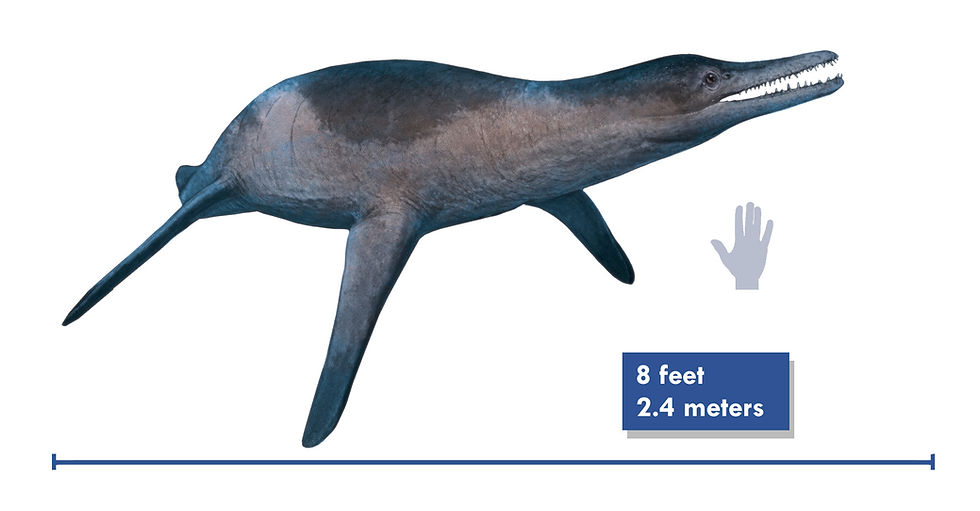
Unktaheela was a small polycotylid with an estimated length of only 8.5 feet, which means that it is considered the smallest known member of its family. Its skull had rather large eye sockets, prominent ridges surrounding the eyes, and broad bony shelves above the orbits that may have reduced glare from sunlight. These characteristics suggest that Unktaheela relied heavily on vision while hunting and may have specialized in pursuing prey in brightly lit surface waters. The scientific study of Unktaheela is relatively recent. Fossils from Wyoming and South Dakota were initially assigned to the genus Dolichorhynchops, and one specimen was described in 1996 as a juvenile individual of that same taxon. Later research demonstrated that these remains represented a distinct genus. In 2023 the genus Untkaheela was named based on two skulls and some additional associated material from other parts of the skeleton.
Media Gallery


Suggested References: Plesiosauria
Angst, Delphine; Bardet, Nathalie (2016). "A new record of the pliosaur Brachauchenius lucasi Williston, 1903 (Reptilia: Sauropterygia) of Turonian (Late Cretaceous) age, Morocco". Geological Magazine. 153
Carpenter, K. (1996). “A review of the short-necked plesiosaurs from the Cretaceous of the Western Interior, North America”. Nues Jahrbuch für Geologie und Paläontologie, Abhandlungen, (Stuttgart), 201(2):259-287.
Carpenter, K. (1999). "Revision of North American elasmosaurs from the Cretaceous of the western interior". Paludicola. 2 (2): 148–173.
Everhart, M. J. (2002). “New data on plesiosaur remains found as stomach contents of a Tylosaurus proriger (Squamata; Mosasauridae) from the Niobrara Formation of western Kansas”. (Abstract) Transactions of the Kansas Academy of Science
Everhart, M.J. (2004). “New data regarding the skull of Dolichorhynchops osborni (Plesiosauroidea: Polycotylidae) from rediscovered photos of the Harvard Museum of Comparative Zoology specimen”. Paludicola 4(3):74-80.
Everhart, M.J. (2000). “Gastroliths associated with plesiosaur remains in the Sharon Springs Member of the Pierre Shale (late Cretaceous), Western Kansas”. Kansas Acad. Sci. Trans. 103(1-2):58-69.
Everhart, M. J. (2005). “Bite marks on an elasmosaur (Sauropterygia; Plesiosauria) paddle from the Niobrara Chalk (Upper Cretaceous) as probable evidence of feeding by the lamniform shark, Cretoxyrhina mantelli”. PalArch, Vertebrate paleontology 2(2): 14-24.
Fischer, V; Benson, R. B. J.; Druckenmiller, P. S.; Ketchum H. F.; Bardet N.(2018). "The evolutionary history of polycotylid plesiosaurians". Royal Society Open Science. 5 (3) 172177.
Ketchum, H. F. & Benson, R. B. J. (2010). "Global interrelationships of Plesiosauria (Reptilia, Sauropterygia) and the pivotal role of taxon sampling in determining the outcome of phylogenetic analyses". Biological Reviews. 85 (2): 361–392
Lucas, Spencer G.; Sullivan, Robert M. (2006). “Late Cretaceous Vertebrates from the Western Interior”: Bulletin 35. New Mexico Museum of Natural History and Science.
Madzia, D; Sachs, S; Lindgren, J. (2018). "Morphological and phylogenetic aspects of the dentition of Megacephalosaurus eulerti, a pliosaurid from the Turonian of Kansas, USA, with remarks on the cranial anatomy of the taxon". Geological Magazine. 156
McIntosh, A. P.; Shimada, K.; Everhart, M. J. (2016). "Late Cretaceous marine vertebrate fauna from the Fairport Chalk Member of the Carlile Shale in southern Ellis County, Kansas, U.S.A." Transactions of the Kansas Academy of Science.
O'Keefe, F. R.; Sander, P. M.; Wintrich, T.; Werning, S. (2019). "Ontogeny of Polycotylid Long Bone Microanatomy and Histology". Integrative Organismal Biology. 1
O'Keefe, F. R.; Chiappe, L. M. (2011). "Viviparity and K-selected life history in a Mesozoic marine plesiosaur (Reptilia, Sauropterygia)". Science. 333 (6044): 870–873.
Russell, D. A. (1988). “A check list of North American marine Cretaceous vertebrates including fresh water fishes”. Royal Tyrrell Museum
Sato, Tamaki (2003). "Terminonatator ponteixensis, a new elasmosaur (Reptilia: Sauropterygia) from the Upper Cretaceous of Saskatchewan". Journal of Vertebrate Paleontology. 23 (1): 89–103.
Schumacher, B. A., (2007), “A new polycotylid plesiosaur (Reptilia; Sauropterygia) from the Greenhorn Limestone (Upper Cretaceous; lower upper Cenomanian), Black Hills, South Dakota”: In: The Geology and Paleontology of the Late Cretaceous marine deposits of the Dakotas, The Geological Society of America, Special Paper 427, p. 133-146.
Schumacher, B.A., Carpenter, K. and Everhart, M.J. (2013). “A new Cretaceous Pliosaurid (Reptilia, Plesiosauria) from the Carlile Shale (middle Turonian) of Russell County, Kansas”, Journal of Vertebrate Paleontology 33(3):613-628
Schumacher, B.A. (2008). “On the skull of a pliosaur (Plesiosauria; Pliosauridae) from the Upper Cretaceous (Early Turonian) of the North American Western Interior” Kansas Academy of Science, Transactions 111(3-4):203-218.
Serratos, D.J.; Druckenmiller, P.; Benson, R.B.J. (2017). "A new elasmosaurid (Sauropterygia, Plesiosauria) from the Bearpaw Shale (Late Cretaceous, Maastrichtian) of Montana demonstrates multiple evolutionary reductions of neck length within Elasmosauridae".
Smith, E.A.; O'Keefe, F.R. (2023). "Occurrence of Styxosaurus (Sauropterygia: Plesiosauria) in the Cenomanian: Implications for relationships of elasmosaurids of the Western Interior Seaway". Journal of Systematic Palaeontology. 21
Storrs, G.W. (1999). “An examination of Plesiosauria (Diapsida: Sauropterygia) from the Niobrara Chalk (upper Cretaceous) of central North America”. The University of Kansas Paleontological Contributions, (N. S.), No. 11, 15 pp.
Taylor, M. A. (1993), “Stomach stones for feeding or buoyancy? The occurrence and function of gastroliths in marine tetrapods”. Phil. Trans. Royal Society London. B 341:163-175.
Zhao, R. J. (2026). "Body reconstruction and size estimation of plesiosaurs". PeerJ. 14