
Echinoderms

Starfishes, Sea Urchins and Brittle Stars
Echinodermata is a group of marine invertebrates which includes animals like sea stars, brittle stars, sea urchins, sand dollars, sea cucumbers, and feather stars. The name “echinoderm” means “spiny skin,” which refers to rough surfaces or spines commonly present on their bodies. Adult echinoderms usually have bodies organized radially with five symmetrical sections arranged around a central point, while their larvae are bilaterally symmetrical. Echinoderms have a skeleton which is built from calcium carbonate structures known as ossicles. They also have an internal system which pumps water through their bodies in order to fill small fluid-filled canals and, in some groups, mobile tube feet. Changes in fluid pressure can make these tube feet stretch out, working together to produce a sort of walking motion. Some echinoderms are fully mobile while others attach themselves to a hard surface or to the loose substrate of the ocean floor. Echinoderm fossils, particularly those of crinoids, are common in deposits from the Paleozoic era but turn up less often in deposits from the Western Interior Sea. Most extant groups of echinoderms had already appeared on the scene by the Late Cretaceous and the most common echinoderm group known from these rock layers are the echinoids, or sea urchins.
(Browse by class)
Sea Urchins (Class Echinoidea)
Codiopsis
Cottaldia
Goniopygus
Cassidulus
Echinobrissus
Nucleolites
Globator
Tetragramma
Crassiholaster
Holaster
Anorthopygus
Holectypus
Gauthiera
Phymosoma
Goniophorus
Salenia
Hemiaster
Heteraster
Holanthus
Mecaster
Micraster
Dunnicrinus
Lakotacrinus
Uintacrinus
Astrocratis
Betelgeusia
Coulonia
Brittle Stars (Class Ophiuroidea)
Brezinacantha
Sea Lilies (Crinoidea)
Temporal Range: ~480 million years ago - Present
Diet: Filter feeders: plankton
Genera in the Western Interior Sea: Lakotacrinus, Uintacrinus, Dunnicrinus
Crinoids are marine echinoderms structured with a cup-shaped central body, known as the calyx, surrounded by flexible arms bearing many smaller filament-like branches called pinnules. These feather-like structures trap plankton and other suspended food particles before moving them through feeding grooves toward their mouths. Sea lilies are anchored to the ocean floor by a structure called a column. Some types of crinoids, like the extinct Cretaceous genus Uintacrinus or the living feather stars, are free-swimming and are not connected to the seafloor.

(ABOVE) Crinoid genera of the Western Interior sea: (A) Lakotacrinus, (B) Uintacrinus, (C) Dunnicrinus

(ABOVE) Detail of a slab containing many fossils of Uintacrinus on display at the KU Natural History Museum. Two crinoids have been shaded in order to show their constituent elements
Starfishes (Asteroidea)
Temporal Range: ~450 million years ago - Present
Diet: Active predator, small fish, invertebrates
Genera in the Western Interior Sea: Coulonia, Astrocratis, Betelgeusia
Starfishes are a type of benthic echinoderm whose bodies are structured as a central disc surrounded by five or more arms. Rows of tube feet line the underside of the body of the starfish and can move the body of the animal by changing the pressure of the seawater passing through an attached vascular system. These tube-feet help the starfish travel, grip surfaces, detect its surroundings, and handle food. Most sea stars hunt invertebrates living on the ocean floor. Some species digest prey by extending their stomach outside their bodies. They also have an internal calcium-based skeleton and can usually regrow injured or missing arms.
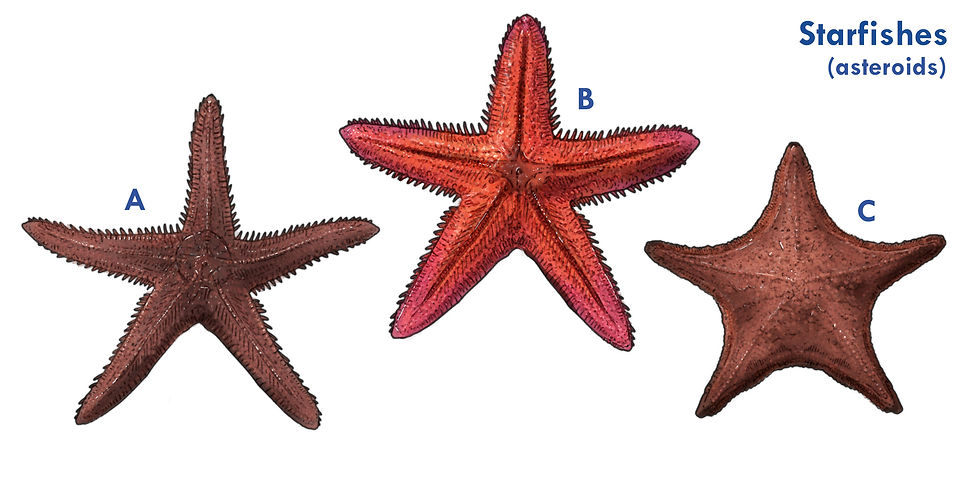
(ABOVE) Starfish genera found in the Western Interior Sea: (A) Coulonia, (B) Astrocratis, (C) Betelgeusia
Brittle Stars (Ophiuroidea)
Temporal Range: ~488 million years ago - Present
Diet: Scavengers, carrion, organic detritus
Genera in the Western Interior Sea: Brezinacantha
Brittle stars, or Ophiuroids, are echinoderms who have five narrow, highly flexible arms extending from a distinct central disc. By twisting and sweeping these segmented arms, they can travel rapidly across the ocean floor. Their tube feet do not have suckers and are mostly used to detect the animal’s surroundings and to gather food. Brittle stars feed on plankton and any type of organic detritus they find on the seafloor. They have longer and more flexible arms than sea stars.

(ABOVE) The genus Brezinacantha known from deposits found in the Western Interior Sea.

(ABOVE) A collection of Ophiura brittle star fossils found in the early Cenomanian Grayson Formation of Texas, fossils collected and image taken by Jared Cooke/ jcookepaleo

(ABOVE) A version of the photo of the brittle star deathbed with the fossils outlined in red. Fossils collected and image taken by Jared Cooke/ jcookepaleo
Sea Urchins (echinoids)
Temporal Range: ~465 million years ago - Present
Diet: Algae, small slow-moving or stationary invertebrates
Order in the Western Interior Sea: Arbacioida, Cassiduloida, Echinoneoida, Euechinoida, Holasteroida, Holectypoida, Phymosomatoida, Salenioida, Spatangoida
Sea urchins are marine members of the echinoderm class Echinoidea. Their rounded bodies are protected by a hard internal shell known as a test, which is built from a series of fused calcium carbonate plates. This structure is covered with spines which help to defend the animal and support its movement. The sea urchin’s tube feet can move in and out of small pores in the test to allow the animal to move slowly over the seafloor. The mouth of the sea urchin is found on the lower side of the body and holds a special organ called an Aristotle’s lantern which is used to scrape food off of rocks. Most of the fossils of sea urchins known from areas which were once covered by the Western Interior Sea are fossils of the tests of these ancient echinoids.

(ABOVE) Cretaceous echinoids of the order Arbacoida: (A) Codiopsis, (B) Cottaldia, (C) Goniopygus

(ABOVE) Cretaceous echinoids of the order Cassiduloida: (A) Cassidulus, (B) Echinobrissus, (C) Nucleolites

(ABOVE) The genus Globator, an echinoid from the early and Late Cretaceous of Texas and New Mexico

(ABOVE) The genus Tetragramma from the Late Cretaceous of Texas

(ABOVE) Cretaceous echinoids of the order Holasteroida: (A) Holaster, (B) Crassiholaster

(ABOVE) Cretaceous echinoids of the order Holectypoida: (A) Anorthopygus, (B) Holectypus

(ABOVE) Cretaceous echinoids of the order Phymosomatoida: (A) Gauthiera, (B) Phymosoma

(ABOVE) Cretaceous echinoids of the order Salenioida: (A) Goniophorus, (B) Salenia

(ABOVE) Cretaceous echinoids of the order Spatangoida: (A) Heteraster, (B) Micraster, (C) Mecaster, (D) Hemiaster, (E) Holanthus
Gallery: Sea Urchin Fossils


Suggested References: Echinoderms
Everhart, M. J. "Notes on Uintacrinus socialis Grinnell" https://www.oceansofkansas.com/Uintacrinus.html
Williston, S. W. (1894). “Notes on Uintacrinus socialis Grinnell”. Kansas University Quarterly, 3(1):19-21 (includes note by B. H. Hill).
Everhart, M.J. (2017). “Oceans of Kansas - A Natural History of the Western Interior Sea, Second Edition”. Indiana University Press, 460 pp.
Voultsiadou, Eleni; Chintiroglou, Chariton (2008). "Aristotle's lantern in echinoderms: an ancient riddle" (PDF). Cahiers de Biologie Marine. 49 (3). Station Biologique de Roscoff: 299–302.
Aaron W. Hunter, Neal L. Larson, Neil H. Landman, Tatsuo Oji; Lakotacrinus brezinai n. gen. n. sp., a new stalked crinoid from cold methane seeps in the Upper Cretaceous (Campanian) Pierre Shale, South Dakota, United States. Journal of Paleontology 2016;; 90 (3): 506–524.