
Bivalves

Clams, Mussels, and Oysters
Bivalves are a class of mollusks whose bodies are enclosed within two shells or valves. These animals have specialized gill structures which are also used to grab ahold of food to help them filter feed. Their shells are mostly made of calcium carbonate but in some animals, elements of their shells are occasionally composed of other minerals, such as aragonite. The two halves of the body of the bivalve are joined at a point called a hinge which is fastened by a strong ligament which allows the shells to open and close. In many types of bivalves, a large lower soft tissue element called a foot protrudes outside of the animal’s valves and can be used to burrow or to help the bivalve move along the seafloor. Bivalves are also some of the oldest groups of extant invertebrates and their fossil record stretches all the way back to the early Cambrian period.
Anatomy
Shell Structure
Bivalves have two hard shells, or valves, connected along their dorsal margins by a hinge mechanism. The hinge includes a ligament and a series of interlocking teeth that keep the valves aligned while allowing them to open and close. Powerful adductor muscles are attached to the inner shell surface, and their points of attachment leave oval-shaped scars on each side of the shell. Between these scars there is a shallow groove on the inside of the shell called the pallial line. This line marks the edge of the internal soft mantle of the bivalve. The shell itself is built from a series of layers, each with their own particular composition. The outer protective covering, known as the periostracum, is built from a protein called conchiolin and shields the shell from environmental wear and chemical damage. Beneath this is the main structural part of the shell, composed of calcium carbonate. In some species, the innermost layer of the shell is made of a substance called nacre, which makes the inside of the shell appear iridescent. The outside surface of the shell is usually marked by a series of concentric growth lines. The outer shell can further be covered in vertical ribs, like those seen in scallops. Along the dorsal edge of each valve the oldest area on the shell and the first growth rings surround a small elevated point called the umbo, which is usually positioned above the hinge of the bivalve.

Shell Variation
Bivalves in the Western Interior Sea came in many forms, some of which would be familiar to our eyes, while other extinct groups would seem very strange to us. Among the most distinctive bivalves found in these ancient environments were the rudists, a group of bivalves which were unique to the Mesozoic era and whose shells were shaped like cylinders, cones or crescents. Rudists were some of the main reef-building animals during the Cretaceous period. Fossilized corals are rather rare in deposits from the Interior Sea but we have a huge array of fossils representing large accumulations of rudist colonies along parts of the seafloor. Inoceramid clams would also have been a common sight in these ancient seaways, some of which could grow to be more than eight feet wide. Most of these unique bivalve groups went extinct at the end of the Cretaceous period but many groups whose fossils are known from Cretaceous rocks, such as the true mussels, cockles, ark clams and oysters, managed to survive to the present day. Most bivalves are suspension feeders but the exact shapes of their shells are determined by their strategies for catching food. Some bivalves are somewhat mobile and can move along the seafloor in search of places to burrow. Others are completely stationary and will cement themselves to rocks, driftwood or other types of harder substrates, even forming reef-like colonies of thousands of bivalves living in the same area.
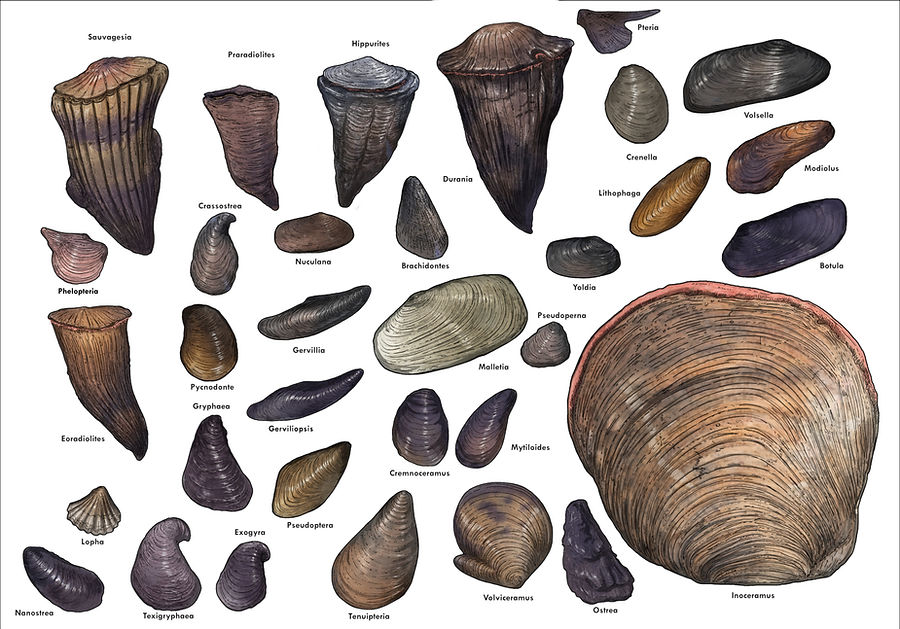


(Browse by order)
Leptosolen
Panope
Panopea
Siliqua
Anatyma
Cuspidaria
Geniomya
Laternula
Pholadomya
Psilomya
Breviarca
Cuculea
Idonearca
Limopsis
Parallelodon
Protarca
Callistina
Cardium
Cyclorisma
Nelltia
Protocardia
Protodonax
Solyma
Tancredia
Tellina
Tellinimera
Trachycardium
Crassatella
Opis
Venericardia
Durania
Eoradiolites
Hippurites
Proradiolites
Sauvagesia
Clissocolus
Ctena
Lucina
Nympholucina
Sexta
Cremnoceramus
Inoceramus
Myalinida
Mylitoides
Volviceramus
Caryocorbula
Corbula
Opertochasma
Parmicorbula
Pholas
Ursirivus
Brachidontes
Botula
Crenella
Lithophaga
Modiolus
Volsella
Malletia
Nuculana
Yoldia
Acila
Nucula
Crassostrea
Exogyra
Gervilliopsis
Gryphaea
Lopha
Nanostrea
Pseudoperna
Pycnodonte
Tenuipteria
Texigryphaea
Phelopteria
Pteria
Anomia
Lima
Pecten
Plicautula
Neithea
Syncyclonema
Solemya
Trigonia
Arctica
Callistina
Corbicula
Cyclorisma
Cyprimeria
Dentonia
Flaventia
Legumen
Adapedonta
Temporal Range: 460 million years ago - Present
Diet: Suspension feeder, plankton, algae
Lifestyle: Burrowers, mobile
Adapedonta is the order which includes today’s razor clams. They are typically found in saltwater environments and many species prefer to live very close to the shoreline. They often burrow into the sand using the “foot” section of their bodies, while it uses its siphon to pull in water and food. Their diets are primarily composed of plankton. Most members of this order have long, thin shells or oval/trapezoidal shells.

(ABOVE) Cretaceous bivalves of the order Adapedonta: A. Panopea, B. Panope, C. Siliqua, D. Leptosolen
Gallery: Adapedonta - click to expand images


Anomalodesmata
Temporal Range: 480 million years ago - Present
Diet: Suspension feeder, plankton, algae, occasionally copepods
Lifestyle: Stationary and mobile forms, some are burrowers
The superorder Anomalodesmata is best represented in the Cretaceous fossil record of the Western Interior Sea by the members of the family Laternulidae, also known as the lantern clams, as well as the superfamily pholadomyoidea. These animals share some basic behavioral similarities with razor clams, as they sit below the substrate of the seafloor with their siphons exposed above the sand or muddy surface in order to draw in food. Lantern clams have long, thin, roughly oval-shaped shells whose umboes protrude somewhat from the surfaces of the valves around the hinges. In living genera the outsides of the shells of these bivalves are usually mostly white in color, occasionally with some darker spots.

(ABOVE) Cretaceous bivalves of the superorder Anomalodesmata, A. Anatymia, B. Laternula, C. Geniomya, D.Cuspidaria, E. Pholadomya, F. Psilomya
Gallery: Anomalodesmata - click to expand images


Arcida
Temporal Range: 484 million years ago - Present
Diet: Suspension feeder, plankton, algae
Lifestyle: Stationary and mobile forms, some are burrowers
Arcida is the order of bivalves which includes ark clams, false ark clams and bittersweets. The outside texture of their valves varies widely between families. Limopsids have mostly smooth outer valve surfaces, ark shells and their relatives have horizontal ridges running along the outsides of their valves, and parallelodontids have vertical ridges on their shells. These animals are mostly found in saltwater environments. Some are capable of forming burrows.

(ABOVE) Cretaceous bivalves of the order Arcida, A. Breviarca, B. Idonearca, C. Cucculea, D. Parallelodon, E. Protarca, F. Limopsis
Gallery: Arcida - click to expand images


Cardiida
Temporal Range: 450 million years ago - Present
Diet: Suspension feeder, plankton, algae
Lifestyle: Stationary and mobile forms, some are burrowers
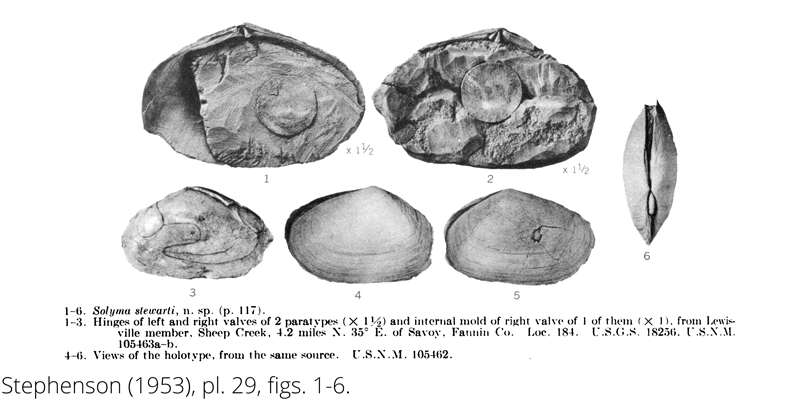
Cardiida is the order of bivalves which includes cockles, bean clams, wedge shells, tellin clams, and venus clams. Their shells vary in shape, some are oval, some are heart-shaped, others, as with many bean clams, are almost triangular. They are usually smooth with some families exhibiting some very faint horizontal ridges on the outsides of their valves, but others can have very prominent vertical ribs similar to those of scallops, as is the case with many cockles. Members of this genus prefer saltwater habitats but some are found very near the shoreline.

(ABOVE) Cretaceous bivalves of the order Cardiida, A. Trachycardium, B. Cardium, C. Sourimis, D. Cyclorisma, E. Protocardia,
F. Tancredia, G. Linearia, H. Nelltia, I. Solyma, J. Tellinimera, K. Callistina, L. Tellina, M. Protodonax
Gallery: Cardiida- click to expand images



Carditida
Temporal Range: 480 million years ago - Present
Diet: Suspension feeder, plankton, algae
Lifestyle: Mobile, some are burrowers
Cariditida is an order of bivalves usually found in marine habitats. Members of this order have rounded, trapezoidal or triangular shells. Some members of this group have smooth shells or shells with strong horizontal or concentric ribbing. Members of the family Carditidae have very strong vertical ribbing which makes them appear very similar to scallops. Members of this group are often fairly mobile and some are capable of forming burrows.

(ABOVE) Cretaceous bivalves of the order Carditida, A. Opis, B. Crassatella, C. Venericardia
Gallery: Carditida- click to expand images


Hippuritida
Temporal Range: ~152 million years ago - 66 million years ago
Diet: Suspension feeder, plankton, algae
Lifestyle: Stationary, anchored to seafloor
Hippuritida is an extinct order of bivalves who are better known as rudists. Rudists were bivalves who took on a distinctive tube-like shape. In many Cretaceous forms, one cylindrical or cone-shaped valve formed the lower portion of the animal’s outer body, while the other valve formed a roughly circular “lid” which covered the animal’s soft internal body. Other shapes are also known from these animals, including some whose valves would each have formed half of a crescent-shaped body plan. Some of these animals could grow to be very large, well over 4 feet across in some cases. Rudists first appear in the fossil record of the late Jurassic period and by the Cretaceous period they were abundant enough to form large reefs composed of their shells. They disappeared during the mass extinction at the end of the Cretaceous period.

(ABOVE) Cretaceous bivalves of the order Hippuritida, A. Sauvagesia, B. Proradiolites, C. Hippurites, D. Durania, E. Eoradiolites
Gallery: Hippuritida- click to expand images


Lucinida
Temporal Range: ~445 million years ago - Present
Diet: Suspension feeder, plankton, algae
Lifestyle: Mobile, some are burrowers
An order of bivalves which includes cleft clams and hatchet shells. Their shells are usually rounded, deep, and sometimes trapezoidal. Some families have valves which are very wide and dome-shaped. Members of this order are burrowing suspension feeders who feed on plankton.

(ABOVE) Cretaceous bivalves of the order Lucinida, A. Lucina, B. Nympholucina, D. Ctena, E. Clissocolus, C. Sexta
Gallery: Lucinida - click to expand images


Myalinida
Temporal Range: 478 million years ago - ~10 million years ago
Diet: Suspension feeder, plankton, algae
Lifestyle: Stationary, attached to seafloor
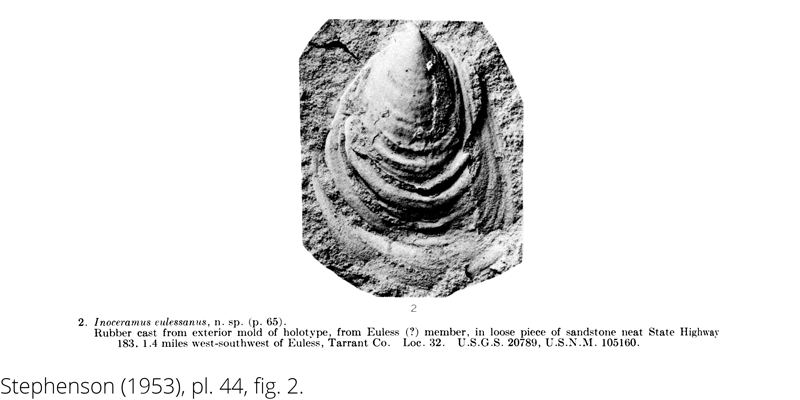
Myalinida is an extinct order of bivalves which includes the giant inoceramid clams. Their shells are mostly smooth, although some exhibit low horizontal ridges. The largest members of this group had shells which were longer than a fully grown person. In some parts of the Niobrara Chalk formation, their shells are extremely common, although they are rarely preserved intact.

(ABOVE) Cretaceous bivalves or the order Myalinida, A. Mylitoides, B. Cremnoceramus, C. Inoceramus, D. Volviceramus
Gallery: Myalinida - click to expand images


Myida
Temporal Range: ~320 million years ago - present
Diet: Suspension feeder, plankton, algae
Liftstyle: Mostly stationary, some are burrowers
An order of bivalves which includes shipworms, softshell clams and their relatives. They are found in saltwater habitats and are almost exclusively burrowing animals with soft, somewhat flexible shells and pronounced siphons. In some members of this group, such as shipworms, the shell is extremely reduced and most of the animal’s body is exposed. Some genera live by burrowing into driftwood.

(ABOVE) Cretaceous bivalves of the order Myida, A. Ursirivus, B. Corbula, C. Caryocorbula, D. Parmicorbula,
E. Pholas, F. Opertochasma
Gallery: Myida - click to expand images


Mytilida
Temporal Range: ~480 million years ago - present million years ago
Diet: Suspension feeder, plankton, algae
Lifestyle: Stationary
Mytilida is an order of bivalves which includes sea mussels and all true mussels. They have valves which are somewhat asymmetrical and attach themselves to rocks or other surfaces using a web of filamentous structures called a byssus. They often form in large groups where substrates permit them to do so and they are found in both marine and estuarine habitats. Most of their shells are oval or otherwise elongated in their shape.

(ABOVE) Cretaceous bivalves of the order Mytilida, A. Volsella, B. Crenella, C. Modiolus, D. Brachidontes,
E. Lithophaga, F. Botula
Gallery: Mytilida - click to expand images


Nuculanida
Temporal Range: 485 million years ago - Present
Diet: Suspension feeder, plankton, algae
Lifestyle: Mobile, most are burrowers
Nuculanida is an order of small saltwater clams. Many members of this group are less than a centimeter long. They tend to have smooth, elongated shells which are either oval or trapezoidal in shape. Their shells are thin-walled and composed of the mineral aragonite. Some smaller forms appear translucent and may have an iridescent appearance.

(ABOVE) Cretaceous bivalves of the order Nuculanida, A. Malletia, B. Yoldia, C. Nuculana
Gallery: Nuculanida - click to expand images


Nuculida
Temporal Range: ~480 million years ago - Present
Diet: Suspension feeder, plankton, algae
Lifestyle: Mobile, slow-moving
Nuculida is an order of small saltwater clams which includes nut clams and their closest relatives. Many members of this group are very good burrowers and tend to live in areas with very fine sand or mud on the seafloor. Their shells are rounded, oval-shaped, or nearly triangular with rounded edges. Some genera have ornamentation on the outsides of their valves, horizontal ridges and/or vertical ribs, which can sometimes give their outer surfaces a crosshatched appearance. Most of their shells have a layer of nacre on the inside.

(ABOVE) Cretaceous bivalves of the order Nuculida, A. Nucula, B. Acila
Gallery: Nuculida - click to expand images


Ostreida
Temporal Range: ~480 million years ago - Present
Diet: Suspension feeder, plankton, algae
Lifestyle: Stationary, cemented to rocks, wood or substrate
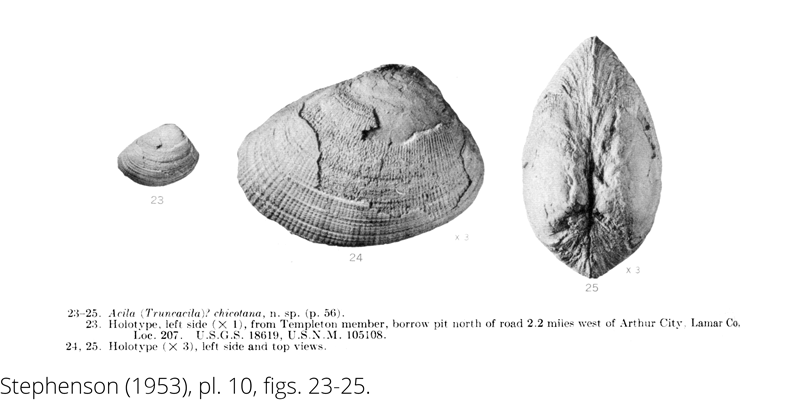
Ostreida is the order of bivalves which includes true oysters and honeycomb oysters. The outsides of their valves usually have a rough bark-like texture. Bivalves in this order tend to grow with their shells cemented to a hard surface, such as a rock, a larger shell or a piece of driftwood. Large groups of these animals can form coastal reefs.

(ABOVE) Cretaceous bivalves of the order Ostreida, A. Crassostrea, B. Gervillia, C. Ostrea, D. Lopha, E. Texigryphea,
F. Pycnodonte, G. Gervilliopsis, H. Nanostrea, I. Gryphaea, J. Pseudoperna, K. Pseudoptera, L. Exogyra, Tenuipteria
Gallery: Ostreida - click to expand images


Pectinida
Temporal Range: ~470 million years ago -Present
Diet: Suspension feeder, plankton, algae
Lifestyle: Stationary, most attach themselves to substrate or to solid objects
Pectinida is an order of bivalves which includes most types of animals commonly referred to as scallops as well as kittenpaws and jingleshells. These animals live in both brackish and saltwater habitats. Most extant members of this group are able to attach themselves to a substrate but some Cretaceous members of this order are unable to do so. In some families, namely the true scallops, the outsides of the shells are covered in very pronounced vertical ribs. Other groups, like jingleshells, have smoother shells or shells with an uneven pavement of divots and ridges.

(ABOVE) Cretaceous bivalves of the order Pectinida, A. Lima, B. Pecten, C. Neithea, D. Anomia, E. Syncyclonema, F. Plicautula
Gallery: Pectinida - click to expand images


Pteriida
Temporal Range: ~460 million years ago - Present
Diet: Suspension feeder, plankton, algae
Lifestyle: Stationary, cemented to rocks, wood or substrate
Pteriida is an order of bivalves which includes pearl oysters and pen shells. The bivalves in this group come in many different shapes. Some have long, thin shells shaped like flattened cones, others have long wing or spike-like projections on the outsides of their valves near their hinges. Like the bivalves in the order Ostreida, these bivalves attach themselves firmly to the seafloor by cementing themselves beside rocks or the outsides of larger shells.

(ABOVE) Cretaceous bivalves of the order Pteriida, A. Phelopteria, B. Pteria
Gallery: Pteriida- click to expand images


Solemyida
Temporal Range: 483 million years ago - Present
Diet: Suspension feeder, plankton, algae
Lifestyle: Mobile
The order Solemyida includes the bivalves commonly known as awning clams. Their shells are usually long and oval in shape and they are found in both shallow and deep water marine habitats. The members of this group are typically burrowing bivalves who are able to tunnel into soft substrate using an enlarged lower foot structure. Some members of this order have shells with shallow vertical ribs issuing outwards from the area around the umbo.

(ABOVE) Cretaceous bivalves of the order Solemyida, A. Solemya
Trigoniida
Temporal Range: ~415 million years ago - Present
Diet: Suspension feeder, plankton, algae
Lifestyle: Mobile
Trigoniida is an order of marine saltwater clams whose members have a lot of variation in their shapes and ornamentation. Some members of this order are superficially similar to scallops, with several families known to have pronounced vertical striations along their shells. The hinge teeth of many of the members of this order are particularly elaborate. In some extinct genera, one larger valve will encompass the second smaller valve. The members of this group were mostly known from fossil material until the discovery of living examples of Trigoniid clams off the coast of Australia during the 19th century.

(ABOVE) Cretaceous bivalves of the order Trigoniida, A. Trigonia
Gallery: Trigoniida - click to expand images


Venerida
Temporal Range: ~450 million years ago - Present
Diet: Suspension feeder, plankton, algae
Lifestyle: Mobile
Venerida is an order of clams which includes animals which are found in both saltwater and freshwater habitats. Members of this group include venus clams, duck clams and kelly clams. They tend to have smooth shells with limited ornamentation aside from their growth lines. Their shells are usually oval or trapezoidal in shape.
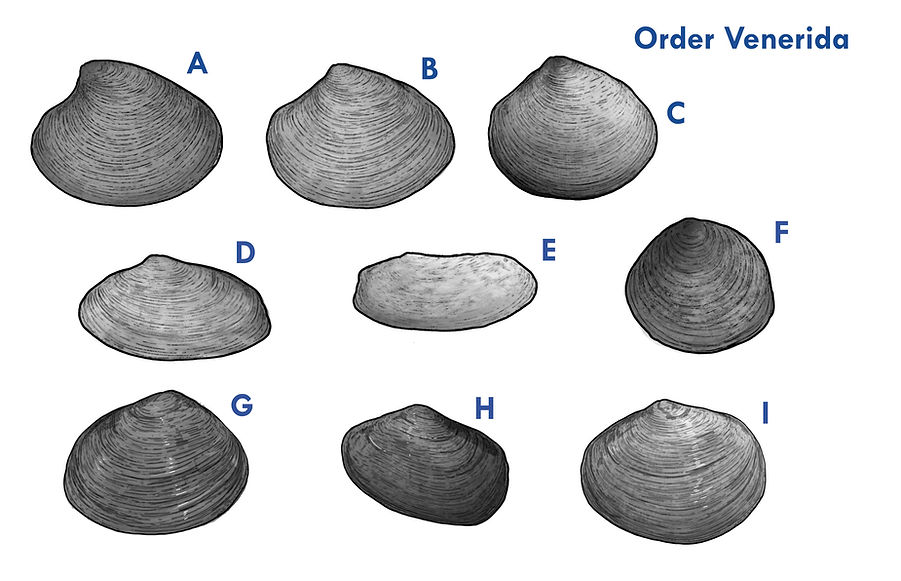
(ABOVE) Cretaceous bivalves of the order Venerida; A. Callistina, B. Flaventia, C. Cyclorisma, D. Sinonia, E. Legumen, F.Cyprimeria, G. Dentonia, H. Arctica, I. Corbicula
Gallery: Venerida - click to expand images


Suggested References: Bivalves
Cox, L. R. et al. (1969). “Bivalvia”, in R. C. Moore ed., Treatise on Invertebrate Paleontology, Part N, Mollusca 6, Volume 2. The University of Kansas and Geological Society of America. 1224 pp.
Crampton, J.S. (2004). “Shell composition, cryptic costae, complex composite molds and taphonomic chicanery in Mytiloides (Inoceramidae, Bivalvia).” Journal of Paleontology 78(6):1091-1096.
Digital Atlas of Ancient Life. (n.d.). “Bivalvia”. Cretaceous Atlas of Ancient Life | Bivalvia. https://www.cretaceousatlas.org/classes/bivalvia/
Everhart, M.J. "Inoceramids" Oceans of Kansas website: http://oceansofkansas.com/Inoceramids.html
Everhart, M.J. (2017). “Oceans of Kansas - A Natural History of the Western Interior Sea, Second Edition.” Indiana University Press, 460 pp.
Selden, P. A., ed. (2009). “Treatise on Invertebrate Paleontology. Part L, Mollusca 4, Revised, vol. 2.” The University of Kansas Paleontological Institute. Lawrence, Kansas
Hattin, D. E. (1988).” Rudists as historians; Smoky Hill Member of Niobrara Chalk (upper Cretaceous) of Kansas”, Fort Hays Studies, Third Series, 10:4-22.
Henderson, R. (2004). “A Mid-Cretaceous association of shell beds and organic-rich shale: Bivalve exploitation of a nutrient-rich, anoxic sea-floor environment.” Palaios, 19(2):156-169.
Stephenson, L.W., & Stenzel, H.B. (1952). Larger invertebrate fossils of the Woodbine formation (Cenomanian) of Texas, with Decapod Crustaceans from the Woodbine formation of Texas.
Stewart, J.D. (1990). “Niobrara Formation symbiotic fish in inoceramid bivalves. p. 31-41 In S. Christopher Bennett (ed.), 1990 Society of Vertebrate Paleontology Niobrara Chalk excursion guidebook”. Museum of Natural History and the Kansas Geological Survey, Lawrence, Kansas