
Arthropods

Crustaceans and Horseshoe Crabs
The fossils of aquatic arthropods, including crabs, lobsters, barnacles and horseshoe crabs, sometimes turn up in deposits left behind by the Western Interior Sea. These animals shared a few common arthropod characteristics, including segmented bodies, jointed limbs, and outer exoskeletons composed of a material called chitin. Decapods, the group containing crabs, lobsters, and similar ten-legged animals went through a diversification event during the Cretaceous period and many more familiar forms of these animals appear in the fossil record around this time. Some remains of horseshoe crabs which appear very similar to their living relatives are also found in layers of sedimentary stone formed in nearshore environments. Arthropod remains are sometimes incomplete because their exoskeletons could separate after death or be discarded during the molting process. Most arthropod groups are fully mobile animals but in the case of some crustaceans such as gooseneck barnacles, the adult forms of these organisms attach themselves to a hard surface such as a rock or a piece of driftwood.
(Browse by class, order)
Horseshoe crabs (Order Xiphosura)
Limulus
Clam shrimp (Superorder Diplostraca)
Cyzicus
Cytherella
Barnacles (Subclass Ciripedia)
Stramentum
Ghost shrimp (Familly Callianassidae)
Protocallianassa
Prawns (Suborder Dendrobranchiata)
Penaeus
Spiny lobsters (Infraorder Achelata)
Linuparis
Panulirus
Rugafarius
Lobsters (Infraorder Astacidae)
Hoploparia
True crabs (Infraorder Brachyura)
Horseshoe Crabs (Xiphosura)
Temporal Range: 480 million years ago - Present
Diet: Benthic carnivore/scavenger, fish, invertebrates
Genera in the Western Interior Sea: Limulus
Horseshoe crabs are marine arthropods that are more closely related to other chelicerates like spiders and scorpions than they are to true crabs. A tough, horseshoe-like or crescent-shaped exoskeleton protects their bodies, which consist of three sections: the prosoma, opisthosoma, and telson. The prosoma holds the eyes, mouth, and legs, while the opisthosoma carries movable spines and five pairs of book gills used to breathe underwater. The long telson is a sharp spine on the rear part of the animal. This structure is not venomous or used for stinging. Instead it helps with steering and allows the animal to flip itself over when it ends up lying upside down. They spend most of their lives at sea but will come ashore in order to lay their eggs.

(ABOVE) The genus Liumulus, the same genus as the extant horseshoe crab which is also found in Cretaceous deposits
Crustaceans
Crustaceans are a very diverse order of arthropods which includes animals like isopods, ostracods, lobsters and crabs. Their clearest diagnostic feature is the presence of two pairs of antennae, including one shorter set called the antenulles. A crustacean’s segmented body is generally divided into the head, thorax, and abdomen, similar to what is seen in insects. In some species the head and thorax unite to form a cephalothorax which is often protected by a shell or carapace. Their bodies are supported by a hard, chitinous exoskeleton that must be molted and shed as the animal grows. Aquatic crustaceans usually take in oxygen through their gills, but many forms of crustaceans have independently adapted to spend extended periods of time on land, and some groups have even become fully terrestrial.
Clam Shrimp (Diplostraca)
Temporal Range: ~410 million years ago - Present
Diet: Microscopic filter feeder/carnivore, tiny plants and animals
Genera in the Western Interior Sea: Cyzicus
Clam shrimps are branchiopod crustaceans whose bodies are protected by a hinged shell made of two valves, giving them a clam-like appearance. Despite this feature and their resemblance to their namesake clams, clam shrimps are still crustaceans rather than bivalve mollusks. They have a series of feathery legs which stick out slightly from the edges of their shells. They also use a specialized set of antennae to push themselves forward when swimming. They are able to seal the valves of their shells closed when they feel threatened. Today these animals usually live in shallow freshwater ponds and temporary pools, although in the distant past these animals seem to have been able to live outside of ephemeral environments and may have survived as fully marine organisms. Many living species endure dry conditions by laying eggs which can stay dormant in the sediment until water returns.
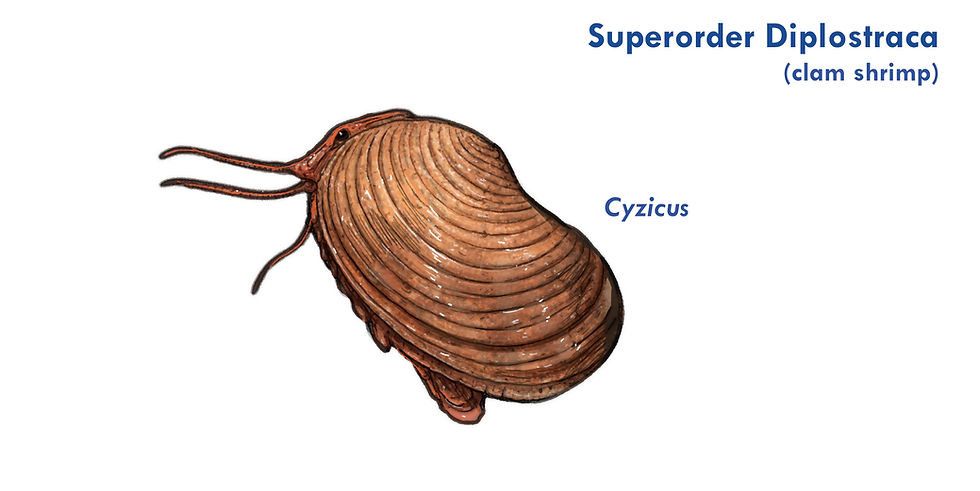
(ABOVE) The clam shrimp genus Cyzicus is a genus whose shells are found in Cretaceous deposits but which is also found living in ephemeral pool environments today
Seed Shrimp (Ostracoda)
Temporal Range: ~460 million years ago - Present
Diet: Detritivore, bacteria, algae, mold, other organic waste
Genera in the Western Interior Sea: Cytherella
Ostracods, often known as seed shrimp, are microscopic crustaceans whose bodies are surrounded by a hinged shell consisting of two valves. This carapace is mostly made of chitin reinforced with calcium carbonate. The presence of this layer of calcium carbonate allows these small animals to fossilize more easily than some other types of microinvertebrates. Although their shells resemble those of tiny clams, ostracods have jointed limbs like most other arthropods, as well as antennae which they use when they are swimming, crawling, and/or detecting their surroundings.

(ABOVE) The ostracod genus Cytherella. These animals are generally quite small, less than 1/2 a millimeter long.
Barnacles (Cirripedia)
Temporal Range: ~320 million years ago - Present
Diet: FIlter feeder, Plankton
Genera in the Western Interior Sea: Stramentum
Cirripedia the subclass of crustaceans that contains barnacles. Most adult barnacles remain firmly attached to rocks, shells, or driftwood once they have fully matured. Their bodies are usually surrounded by a hard calcified mantle. Their feather-like limbs called cirri reach through the shell opening to collect plankton and suspended organic material as part of their suspension-feeding process. Although adults are stationary, their larvae swim freely before selecting a surface and becoming attached. Acorn barnacles fasten directly to surfaces, while goose barnacles attach themselves to surfaces along flexible stalks. Gooseneck barnacles, like the genus Stramentum, are the best represented group of barnacles known from deposits formed by the Western Interior Sea.

(ABOVE) The genus Stramentum is the most common barnacle found fossilized in the Western Interior Sea. As a gooseneck barnacle it would have been connected to a hard surface by a tube of softer tissue which is rarely preserved.
Decapods (Decapoda)
Temporal Range: ~376 million years ago - Present
Diet: Includes active predators, scavengers, detritivores
Genera in the Western Interior Sea: Protocallianassa, Penaeus, Panulirus, Rugafarius, Linuparis, Hoploparia, Cenomanocarcinus, Dakoticancer, Necrocarcinus, Hoplitocarcinus, Zygastrocarcinus, Heus, Raninella, Dromiopsis, Dioratiopus, Xanthosia, Plagiophthalmus
Decapods are a group of crustaceans who are named for their tendency to have ten legs. Many members of this group, including crabs, lobsters and ghost shrimp, have limbs which have transformed over time into chelae, or claws, of various sizes. In some other lineages, like the spiny lobsters, the five pairs of legs remain roughly the same size while their antennae grow to be quite large. The segmented bodies of decapods consist of a cephalothorax, formed by the fused head and thorax, and a rear, often segmented, section called an abdomen. A rigid carapace covers the cephalothorax and protects the organs and gills beneath.
A series of smaller appendages called pleopods which can be found on the lower surfaces of the tails of some decapods are used to help these animals swim. In some forms of shrimp, spiny lobsters and true lobsters, the muscular sections of their abdomens end in tail fans formed by the telson and uropods. These structures are used to help these animals steer themselves through the water. In crabs, the abdomen is generally reduced and folded beneath the cephalothorax. This abdominal reduction is a feature found in true brachyuran crabs as well as several groups of anomuran “false crabs”.

(ABOVE) The genus Protocallianassa from the Late Cretaceous. Note the asymmetrical claws

(ABOVE) The genus Penaeus, an extant genus also known from the Late Cretaceous of Kansas. Like many types of prawns these animals have prominent pleopods on their ventral surfaces

(ABOVE) Spiny lobsters of the Western Interior Sea: (A) Panulirus, (B) Linuparis, (C) Rugafarius

(ABOVE) The genus Hoploparia, a Late Cretaceous lobster. These animals had a fairly wide geographic distribution and could grow to be as large as some extant lobsters.

(ABOVE) Types of crabs found in the Western Interior Sea. Remains from these animals are fairly rare in deposits from
central North America
Crab Genera
Family Dakoticancridae: Dakoticancer
Family Cenomanocarcinidae: Cenomanocarcinus
Family Homolidae: Hoplitocarcinus, Zygastrocarcinus, Plagiophthalmus?
Family Raninidae: Heus, Raninella
Family Longodromitidae: Dioratiopus
Family Necrocarcinidae: Necrocarcinus
Family Dromiidae: Dromiopsis
Family Xanthidae: Xanthosia
Suggested References: Arthropods
Digital Atlas of Ancient Life. (n.d.). Maxillopoda. Cretaceous Atlas of Ancient Life | Maxillopoda. https://www.cretaceousatlas.org/classes/maxillopoda/
Digital Atlas of Ancient Life. (n.d.). Branchiopoda. Cretaceous Atlas of Ancient Life | Branchiopoda. https://www.cretaceousatlas.org/classes/branchiopoda/
Digital Atlas of Ancient Life. (n.d.). Malacostraca. Cretaceous Atlas of Ancient Life | Malacostraca. https://www.cretaceousatlas.org/classes/malacostraca/
Dunlop, J. A., Penney, D. & Jekel, D. (2013). “A summary list of fossil spiders and their relatives”. In Platnick, N. I. (ed.) The world spider catalog, version 14.0
Everhart, M.J. (2017). “Oceans of Kansas - A Natural History of the Western Interior Sea,” Second Edition. Indiana University Press, 460 pp.
Newman, W. A. et al., 1969. Cirripedia in Moore, R. C., ed., “Treatise on Invertebrate Paleontology, Part R, Arthropoda 4(1), Volume 1”. The University of Kansas and Geological Society of America. 398 pp.
Schweitzer, C.E.; Feldmann, R.M. (2001). "New Cretaceous and Tertiary decapod crustaceans from western North America". Bulletin of the Mizunami Fossil Museum. 28: 173–210.
Sammy De Grave; N. Dean Pentcheff; Shane T. Ahyong; et al. (2009). "A classification of living and fossil genera of decapod crustaceans" (PDF). Raffles Bulletin of Zoology. Suppl. 21: 1–109.