
Ichthyosauria

Ichthyosaurs of the Western Interior Sea
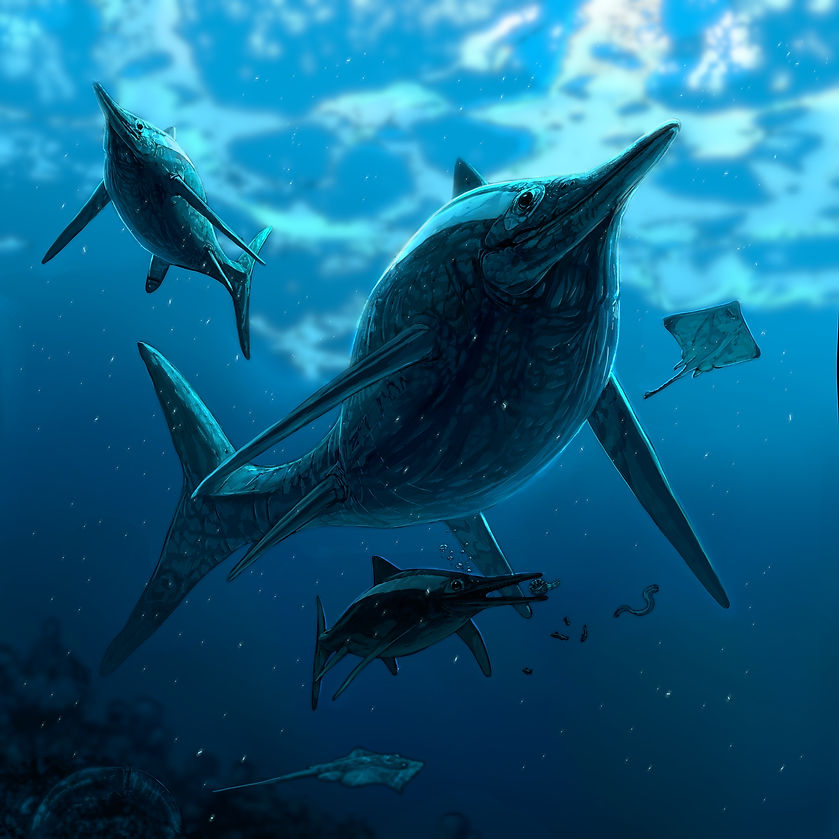
Ichthyosaurs were a group of marine reptiles whose streamlined bodies closely resembled those of modern dolphins. They had shark-like tail flukes, paddle-shaped limbs and often also had exceptionally large eyes that helped them to hunt effectively in low-light underwater environments. Unlike most reptiles, ichthyosaurs were viviparous, giving birth to live young in the ocean rather than laying eggs on land. During the Cretaceous Period, many of the surviving ichthyosaurs belonged to the platypterygiine lineage, a subgroup of ophthalmosaurid ichthyosaurs who managed to live on long after most other types of ichthyosaurs had long since gone extinct.
Evolutionary History
(BELOW) A group of large Ichthyosaurs has washed ashore during the late Triassic. During the mass extinction event at the end of this period, most of the larger types of ichthyosaurs would die out and vanish from the fossil record.

An Ancient Group of Marine Reptiles
Ichthyosaurs were one of the first major groups of reptiles to become fully adapted to life in the ocean. Their evolutionary history begins all the way back during the Early Triassic shortly after the end-Permian mass extinction. The terrestrial ancestors of this group gradually acquired a range of aquatic adaptations, first becoming semi-aquatic and then eventually fully marine animals. Throughout the middle and late Triassic period ichthyosaurs diversified dramatically. They developed their dolphin-like streamlined bodies and became important predators in marine ecosystems. Some species, including Shonisaurus, evolved enormous sizes and ranked among the largest marine reptiles of the era, growing to be larger than some of today’s sperm whales. Some of these ancient giants may have even evolved specialized jaw structures used for filter feeding. Ichthyosaur sizes reached their peak towards the end of the Triassic period but most of the larger groups of ichthyosaurs died out during the end-Triassic extinction event.
The animals who made it through to the Jurassic period were generally smaller and more heavily built than the large, slender ichthyosaurs of the late Triassic period. They remained a key part of the ocean food web as generalists and even large macropredators all the way through the Jurassic, although they faced increased competition from other types of marine reptiles such as plesiosaurs. Although ichthyosaur diversity declined during the Cretaceous, the group continued to be represented by advanced members of the subfamily Platypterygiinae before they disappeared completely during the early part of the late Cretaceous.
(BELOW) A fossil preserving the remains of the Cretaceous Ichthyosaur Maiaspondylus was found alongside the bones of two ichthyosaur embryos. These animals were unable to leave the water to lay eggs and so they instead gave live birth at sea.
Platypterygiines (Platypterygiinae)
The Last of the Ichthyosaurs
Platypterygiines were a distinctive subgroup of ichthyosaurs that were some of the last Ichthyosaurs to exist before their extinction during the middle Cretaceous period. These animals are often grouped together based on the square-shaped tooth roots, specialized limb structures, and broad, powerful pectoral fins often seen in the members of the platypterigiine lineage. These adaptations likely helped them occupy a variety of predatory niches in Cretaceous marine ecosystems, msotly as soft-prey specialists. During the middle Cretaceous, North American seas were home to several platypterygiine taxa of various sizes, whose fossil remains are found in deposits located in Canada and Wyoming dating to a time before the two halves of the Interior Sea had fully joined together.

Athabascasaurus
Temporal Range: 112.6 million years ago - 109 million years ago
Geographic Range: Alberta
Species: A. bitumineus
Diet: Carnivorous, fish, squid
Athabascasaurus was an ichthyosaur that measured around 11 feet long which would have made it a medium-sized marine predator within the Cretaceous seas of North America. Its first fossils were found in 2000 at an oil sands mine near Fort McMurray, Alberta. The fossil included a nearly complete skull and most of an articulated skeleton which was enough material to tell that this animal should belong to a new genus. The name Athabascasaurus honors the Athabasca region where the specimen was discovered, while the species name bitumineus references its recovery from bitumen-rich oil sands deposits.


Maiaspondylus
Temporal Range: 113 million years ago - 94.3 million years ago
Geographic Range: Northwest Territories, the UK, Russia
Species: M. cantabrigiensis, M. lindoei
Diet: Carnivorous, fish, squid
Maiaspondylus is a platypterigiine ichthyosaur known from fossil material discovered in the Loon River Formation of northern Canada. It can be distinguished from other ichthyosaurs by its enlarged front flippers and widened upper arm bones which formed a large section of the point where its flippers articulated with the joints of its shoulders. The original material we now call Maiaspondylus was initially assigned to the genus Platypterygius, a genus which has since become considered a “wastebasket taxon” with many distantly related ichthyosaurs placed within this genus as new species. Many of these species have since been split into new genera of platypterigiines. Further study led to the fossil from the Loon River Formation being formally named Maiaspondylus in 2006. The genus name means “good mother vertebra”. This name was inspired by a fossil containing two embryos preserved alongside the remains of an adult individual. This specimen showed that Maiaspondylus, much like other ichthyosaurs, gave birth to live young at sea.

Suggested References: Ichthyosauria
Druckenmiller, P. S.; Maxwell, E. E. (2010). "A new Lower Cretaceous (lower Albian) ichthyosaur genus from the Clearwater Formation, Alberta, Canada". Canadian Journal of Earth Sciences. 47 (8): 1037–1053.
Fischer, V; Maisch, M. W.; Naish, D ; Kosma, R.; Liston, J.; Joger, U.; Krüger, F.J.; Pérez J. P.; Tainsh, J; Appleby, R. M. (2012). "New Ophthalmosaurid Ichthyosaurs from the European Lower Cretaceous Demonstrate Extensive Ichthyosaur Survival across the Jurassic–Cretaceous Boundary". PLOS ONE. 7 (1) e29234.
Naish, D. (2023). “Ancient Sea Reptiles: Plesiosaurs, Ichthyosaurs, Mosasaurs, and More. Washington, DC”: Smithsonian Books, 192 p
Zverkov, N. G. ; Grigoriev, D. V. (2020). "An unrevealed lineage of platypterygiines (Ichthyosauria) with peculiar forefin structure and semiglobal distribution in the mid-Cretaceous (Albian–Cenomanian)". Cretaceous Research. 115 104550.