
The Mesozoic Era
252 million years ago - 66 million years ago
The Mesozoic era is the span of time lasting from the start of the Triassic period 252 million years ago to the end of the Cretaceous period 66 million years ago. It is composed of three time periods; the Triassic, the Jurassic and the Cretaceous. This era in Earth’s history saw the appearance of many of the groups of animals and plants we see around us today with the first birds, flowering plants, wasps, bees, true sharks, lizards, turtles and mammals appearing in the Mesozoic.
Fossils from the Triassic and Jurassic periods are very rare in the Midwest but deposits from the Cretaceous period are found all across the Great Plains. These Cretaceous rocks preserve the remains of ancient ocean animals who lived in an expansive body of water called the Western Interior Sea which split North America in two between about 110 and 70 million years ago. Fossils of mosasaurs, plesiosaurs, sharks, massive clams and giant carnivorous fishes are found in deposits linked to this ancient seaway. Other Cretaceous deposits were formed on land, including the Dakota sandstone which is famous for its well-preserved leaf fossils.


The Triassic Period:
252 - 201 million years ago


The Triassic period is not well represented in the fossil record of the Midwest. This time period began in the aftermath of the most devastating mass extinction in Earth’s history; the end-Permian extinction, also known as the Great Dying. Only a small fraction of the species who lived in the late Permian managed to survive into the early Triassic and as a result the survivors of the extinction were able to radiate into newly opened niches. The Triassic period was when we started to see the first marine reptiles, distant crocodile relatives and dinosaurs appear in the fossil record. Some of the largest reptiles of all time lived during this period, with massive ichthyosaurs reaching sizes comparable to those of living sperm whales. On land large dicynodont synapsids still occupied the roles of giant herbivores. Pseudosuchians filled both predatory and herbivorous niches, with a particularly strange plant-eating group called the aetosaurs developing long shoulder spines and thick dorsal armor composed of large bony plates. The first dinosaurs appeared around 233 million years ago as small-to-medium-sized carnivores and by the end of the Triassic some of the firstlong-necked herbivorous sauropodomorphs, like Plateosaurus, had begun to grow to be around the size of a rhinoceros. The Triassic period ended with another volcanism-driven mass extinction event. The survivors of this extinction event, including dinosaurs and mammaliaforms, would play a major role in the next period, the Jurassic.

(ABOVE) A scene set at the end of the Triassic period. A group of large ichthyosaurs has washed up on a beach and are being scavenged by small theropod dinosaurs. Most of the larger types of ichthyosaurs did not make it through the end of the Triassic period and their relatives who made it into the Jurassic and Cretaceous periods would never again reach the same massive sizes the group had once reached during the Triassic.
The Triassic Period
201 million years ago
The Jurassic Period


The Jurassic Period:
201 - 143 million years ago


Rocks from the Jurassic period are not very common in the Midwest. Some parts of the Great Plains which extend into parts of Oklahoma and eastern Colorado do have outcrops of rocks from the Morrison formation. The fossils in these rocks date back to the very end of the Jurassic period and include the remains of some famous types of dinosaurs such as Apatosaurus, Allosaurus, Diplodocus and Stegosaurus. The climate in the eastern part of the Morrison formation would have been seasonally arid, with patches of forests and greenery found near rivers and floodplains while drier open areas were found in areas with less water. In the world’s oceans, marine reptiles began to diversify as well, with many types of long necked plesiosaurs, short-necked macropredatory pliosaurs, and fish-like ichthyosaurs found in marine deposits from this time. Alongside these ocean reptiles, some of the first true sharks also appear during the Jurassic period, as do the first members of the stingray group. Fossils of birds also show up in rocks from the Jurassic period as these flying dinosaurs seem to have already developed the advanced flight feathers seen in their living relatives.
.jpg)
(ABOVE) A scene set in the Late Jurassic of western North America. several species of long-necked sauropods such as Diplodocus (left) and Apatosaurus (right) are found in deposits dated back to this moment in time. A pair of large allosauroid theropod dinosaurs stalks along the edges of the floodplain in the background.
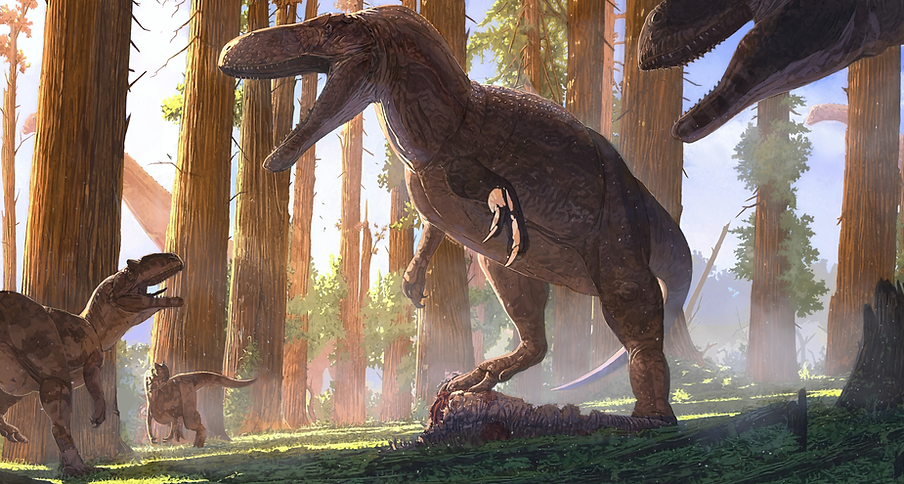
(ABOVE) A giant Torvosaurus fends off a group of juvenile Allosaurus in a Jurassic forest. Many types of large meat-eating dinosaurs lived in the same areas during the Jurassic period. Prey animals were abundant and there were many niches available for large, medium, and small theropods.
Jurassic Animals


The Jurassic Period
143 million years ago
The Cretaceous Period


The Cretaceous Period:
143 - 66 million years ago


The Cretaceous is the final period of the Mesozoic era. For most of the Cretaceous the Earth was much warmer than it is today. Ice caps were virtually nonexistent at the poles and as a result, sea levels were very high. As the continents began to move into the arrangement we know today, Europe and America became further separated and the Atlantic ocean grew increasingly wide over the course of the Cretaceous. Across the area we now call the Great Plains, a combination of elevated sea levels and a steady local downwarping of the Earth’s crust resulted in the formation of the Western Interior Sea, a body of water which once spanned from the Arctic Ocean to the Gulf of Mexico. Deposits linked to this ancient seaway are found from central Mexico to northern Canada. They preserve the fossils of mosasaurs, giant sharks, plesiosaurs and huge cephalopods. Along the coastlines of this seaway dinosaurs continued to flourish. On the western side of the Interior Sea the ancient continent of Laramidia was home to horned dinosaurs, azhdarchid pterosaurs and giant tyrannosaurs. Eastern North America formed the ancient continent of Appalachia where fossils of terrestrial animals are fairly rare. Deposits from the Cretaceous found in eastern North America often preserve the remains of hadrosaurs, crocodilians and early flowering plants.

(ABOVE) A baby horned dinosaur comes across the decaying skeleton of a large Albertosaurus in the middle of a dense conifer forest. Many types of horned dinosaurs were very common across the ancient landmass of Laramidia which makes up most of what is now western North America. Albertosaurus and other tyrannosauroids were some of the region's largest terrestrial carnivores.
~3.png)
(ABOVE) A giant long-necked Styxosaurus plesiosaur and a group of diving Pteranodon chase down a school of small Apsopelix fish. Pteranodon had very fragile skeletons but may have been able to swim underwater for brief periods of time to catch fast-moving aquatic prey.

(ABOVE) A pair of Nyctosaurus pterosaurs flying over the Western Interior Sea in an area which will eventually become central Kansas. These bizarre flying reptiles had very long forked head crests.

Our Western Interior Sea Field Guide
(ABOVE) Animals found in the Western Interior Sea: (1) Belonostomus, (2) Mosasaurus, (3) Plesioelasmosaurus, (4) Dolichorhynchops, (5) Squalicorax, (6) Xiphactinus
We have an online field guide about all the different kinds of animals who lived in the waters covering the Great Plains during the Late Cretaceous! Click the link to learn more!


