
The Western Interior Sea

The seas which once covered the Great Plains were made possible by the elevated sea levels of the Late Cretaceous as well as a downward shift in the elevation of central North America. The waters of this seaway were generally warm and fairly shallow.
Traces of a world covered in water
The Late Cretaceous was a very warm time in the history of the Earth. There were virtually no ice sheets at the poles and accordingly the world's sea levels were much higher than they are today. We are used to living on a planet where roughly 75 percent of the surface is covered in water but during the Campanian and Cenomanian stages of the Cretaceous period roughly 85 percent of the Earth's surface was covered in water. Huge swaths of low-lying land in the southern, eastern and central parts of North America were covered in warm shallow seas at this time. One of the best studied bodies of water from the Late Cretaceous is the Western Interior Sea, which once spanned from the Arctic Ocean to the gulf coast. Fossils of ancient marine life recovered from deposits of shale and chalk left behind by this body of water were first studied in the mid-late 19th century as teams of paleontologists and collectors from scientific institutions in the eastern US became increasingly interested in the fossils of giant marine reptiles, pterosaurs and carnivorous fishes. Since then the fossils of many types of world famous air and sea animals have been found in these marine deposits, such as those of Archelon, Tylosaurus, Pteranodon and Xiphactinus.
Geography
The early development of the Western Interior Sea is strongly linked to a phase of mountain building known as the Sevier orogeny which took place in the western part of North America during the Jurassic and Cretaceous periods. The shallow subduction of a plate of rock called the Farallon plate caused the middle part of the North American continent to warp downwards. At the same time, sea levels remained very high during the Late Cretaceous. This combination of factors led to the formation of large bodies of water in the middle of the continent, beginning with extensions of the Arctic Ocean moving south into a body of water called the Mowry sea which covered parts of central Canada during the middle Cretaceous. This body of water would eventually link up with some of the waters of the Gulf of Mexico in order to form a fully connected seaway at various times during the Cretaceous. The Western Interior Sea is best known as a body of water which split North America in two, with the continent of Laramidia in the west and Appalachia in the east. However, it should be noted that this contiguous seaway stretching across the entire continent was only present at the points when this body of water was at its maximum size and there were several phases of expansion and regression which saw the waters of the Interior Sea rise and fall over the course of the Late Cretaceous. The evidence for these changes in the extent of the seaway can be seen in the cyclothems found in the layers of rock below the Great Plains, with bands of marine sediment being separated by bands of rock which formed in terrestrial environments
(ABOVE) Pleistocene woodlands were often found near rivers and wetland habitats and were home to many types of browsing and semi-aquatic mammals. Cervalces (1), Castoroides (2), American mastodon (3)

(ABOVE) A map of North America as it appeared during the Campanian stage of the Late Cretaceous, around 75 million years ago. Image adapted from a figure from Sampson et. al. (2010)
The Western Interior Sea became fully connected for the first time during the late Albian stage of the Early Cretaceous, around 105 million years ago. The seaway was narrower at this point than it would be later in the Cretaceous and by the start of the Cenomanian (~100 million years ago) it had retreated somewhat. Areas in Kansas, Texas and Colorado which had previously been submerged were now above the water once again. This regression phase was followed by yet another expansion of the Interior Sea from around 95-85 million years ago during which the seaway became fully connected once again and most of Kansas, Nebraska and the Dakotas were submerged. The last 10 million years of the Cretaceous would see the Western Interior Sea slowly recede as the mountain building process further west continued to push the middle of North America upwards. By the very end of the Cretaceous very little was left of the seaway, aside from a line of wetlands, lakes and deltas running from the Dakotas all the way up to the Arctic Ocean
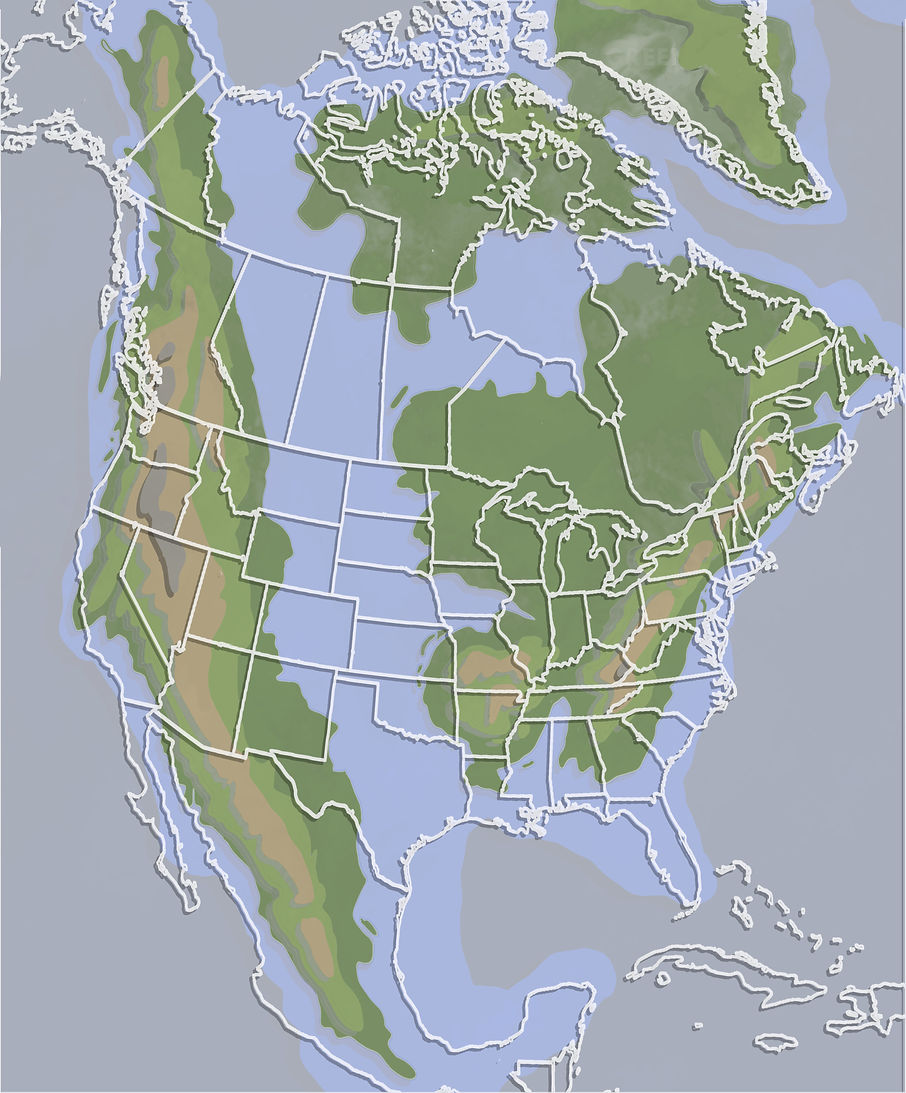
(ABOVE) A map of North America during the Campanian stage of the Cretaceous with an overlay of modern borders
The seaway was a very large body of water in terms of surface area but it wasn't particularly deep. The entire sea was positioned over the continental shelf and would most likely have been no more than 2,500-3000 feet deep. The waters of this body of water were very warm with estimated surface temperatures ranging from between 90-100 degrees Fahrenheit during the earlier phases of the seaway and around 65-70 degrees towards the very end of the Cretaceous period. Deeper waters near the seafloor were most likely considerably colder.
Stratigraphy
The history of the Western Interior Sea extends over the course of around 40 million years. Consequently, no single layer of rock can give us the whole picture of life in these Cretaceous waters. Scientists studying marine fossils from this area reconstruct the story of the seaway by looking at many different overlapping geological formations which were deposited by the Western Interior Sea, each of which have outcrops in different areas. By looking for changes in the types of animals found in a given area, as well as changes in the types of rocks surrounding them, paleontologists can see how this ancient environment shifted over time and the ways that prehistoric animals adapted to be able to survive in a constantly changing landscape. Broadly speaking, the Western Interior Sea can be said to have existed from around 110 million years ago during the middle Albian stage of the Early Cretaceous, all the way up until the later part of the Maastrichtian stage, around 68-67 million years ago. Geological formations linked to the presence of the seaway are known from outcrops spanning from northern Canada to central Mexico.

(ABOVE) The duration of the Western Interior Seaway as compared with the entire span of the Cretaceous period.
The oldest deposits linked to the Western Interior Sea are from formations like the Kiowa Shale formation in Kansas and the Clearwater Formation in Alberta. The Kiowa Shale preserves the remains of some types of plesiosaur fossils as well as fossils of oysters and ammonoids, while the Clearwater Formation contains the fossils of some of the last known Ichthyosaurs, like Athabascasarus. Younger layers of rock like the Niobrara Chalk and Greenhorn Limestone preserve many of the best known fossils from the Western Interior Sea, including animals like Xiphactinus, Pteranodon and Tylosaurus. The youngest layers of rock from the Western Interior Sea are found in formations like the Pierre Shale and Bearpaw Shale formations. These layers were formed as the seaway was beginning its retreat further north towards the Arctic Ocean. In the case of the Bearpaw Shale, the younger layers of this formation seem to mostly preserve the remains of animals living in a estuarine or river delta environment instead of an expanse of open water.

(ABOVE) Formations deposited by the Western Interior Sea are found across central North America and date from the late Albian stage all the way up to the early Maastrichtian, spanning around 40 million years of time.
The types of rocks which make up the layers found in these formations vary depending on the depositional environment which existed at the time/place when they were formed. Some layers are formed from mudstones made of compressed seafloor substrate while others are made of limestone. Limestone/chalk is a rock type that is fairly unique to marine depositional environments and is formed from the calcium carbonate accumulated from the remains of trillions of marine microorganisms, in particular a group of algae called the coccolithophores.
The Niobrara Chalk Formation
Dated to around 87 - 82 million years ago this formation has outcrops in parts of Kansas, Nebraska and North Dakota. This formation sits above the Carlile Shale Formation and below the Pierre Shale Formation. Its main members are the Smoky Hill Chalk and the Fort Hays Limestone. The Niobrara Chalk preserves the remains of animals who lived in the Western Interior Sea at the height of its size, including the fossils of sharks, elasmosaurs, pachycormid fishes, pterosaurs and sea turtles. Some dinosaur bones are also known from the Niobrara Chalk, namely Niobrarasaurus, which is one of only a few dinosaurs known from fossils found in the state of Kansas. It seems as though this animal would have died closer to shore before being washed out into the Interior Sea and deposited on the seafloor.
(BELOW) Selected taxa known from fossils found within the rock layers of the Niobrara Chalk Formation


The Pierre Shale Formation
Some of the largest animals known from the Western Interior Sea are found in deposits which formed late in the sea's history. In the Pierre Shale formation, which extends from Manitoba to New Mexico, we find fossils of some animals like Mosasaurus missouriensis and the strange long-necked polycotylid plesiosaur Serpentisuchops. The Pierre Shale is also the formation which contains the remains of the largest known turtle, a giant protostegid sea turtle called Archelon. The Pierre Shale Formation was deposited over a very long time, starting in the Campanian stage at the height of the extent of the seaway, and lasting all the way up until the Interior Sea had nearly fully receded at the beginning of the Maastrichtian stage. Some of the best known fossils recovered from the Pierre Shale are those of ammonoids like the large horn-shaped heteromorph genus Baculites.
(BELOW) Selected taxa known from fossils found within the rock layers of the Pierre Shale Formation


The Carlile Shale Formation
One expansive formation found across much of the central and western US is the Carlile shale which dates back to the early days of the Western Interior Sea during the Turonian stage of the Cretaceous. One of the most famous fossils recovered from these rocks is the skeleton of a pliosauroid plesiosaur called Megacephalosaurus. This huge marine reptile was one of the last members of the pliosauroid group which had previously been the top predators of the worlds oceans during the Jurassic and Early Cretaceous. Shark tooth fossils are also commonly found in the Carlile Shale. Squalicorax is well represented in these rocks, as is a unique type of sand tiger shark named Johnlongia, which seems to have been a close relative of the filter feeding odontaspid Pseudomegachasma. Fossils of marine crocodylomorphs like Terminonaris are also found in this formation.
(BELOW) Selected taxa known from fossils found within the rock layers of the Carlile Shale Formation


The Bearpaw Shale Formation
The Bearpaw Shale is a formation which contains fossils of animals from the last few million years of the Western Interior Sea. This formation extends throughout parts of Montana and the southern parts of Alberta and Saskatchewan and is a particularly productive source of the mineral ammolite which is formed from the shells of ancient ammonoids. Vertebrate fossils in the lowest layers of the Bearpaw Shale represent the remains of mosasaurs and plesiosaurs while the younger rock layers above preserve the fossils of terrestrial animals such as theropod dinosaurs and hadrosaurs. The Bearpaw formation gives us a good idea of what kinds of environmental transitions took place as the Interior Sea began to retreat northwards
(BELOW) Selected taxa known from fossils found within the rock layers of the Carlile Shale Formation


Marine and Coastal Environments
The Western Interior Sea supported a wide range of habitats, both within its waters and along its coastlines. The seaway itself was quite large, around the same size as the Mediterranean sea today, and at any given time during the Late Cretaceous the climate would likely have been quite different in the far northern parts of the seaway as compared to the warmer southern waters where the Interior Sea entered the Gulf of Mexico. Estimates for the maximum depth of the seaway vary somewhat but they range between estimates of around 1,000 feet of maximum depth to around 3,000 feet of depth. In either case these depth estimates indicate that the deepest parts of the Interior Sea, despite being fairly shallow when compared with the deepest oceans, would still have been deep enough that they would have experienced very little if any sunlight. Large colonies of bivalves seem to have survived very well at these depths where they sustained populations of smaller vertebrates and invertebrates.

(ABOVE) A chart showing the zones found in the water column of the ocean. Since most of the Western Interior Sea sat atop the continental shelf, even the deepest parts of the sea would not have gone any deeper than the mesopelagic zone.
Along the shorelines of the Western Interior Sea there would have been extensive systems of river deltas, lagoons and estuaries. Some formations in eastern Texas which seem to have been formed in these types of estuarine systems preserve the remains of many types of gastropods and shallow water bivalves, including the remains of large oyster beds. In the shallow waters of the seaway stony coral reefs were notably absent. Instead the main reef building organisms in these environments seem to have been the rudists; a unique group of bivalves who grew in large colonial clusters in both shallow and deeper waters. These rudists were a group which only lived during the Mesozoic era and became extinct at the end of the Cretaceous but owing to their dominance at this time, scleractinian coral fossils are very rare in deposits from the Western Interior Sea. Fossils of the remains of pieces of driftwood are also found in deposits from the Interior Sea. These pieces of wood are often found full of the traces of burrows left behind by shipworm bivalves. Above the seas, pterosaurs and seabirds would have been a common sight as they hunted for fish or combed the beaches in search of carrion.

(ABOVE) Coastal and near-shore environments found alongside the Western Interior Sea included deltas, estuaries, lagoons, shallow bays and sandbars. Some animals were also able to fly above the seas for great distances
The open waters of the Western Interior Sea would have been one of the most dangerous marine environments ever to exist in the entire history of the Earth. Mosasaurs, giant sharks and plesiosaurs would have roamed these waters in search of food. Schools of fish, both large and small would also have been found in the sunlit surface waters, or they may have possibly migrated up from deeper waters under the cover of night for protection from predators. These sunlit waters would also have supported a large volume of plankton, which in turn was a food source for some of the large Cretaceous filter-feeding fishes whose fossils are known from these areas. The giant pachycormid fish Bonnerichthys and the filter-feeding sand tiger shark Pseudomegachasma might have occupied the same ecological niches as today's whale sharks, basking sharks and baleen whales.

(ABOVE) Environments found further out in the open waters of the Western Interior Sea and in the deepest areas of the seafloor
The very deepest parts of the Western Interior Sea may have experienced near or total darkness even during the brightest parts of the day. At these depths the waters of the seaway would have been much colder than they were at the surface. The lower layers of substrate found along much of the seafloor in the seaway would not have been composed of sand, but rather made up of a lime-rich ooze. Very little was able to survive while anchored to this ooze, outside of some very tenacious (and in some cases very large) bivalves like the giant Inoceramid clams which are hallmarks of the fossil beds found in parts of western Kansas.
Fauna
Hundreds of different genera of ancient animals are known from deposits linked to the Western Interior Sea, ranging from tiny zooplankton all the way up to the mightiest mosasaurs. However, these animals were often separated from one another by millions of years of time and even some contemporaneous taxa may not have come across one another simply because they lived in two very different areas. Yet thanks to the stunning preservation of the remains of the animals found in these rock formations, we can piece together a lot of information about what kinds of animals would have lived alongside one another, competing for resources or becoming the unfortunate prey of a larger carnivore.
Estuaries

(ABOVE) Estuarine and terrestrial animals whose fossils are found in deposits linked to the Western Interior Sea
The estuaries and deltas found where rivers met the Interior Sea would have been full of all sorts of life. Gastropod remains from ancient snails (1) are often found in places like the Woodbine formation in Texas, where they lived in coastal habitats along side bryozoans (2), solitary corals (3) , sponges (4) and brachiopods (5). Giant crocodylomorphs like Deinosuchus (6) roamed the swamps along the edge of the seaway. These crocs grew so large that they could very easily have preyed upon unlucky dinosaurs who wandered too far into the water. Much like their modern relatives, ancient sea turtles (7) most likely came ashore in order to lay their eggs. Scavengers also picked their way along the edges of the sea and animals like Pteranodon (8) and Ichthyornis (9) would have scrounged for any sort of detritus or carrion which might have washed up on the beach. Dinosaurs were of course very common in these coastal areas and animals like Niobrarasarus (10) were occasionally washed out to sea where they became preserved and fossilized on the seafloor, possibly hundreds of miles away from their point of origin by powerful currents.
Above the seaway

(ABOVE) Flying animals whose fossils are found in deposits linked to the Western Interior Sea
Fossils of pterosaurs like Nyctosaurus (1) and Pteranodon (2) have been found in places which would once have been very far out at sea, meaning that these animals were no doubt capable of flying for great distances over open water in search of food. They may have even been able to sit atop the surface of the water and plunge their heads beneath the surface to grab ahold of fish. Seabirds were also able to take advantage of the abundance of food in the Interior Sea. Some animals like Iaceornis (3) were able to fly just like living seagulls while others like Baptornis (4) were completely flightless and had very short wings, heavy bodies and long webbed hind feet used to swim while underwater.
Shallow water

(ABOVE) Shallow water animals whose fossils are found in deposits linked to the Western Interior Sea
The sunlit shallow waters near the shoreline of the Western Interior Sea would have been very productive marine environments. These areas were home to a variety of pycnodont fishes (1) which used their crushing teeth to break open the shells of bivalves and small ammonoids (2). Small plesiosaurs (3) would have lived in these areas as well, possibly using these sheltered shallow waters as nurseries to care for their young before moving out to more open waters later in life. Other types of durophagous fishes like Hadrodus (4) are also known from areas which would have been covered in shallow waters. Basal mosasaurs (5) likely got their start living in these types of nearshore environments and some animals like Dallasaurus and Russellosaurus continued to occupy this sort of semi-aquatic transitional niche for millions of years.
Open water

(ABOVE) Pelagic animals whose fossils are found in deposits linked to the Western Interior Sea
The open waters of the Interior Sea were home to some small animals, such as the aspidorhynchiform false needlefishes (1) as well as some of the largest vertebrates of the entire Cretaceous period, including the massive Mosasaurus missouriensis (2). Long-necked elasmosaurid plesiosaurs (3) were also commonly found in these open areas, using their long necks to obfuscate the shape and size of their bodies as they picked through shoals of fish. Smaller polycotylid plesiosaurs (3) would have been more adapted for pursuit and used their long snouts to grab ahold of soft bodied prey such as fish, belemnites or squid. Some animals in these waters were scavengers instead of hunters. Squalicorax (5) teeth have been found embedded in the bones of many types of large marine reptiles, seemingly picking over these giant carcasses as they floated at the ocean's surface. Ravenous carnivorous fishes such as Xiphactinus (6) were also commonly found in these pelagic environments, where they would have hunted everything from sharks to marine reptiles to seabirds.
The seafloor

(ABOVE) Benthic and deep-water animals whose fossils are found in deposits linked to the Western Interior Sea
The depths of the Western Interior Sea were mostly devoid of sunlight but were nevertheless home to many different types of vertebrates and invertebrates. Just as in today's oceans giant sixgill sharks (1) were found living in the depths of the seaway, preying upon cephalopods or searching for sunken carrion in the deep twilight. Rudists (2) and Inoceramid clams (3) were a common sight on the seafloor. Other types of mollusks found in these areas included large muensterellid octopods (4) and car-sized ammonoids like Parapuzosia (5), possibly one of the largest mollusks of all time. Smaller animals like beardfishes (6) would have taken shelter in the shells of large clams and rudists, benefiting from the nearly impenetrable walls of their shell valves as a form of protection from benthic predators like the angelshark Squatina. (7)