
Archosauria

Dinosaurs, Crocs and Pterosaurs
Archosauria is a diverse group of reptiles that includes dinosaurs, pterosaurs, crocodilians, and modern birds. Members of this clade share several key characteristics, such as openings in the skull located in front of their orbits, teeth anchored within sockets, and an upright limb posture. These features improved the mobility and efficiency of these reptiles and helped archosaurs become one of the most successful vertebrate groups of the Mesozoic era. The first Archosaurs showed up during the Triassic period and they quickly evolved into a wide variety of forms adapted to life on land, in the air and in aquatic environments.
During the Cretaceous Period, the Western Interior Sea was home to a wide variety of Archosaurs. Pterosaurs flew over the seaway, while birds occupied coastal and marine habitats. Dinosaurs, including hadrosaurs and tyrannosaurs, lived along nearby shorelines and floodplains and crocodyliforms were common in rivers, estuaries, marshes and coastal regions connected to the seaway.
Anatomy

(ABOVE) A labeled diagram of the skull of the tyrannosauroid Gorgosaurus showing the placement of bones and key openings
General Characteristics
Archosaurs are a very diverse group of reptiles and as a result of the range of forms taken by the members of this group it can be difficult to find shared anatomical traits found in many living and extinct archosaurian lineages. Despite this, by looking back into the fossil record, we see that one of the key traits of the archosaurs as a group is the antorbital fenestra, an opening located in between the eye socket and nostril which helped lighten the skull. In some groups of archosaurs, such as crocodilians and birds, this fenestra was later lost. Many types of archosaurs also had a mandibular fenestra in their lower jaws, which reduced bone mass and provided additional space for jaw muscles. Their teeth are also anchored within deep sockets in the jaw. Early archosaurs also had very mobile ankles and reinforced pelvic bones which allowed them to hold themselves off the ground instead of holding a sprawled posture.
(BELOW) The bones of the forelimbs of different types of archosaurs. Archosaurs ancestrally had five fingers on each hand, although only the front three fingers would have had a claw/nail. Some groups of archosaurs lost digits over time.

Dinosaurs
Many of the major distinguishing features which separate different groups of dinosaurs are related to the skeletal anatomies of these extinct animals. There are generally considered to be two main groups of dinosaurs; saurischians and ornithischians, which differ primarily in the arrangement of their pelvic bones. Saurischians, including theropods and sauropodomorphs, had a forward-directed pubis bone, while ornithischians evolved a pelvis in which the pubis pointed backward. Many saurischians also had hollow, lightweight bones, three-toed hind feet, and sharp teeth suited for catching and consuming prey. Some members of this group, like the sauropods, had long necks, relatively small heads, sturdy pillar-like limbs, and robust vertebrae adapted to support their immense bodies. Many saurischians seem to have had large air sacs inside of their bodies which would have helped them grow to giant sizes while remaining fairly light relative to their immense volume. It seems as though these saurischian air sacs also played a role in giving these animals more efficient ways to breathe. Ornithischians on the other hand developed several features associated with specializing in plant-eating diets, including specialized grinding teeth and in some groups an extra predentary bone at the front of the lower jaw. Some groups, such as ceratopsians, evolved horns and large frills around their skulls, whereas stegosaurs and ankylosaurs would have had protective armor and defensive skeletal structures along the length of their bodies.
(BELOW) A labeled diagram of the skeletal anatomy of Gorgosaurus. The furcula, or wishbone, was present in many types of derived theropod dinosaurs by the Late Cretaceous, even in lineages which were not able to fly.


Adaptations For Flight
(ABOVE) Dinosaurs are usually classified as ornithischians or saurischians based on the arrangement and shape of their hip bones. Birds, which are part of the saurischian theropod group, independently developed a hip with a retroverted pubis.
Various different archosaur groups independently evolved specialized skeletal features that helped them achieve powered flight. Pterosaurs, the earliest known vertebrates capable of powered flight, had wings formed by a set of membranes called patagia which stretched along an exceptionally elongated fourth finger and which were supported by thin rods called actinofibrils. Their skeletons were highly adapted for aerial locomotion, with hollow lightweight bones that minimized body weight without sacrificing structural strength. Birds, descendants of maniraptoran theropod dinosaurs, developed an alternative wing design in which feathers attached to modified bones in their forelimbs. Over time they evolved several new flight-related adaptations, including a fused clavicle, or furcula (the wishbone), and a large keeled sternum that anchored large flight muscles developed from the pectoral muscles around the chest. Fusing different bones was a common strategy in different types of flying archosaurs. In pterosaurs for instance, many of the thoracic vertebrae became linked together into a rigid bony structure called a notarium. Many of these animals also had fused synsacra composed of their fused or semi-fused sacral vertebrae.
(BELOW) In order to deal with the skeletal stresses required for a bird to develop powered flight, these animals evolved a suite of anatomical characteristics which gave them more support for their flight muscles. This includes the extra large sternal keel. Some ancient seabirds would have had some unique anatomical features not seen in today's birds. For instance, many Cretaceous seabirds would have had teeth lining their bills, similar to the serrations seen on the beaks of living mergansers, likely an adaptation for catching slippery prey.

(BELOW) A series of diagrams with labels showing the skeletal anatomy of the pterosaur Pteranodon sternbergi. Note the fusion of the thoracic vertebrae into a notarium and the fused sacral vertebrae which have formed a synsacrum.


(BELOW) The bones of the wings of Pteranodon and their corresponding equivalents in the bones of a human arm. The second half of a pterosaur's wing is built from the bones of the 4th finger. The wing membranes of these animals were held in place by a series of strong soft tissue structures called actinofibrils which became more densely packed towards the wingtip

Aquatic Adaptations
Ancient archosaurs didn't just take over the land and manage to evolve powered flight, some groups also became partially or fully aquatic. Many crocodylomorph groups evolved streamlined body shapes that reduced water resistance and enhanced swimming ability. Long, narrow jaws lined with sharp teeth were particularly effective for capturing fish and other aquatic prey. The placement of the eyes and nostrils high on the skull allowed these animals to remain largely submerged while still being able to see and breathe at the water’s surface. Adaptations of the limbs also played an important role in the transition to the water, and some forms developed paddle-like appendages that gave them extra propulsion while swimming, although most of these animals depended primarily on their tails to push themselves forward. Among the most specialized marine crocodylomorphs, such as metriorhynchids, further modifications included flipper-like limbs, reduced osteoderms, and powerful tail fins adapted for sustained swimming in open seas. Some groups even developed specialized salt glands which allowed these animals to process saltwater, a trait which is also found in many of today’s living crocodiles.

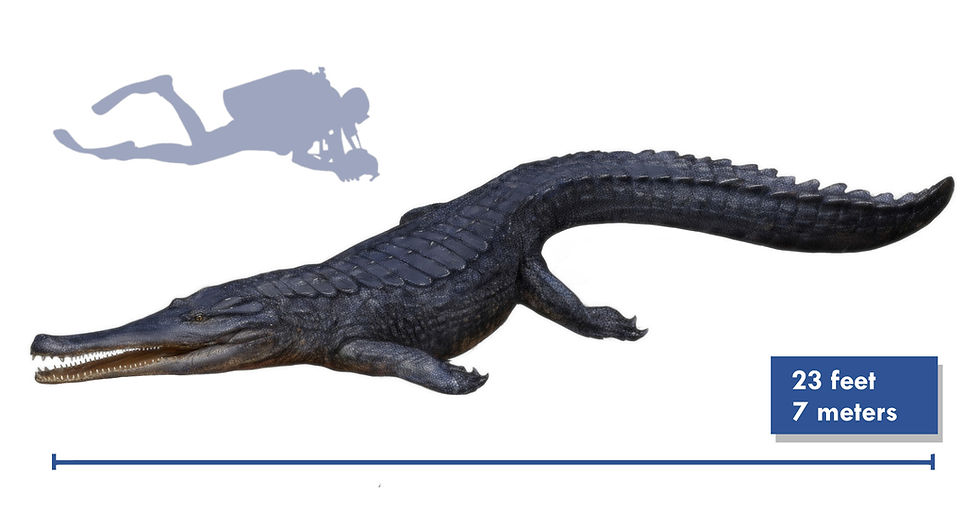
(ABOVE) The crocodylomorph Terminonaris is an example of a type of archosaur which became adapted to spending life at sea. Many anatomical features associated with today's crocodilians appeared independently at many points during the evolutionary history of crocodylomorphs as different lineages of these animals repeatedly moved into aquatic niches
Non-Avian Dinosaurs (Dinosauria)

Dinosaurs Preserved at Sea
The term “non-avian dinosaurs” is used to refer to all dinosaurs except for the group which includes today’s birds and their closest extinct bird relatives. Most non-avian dinosaur fossils found in rocks left behind by the Western Interior Sea are the remains of animals that were washed out to sea. Two of the most notable cases of this type of fossilization are the fossils of Niobrarasaurus and Claosaurus. Niobrarasaurus was a nodosaurid ankylosaur, a heavily built, four-legged herbivore protected by rows of bony armor plates called osteoderms. Unlike some other ankylosaurs, it lacked a tail club and likely relied on its thick armor and defensive shoulder spines for protection. Claosaurus, in contrast, was a slender early hadrosauromorph closely related to the duck-billed dinosaurs. It had small forelimbs, an elongated tail, long hind limbs, and a lightweight body adapted for efficient movement. Claosaurus did not have any dermal armor covering its skin and would have had simpler teeth than more advanced hadrosaurs.

Claosaurus
Temporal Range: 87 million years ago - 82 million years ago
Geographic Range: Kansas
Species: C. agilis
Diet: Herbivorous browser, ferns, leaves, leaf buds
Claosaurus was among the first dinosaur genera to be discovered in the Niobrara Formation of western Kansas. The fossil remains were collected by Othniel Charles Marsh in 1871 near the Smoky Hill River and were originally described in 1872 as Hadrosaurus agilis. As additional material became available and the specimen was studied more closely, Marsh determined that it differed significantly from Hadrosaurus and established the new genus Claosaurus in 1890. Fossils attributed to Claosaurus include portions of the skull, vertebral column, ribs, limb bones, and pelvic elements. These remains have made the genus an important subject in studies of hadrosauromorph evolution because it represents an early relative of the more specialized duck-billed dinosaurs that also lived during the Cretaceous.
The occurrence of Claosaurus fossils in marine chalk deposits is particularly noteworthy because the animal lived on land. During the Late Cretaceous, much of present-day Kansas was submerged beneath the Western Interior Seaway. After this particular Claosaurus died its remains were likely transported from a nearby coastal region into the seaway, where they settled on the sea floor and became buried in fine carbonate sediments. Over millions of years, these sediments lithified into the chalk deposits of the Smoky Hill Member, preserving the remains of this terrestrial dinosaur in an otherwise marine environment.

(BELOW) A photo of the mounted remains of Claosaurus agilis at the Yale Peabody Museum. Photo credit: user Greygirlbeast, accessed via Wikimedia Commons, distributed under a CC BY-SA 3.0 license

(BELOW) Most of the skull is missing from the holotype specimen of Claosaurus. It is usually restored with a skull shape similar to that of animals like Eotrachodon, with a wide beak at the front of the mouth and large chewing tooth batteries


Niobrarasaurus
Temporal Range: 87 million years ago - 82 million years ago
Geographic Range: Kansas
Species: N. coleii
Diet: Herbivorous browser, ferns, leaves, leaf buds
Niobrarasaurus was an armored herbivorous dinosaur belonging to the nodosaurid branch of the ankylosaurs. Its body was covered with osteoderms, or bony plates, embedded within the skin, which formed a protective shield against predators. Unlike ankylosaurids such as Ankylosaurus, Niobrarasaurus did not have a tail club. Instead, it likely depended on its heavy body armor and on the enlarged defensive spines along its shoulders and the sides of the body for protection. The dinosaur walked on four sturdy legs and was adapted for a life spent browsing on low-growing vegetation.
Scientific study of Niobrarasaurus began in 1930 when geologist Virgil Cole discovered a collection of fossil remains in western Kansas. The specimen was formally described in 1936, and was named Hierosaurus coleii. Decades later, paleontologists reexamined the fossils and concluded that they represented a distinct genus, later named Niobrarasaurus in 1995.
(BELOW) The skeleton of Niobrarasaurus, MU 650 VP, on display at the Sternberg Museum of Natural History in Hays, Kansas. These fossils were found in Gove County, Kansas and are one of only a few non-avian dinosaur remains to have been found in the state. This image shows the reconstructed skull, forelimb bones and the osteoderms of the front of the body,

.jpg)
(BELOW) The skeleton of Niobrarasaurus, MU 650 VP, middle section showing the ribs, osteoderms of the middle of the trunk
(BELOW) The skeleton of Niobrarasaurus, MU 650 VP, this photo is of the rear section of the skeleton and shows the pelvis, hind limbs, rear osteoderms and caudal vertebrae of the animal
.jpg)
Birds (Aves)

Cretaceous Toothed Seabirds
The Western Interior Sea was home to many types of marine birds. Unlike many of today’s birds, most birds from the Western Interior Sea still had small teeth lining their bills. These teeth would have been useful as tools for holding on to slippery fish, which are thought to have been the main source of food for many of these prehistoric animals. These Cretaceous birds were part of groups which were not directly ancestral to today’s birds and many of these ancient lineages would go extinct, along with the non-avian dinosaurs, at the end of the Cretaceous period.

Apatornis
Temporal Range: 83 million years ago
Geographic Range: Kansas
Species: A. celer
Diet: Carnivorous, small fish, squid
Apatornis was a small ornithuran bird that lived during the Late Cretaceous and is known from fossils recovered in the Smoky Hill Chalk of Kansas. Although only limited skeletal material has been discovered, the preserved remains reveal several features that distinguish it from other contemporary birds. The most important fossil consists of a synsacrum, the fused vertebrae associated with the pelvic region. Comparisons with related birds indicate that Apatornis had at least one more sacral rib than Ichthyornis and lacked the bony tendons that reinforced the sacral region in other genera. A study of some of the material known from Apatornis published in 2004 showed that the specimen could not be confidently linked to the original material and it was reassigned to the separate genus Iaceornis. As a result our current understanding of Apatornis is based largely on a single very incomplete original fossil, and many aspects of its biology and evolutionary relationships remain uncertain.

Baptornis
Temporal Range: 83 million years ago - 80 million years ago
Geographic Range: Kansas, Sweden
Species: B. advenus
Diet: Carnivorous, small fish, squid
Baptornis was possibly the most specialized marine diver of all the hesperornitheans. It had a long, slender neck, heavy bones that reduced buoyancy, and extremely large and strong hind limbs that it used as its main propulsion tool while swimming underwater. Although it wasn't able to fly, its skeletal remains still preserved small, reduced wing bones. Its elongated toes and powerful legs suggest that it was an efficient swimmer that relied on underwater pursuit rather than aerial hunting. Fossils of Baptornis were found fairly early on in the history of Kansas paleontology. Their remains were described In 1877. Because it was among the earliest fossil birds discovered from the Mesozoic Era, Baptornis became an important animal in studies of avian evolution. Additional specimens collected throughout the twentieth century revealed much more of its skeleton and allowed researchers to reconstruct its aquatic lifestyle, anatomy, and evolutionary relationships.


Fumicollis
Temporal Range: 85 million years ago
Geographic Range: Kansas
Species: F. hoffmani
Diet: Carnivorous, small fish, squid
Fumicollis belonged to the group of flightless diving birds known as hesperornitheans. Its fossil remains were first collected in 1937 from the Smoky Hill Member of the Niobrara Chalk in Kansas by Harold Shepherd and George Sternberg. For many years, the specimen was classified as belonging to the diving bird genus Baptornis. Subsequent research determined that these fossils displayed some unique features, including enlarged processes on the vertebrae and unusually elongated pelvis, which suggested that the animal was distinct from Baptornis and other known hesperornitheans. Following a detailed reexamination of the material, paleontologists Alyssa Bell and Luis Chiappe named the new genus and species Fumicollis hoffmani in 2015.

Guildavis
Temporal Range: 83 million years ago
Geographic Range: Kansas
Species: G. tener
Diet: Carnivorous, small fish, squid
Guildavis was a small bird that lived during the Late Cretaceous and is known from fossils recovered from the Niobrara Chalk Formation of Kansas. Although the available fossil material is limited, the genus appears to represent a distinct lineage of early ornithuran birds, the group that includes modern birds and their close relatives. The most important fossils consist of portions of the synsacrum, the fused vertebrae that support the pelvic region. It has at various times been considered to be a synonym of Ichthyornis.

Hesperornis
Temporal Range: 83 million years ago - 72 million years ago
Geographic Range: Kansas, South Dakota, Alberta, parts of Russia
Species: H. regalis, H. crassipes, H. gracilis, H. altus, H. rossicus, H. montana, H. bairdi, H. macdonaldi, H. mengeli
Diet: Carnivorous, small prey, fish
Hesperornis was a highly specialized marine bird which had completely lost its ability to fly. Its wings were greatly reduced, while its powerful paddle-like hind limbs were adapted for efficient swimming and underwater pursuit of prey. Unlike modern birds Hesperornis also had sharp teeth set within grooves in its jaws. Its streamlined body and strong legs made it an effective diver, and its lifestyle has often been compared to those of modern loons and grebes. Research on Hesperornis began in the late nineteenth century when Othniel Charles Marsh described fossils from the marine deposits of Kansas in 1872. The discovery was especially important because it revealed a bird with both avian characteristics and teeth, which in turn provided key evidence for the evolutionary connection between birds and their reptilian ancestors.

Iaceornis
Temporal Range: 83 million years ago
Geographic Range: Kansas
Species: I. marshi
Diet: Carnivorous, small fish, squid
Iaceornis was a small bird once considered part of the genus Apatornis. The shape of its skeleton has resulted in this genus being placed in a position in between earlier birds such as Ichthyornis and the ancestors of modern birds. Its wing bones have more in common with wings of living birds than the wing anatomies seen in many of its contemporary Late Cretaceous species. For many decades the specimen now considered the holotype of Iaceronis was assigned to the species Apatornis celer and was widely used in descriptions of that genus. A revision of many types of Cretaceous seabirds published in 2004 determined that the wing bones of this particular specimen differed significantly from those seen in the Apatornis holotype which established Iaceornis as a new genus.

Ichthyornis
Temporal Range: 83 million years ago
Geographic Range: Kansas, Texas, Alabama, Alberta, Saskatchewan
Species: I. dispar
Diet: Carnivorous, small fish, squid
Ichthyornis was a seabird from the Cretaceous period that was superficially similar to a small seagull. It had sharp teeth embedded within its jaws, while the front portions of the jaws were covered by a beak. This unusual combination makes Ichthyornis one of the most important transitional birds known from the fossil record. It had a lightweight skeleton, powerful wings, and was well adapted for sustained flight over the waters of the Western Interior Sea. Othniel Charles Marsh formally described this genus in the early 1870s based on fossils found in Kansas, and the fossils quickly attracted scientific attention because they combined avian features with toothed jaws.

Parahesperornis
Temporal Range: 85 million years ago - 82 million years ago
Geographic Range: Kansas
Species: P. alexi
Diet: Carnivorous, small fish, squid
Parahesperornis was a flightless, toothed seabird that used its powerful hind limbs to propel itself through the water while hunting for fish. It is named for its similarities with Hesperornis and other hesperornithean birds. Fossils of the bird were first collected from the Smoky Hill Chalk of Kansas in 1894, but their significance was not immediately recognized. For many years, these remains were grouped with other hesperornithean specimens, leading to confusion about their classification. It was classified as its own genus and species in 1984.

Pasquiaornis
Temporal Range: 94 million years ago
Geographic Range: Saskatchewan
Species: P. hardiei, P. tankei
Diet: Carnivorous, small fish, squid
Pasquiaornis was an early member of the Hesperornithes whose remains show a combination of features that link it to both more advanced diving birds and their less specialized flying ancestors. Its limb bones and foot anatomy were adapted for swimming, but many skeletal characteristics retained a more ancestral condition than those seen in later hesperornitheans. It was originally thought to be a close relative of Baptornis but it has since been moved closer to the base of the hesperornithean family tree. There is some evidence that they might have spent time in groups since some of the original fossils found from this animal were found with many individuals located in a small area where they seem to have been deposited at around the same time.
Pterosaurs (Pterosauria)

Pterosaurs of the Western Interior Sea
Pterosaurs were a group of Mesozoic flying reptiles and the first vertebrates to master true powered flight. They were characterized by lightweight, hollow bones, large wings made of skin membranes, and an elongated fourth finger that supported a large part of the membrane on each wing. Unlike birds, pterosaurs had wings composed of flaps of skin called patagia, superficially similar to the wing membranes of bats. Many species also displayed prominent head crests. By the end of the Cretaceous, the only remaining pterosaurs were animals with long hind legs and short tails. Many of these animals had large display crests or elaborate bill shapes. Some of the earlier Cretaceous pterosaurs of the Western Interior Sea still had teeth in their bills.

Aetodactylus
Temporal Range: 95 million years ago
Geographic Range: Texas
Species: A. halli
Diet: Carnivorous, fish, squid
Aetodactylus is a small toothy pterosaur known from sites in Texas. It was discovered when a fossil lower jaw was found in 2006 near Mansfield, Texas in rocks belonging to the Tarrant Formation. In 2010, paleontologist Timothy Myers described the fossil and named the species Aetodactylus halli in recognition of its discoverer, Lance Hall. The discovery showed that certain types of toothed pterosaurs remained part of North American ecosystems even during parts of the Late Cretaceous when they had previously been considered largely extinct.The teeth of Aetodactylus seen in these snout fossils were organized with the teeth at the front of the mouth projecting forward, while the largest teeth were concentrated near the tip of the jaw and decreased in size toward the back. Unlike some ornithocheirid pterosaurs, Aetodactylus lacked a crest on its lower jaw.

Alamodactylus
Temporal Range: 88 million years ago
Geographic Range: Texas
Species: A. byrdi
Diet: Carnivorous, fish, squid
Alamodactylus was a medium-sized pterosaur that lived above the Western Interior Sea during the Late Cretaceous. It is currently considered to be a close relative of animals like Nyctosaurus, another Interior Sea pterosaur whose fossils are found in Kansas. Scientists first studied Alamodactylus from a partial wing skeleton discovered in the Atco Formation of Texas. It was initially thought to be related to Pteranodon but in 2013 it was determined to be a distinct genus was named Alamodactylus byrdi after fossil collector Gary Byrd.

Cimoliopterus
Temporal Range: 95 million years ago
Geographic Range: Texas, the UK
Species: C. dunni, C. cuvieri, C. colorhinus
Diet: Carnivorous, fish, squid
Cimoliopterus was a genus of pterosaur that lived in parts of what are now England and North America during the Cretaceous Period. Its snout was tall and narrow, with only a slight widening at the tip, unlike the broader jaw expansions seen in some related fish-eating pterosaurs. Its crest began farther back on the upper jaw and differed in shape and position from those of closely related genera. Its teeth were also organized in a distinctive way with larger teeth near the front of the jaws and smaller, more widely spaced teeth farther back, most likely an adaptation for snagging fish from the surface of the water. Its fossils were first found in the 19th century but it wasn't formally given its own name until a review published in 2013 concluded that the material represented a distinct genus, leading to the establishment of Cimoliopterus. A specimen described in 2015 widened its range to include parts of Texas in what was at that time the southern part of the Western Interior Sea

Nyctosaurus
Temporal Range: 85 million years ago
Geographic Range: Kansas
Species: N. gracilis
Diet: Carnivorous, fish, squid
Nyctosaurus was a pterosaur whose most famous characteristic was an enormous forked crest that projected upward and backward from the skull. In some individuals, this crest was disproportionately large compared to the rest of the body. Nyctosaurus was also one of only a few pterosaurs to lose all of its smaller clawed fingers except the elongated fourth finger that supported the wing membrane. Because of this reduced hand structure, scientists think that Nyctosaurus was highly specialized for flight and may have spent very little time moving on the ground. Its fossils were found in the 19th century in Kansas.

Pteranodon
Temporal Range: 86 million years ago - 78 million years ago
Geographic Range: Central US, Alabama
Species: P. longiceps, P. sternbergi
Diet: Carnivorous, small fish, squid
Pteranodon is by far the best known type of pterosaur, essentially synonymous with the use of the outdated term “pterodactyl”. It had a long pointed toothless beak, and a large bony crest extending from the back of its skull. Its name, which means “toothless wing,” reflects this lack of teeth. With wingspans that could exceed 6 meters (20 feet), Pteranodon ranked among the largest flying animals of its time and was considered the largest pterosaur genus up until the discovery of larger Azdarchid pterosaurs like Quetzalcoatlus. Its lightweight skeleton, elongated wings, and aerodynamic body made it especially well suited for sustained flight above the waters of the Western Interior Sea. Paleontologists believe it fed mainly on fish, which it likely captured from the ocean surface using its long beak. Currently there are two widely accepted species of Pteranodon; Pteranodon longiceps, which had a long thin crest, and Pteranodon sternbergi which had a wider roughly diamond-shaped crest. Some workers consider Pteranodon sternbergi to be its own genus, Geosternbergia. When fossils of Pteranodon were found in chalk deposits from Kansas in the 19th century, the paleontologist Othniel Charles Marsh initially placed the remains in another group close to the smaller European genus Pterodactylus, but in 1876 he recognized their unusual toothless jaws and established the genus Pteranodon. Over the following decades many more of their fossils were found. In some parts of Kansas, their fossils are extremely abundant and comparatively easy for fossil hunters to find.

(BELOW) A model of a Pteranodon longiceps skull on display at the KU Natural History Museum. Most fossils of these animals found in rocks from western Kansas have been compressed or flattened within the rock surrounding the fossils.
(BELOW) The middle bones of the wings of a Pteranodon at the KU Natural History Museum. This is part of a composite skeleton. The three fingers on the left side of the image are a feature seen in most pterosaurs with the exception of Nyctosaurus and its closest relatives. The spur of bone between the radius and the 4th metacarpal is called the pteroid bone. This structure anchors the front-most wing membrane, a feature known as the brachiopatagium.

Crocodylomorphs (Crocodylomorpha)

Giant Crocs of the Western Interior Sea
Crocodylomorphs are a group of archosaurian reptiles which includes modern crocodilians and many of their extinct relatives. Today’s crocodylomorphs are generally recognized by their elongated snouts, powerful jaws equipped with conical teeth, protective bony armor embedded in the skin, and muscular tails that they use when swimming. Although many types of extinct crocodylomorphs lived in rivers, lakes, and coastal environments, others became highly adapted to different habitats and niches, including borrowing, terrestrial locomotion, herbivory and life in marine settings. Fossils found in the layers of rock left behind by the Western Interior Sea preserve the remains of both open ocean specialist crocodylomorphs and animals that preferred to live in near-shore and estuarine habitats.

Deinosuchus
Temporal Range: 82 million years ago - 73 million years ago
Geographic Range: North Carolina, Texas, Montana
Species: D. hatcheri, D. rugosus, D. riograndensis, D. schwimmeri
Diet: Carnivorous, large prey, dinosaurs, fish, turtles
Deinosuchus was one of the largest crocodylomorphs known from the fossil record. Its broad skull, heavily constructed jaws, and thick, crushing teeth were adapted for tackling large prey, possibly even hunting large dinosaurs. Its body was protected by robust bony armor plates known as osteoderms. Deinosuchus had a diet composed of a variety of prey, including fish, turtles, and large terrestrial animals that approached waterways. Its range extended over both sides of the Interior Sea with fossils found in North Carolina, Texas and Wyoming in areas which were once swamplands, river basins and coastal estuaries. These animals seem to have been fairly closely related to today’s crocodilians. It would have looked very similar to today’s alligators but with a large bulb-shaped extension on the tip of its snout which is a feature absent in today’s broad-snouted crocodilians.
Terminonaris
Temporal Range: 96 million years ago - 91 million years ago
Geographic Range: Kansas, Alberta
Species: T. browni, T. robusta
Diet: Carnivorous, fish, marine reptiles, large prey
Terminonaris was a marine crocodylomorph that lived in coastal regions of the Western Interior Seaway during the Late Cretaceous. It had a long, slender snout and narrow jaws which were equipped with thin, interlocking teeth well suited for capturing fish and other small aquatic animals. Terminonaris was a large predator, but its skull shape suggests a feeding strategy different from that of today’s broad-snouted crocodilians that are adapted for crushing larger prey and could have possibly been more similar to the fish-hunting strategies seen in today’s gharials. The first fossils from this animal were described in 1904 and given the name “Teleorhinus”. Because that name had already been used for another organism, the genus was subsequently renamed Terminonaris. Its fossils have since been found in parts of Alberta and Kansas.
Media Gallery


Suggested References: Archosauria
Adams, Thomas L.; Polcyn, Michael J.; Mateus, Octávio; Winkler, Dale A.; Jacobs, Louis L. (2011). "First occurrence of the long-snouted crocodyliform Terminonaris (Pholidosauridae) from the Woodbine Formation (Cenomanian) of Texas". Journal of Vertebrate Paleontology. 31 (3): 712–716.
Bell, A. and Everhart, M.J. (2009). “A new specimen of Parahesperornis(Aves: Hesperornithiformes) from the Smoky Hill Chalk (Early Campanian) of western Kansas”. Kansas Academy of Science, Transactions 112(1/2):7-14.
Bennett, S.C. (1992). “Sexual dimorphism of Pteranodon and other pterosaurs, with comments on cranial crests”. Journal of Vertebrate Paleontology 12 p. 422-434.\
Bennett, S.C. (2001). “The osteology and functional morphology of the Late Cretaceous pterosaur Pteranodon. Part I. General description of osteology”. Palaeontographica, Abteilung A, 260:1-112.
Carpenter, K (2003). "Vertebrate Biostratigraphy of the Smoky Hill Chalk (Niobrara Formation) and the Sharon Springs Member (Pierre Shale)". High-Resolution Approaches in Stratigraphic Paleontology. Topics in Geobiology. 21: 421–437.
Carpenter, K., Dilkes, D., & Weishampel, D. B. (1995). “The Dinosaurs of the Niobrara Chalk Formation (Upper Cretaceous, Kansas)”. Journal of Vertebrate Paleontology, 15(2), 275–297.
Carpenter, K. and Everhart, M. J. (2007). “Skull of the ankylosaur Niobrarasaurus coleii (Ankylosauria: Nodosauridae) from the Smoky Hill Chalk (Coniacian) of western Kansas”. Kansas Academy of Science, Transactions, 110(1/2): 1-9.
Chinsamy, A., L. D. Martin and P. Dodson. (1998). “Bone microstructure of the diving Hesperornis and the volant Ichthyornis from the Niobrara Chalk of western Kansas”. Cretaceous Research 19:225-235.
Cole, V. B. (2007). “Field notes regarding the 1930 discovery of the type specimen of Niobrarasaurus coleii, Gove County, Kansas”. Transactions of the Kansas Academy of Science 110(1/2): 132–134.
Cossette, Adam P.; Brochu, Christopher A. (2020). "A systematic review of the giant alligatoroid Deinosuchus from the Campanian of North America and its implications for the relationships at the root of Crocodylia". Journal of Vertebrate Paleontology. 40
Cumbaa, S.L. and Tokaryk, T.S. (1999). “Recent discoveries of Cretaceous marine vertebrates on the eastern margins of the Western Interior Seaway”. In: Summary of Investigations 1999, Vol. 1, Saskatchewan Geological Survey, Sask. Energy Mines, Miscellaneous Report 99-4.1, p. 57-63.
Everhart, M. J. and K. Ewell. (2006). “Shark-bitten dinosaur (Hadrosauridae) vertebrae from the Niobrara Chalk (Upper Coniacian) of western Kansas”. Kansas Academy of Science, Transactions, 109 (1-2):27-35.
Hamm, S. A. and M. J. Everhart. (2001). “Notes on the occurrence of nodosaurs (Ankylosauridae) in the Smoky Hill Chalk (Upper Cretaceous) of western Kansas”. Journal of Vertebrate Paleontology 21(suppl. to 3): 58A.
Hone, David W.E.; Witton, Mark P.; Habib, Michael B. (2018). "Evidence for the Cretaceous shark Cretoxyrhina mantelli feeding on the pterosaur Pteranodon from the Niobrara Formation". PeerJ. 6 e6031.
Liggett, G. A. 2005. A review of the dinosaurs from Kansas. Kansas Academy of Science. Transactions 108(1/2): 1-14.
Lucas, Spencer G.; Sullivan, Robert M. (2006-01-01). Late Cretaceous Vertebrates from the Western Interior: Bulletin 35. New Mexico Museum of Natural History and Science.
Witton, Mark P. (2013). “Pterosaurs: Natural History, Evolution, Anatomy”. Princeton University Press. ISBN 0691150613.
McIntosh, A. P.; Shimada, K.; Everhart, M. J. (2016). "Late Cretaceous marine vertebrate fauna from the Fairport Chalk Member of the Carlile Shale in southern Ellis County, Kansas, U.S.A." Transactions of the Kansas Academy of Science.
Myers, T.S. (2010). “Earliest occurrence of the Pteranodontidae (Archosauria: Pterosauria) in North America: New material from the Austin Group of Texas”. Journal of Paleontology 84(6):1071-1081.
Myers, T. S. (2015). "First North American occurrence of the toothed pteranodontoid pterosaur Cimoliopterus". Journal of Vertebrate Paleontology. 35 (6): 1–9
Pêgas, R. V.; Holgado, B.; Leal, M.E.C. (2019). "On Targaryendraco wiedenrothi gen. nov. (Pterodactyloidea, Pteranodontoidea, Lanceodontia) and recognition of a new cosmopolitan lineage of Cretaceous toothed pterodactyloids". Historical Biology. 33 (8): 1–15.
Prieto-Márquez, A. (2011). "Revised diagnoses of Hadrosaurus foulkii Leidy, 1858 (the type genus and species of Hadrosauridae Cope, 1869) and Claosaurus agilis Marsh, 1872 (Dinosauria: Ornithopoda) from the Late Cretaceous of North America". Zootaxa. 2765: 61–68.
Reynaud, F. (2006). “Hind limb and pelvis proportions of Hesperornis regalis: A comparison with extant diving birds”. Journal of Vertebrate Paleontology 26(3):115A.
Shimada, K., and Parris, D.C., (2007). “A long-snouted Late Cretaceous crocodyliform, Terminonaris cf. T. browni, from the Carlile Shale (Turonian) of Kansas”. Transactions of the Kansas Academy of Science 110(1):107-115.
Witton, Mark (2010). "Pteranodon and beyond: The history of giant pterosaurs from 1870 onwards". Geological Society, London, Special Publications. 343 (1): 313–323