
Artiodactyla
Even-Toed Ungulates
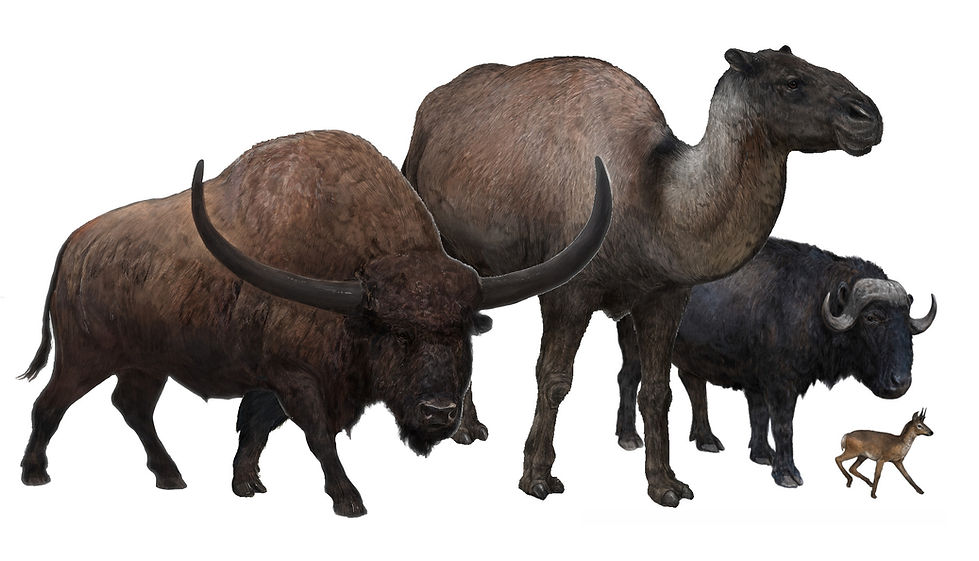
Artiodactyla, a group also known as the even-toed ungulates, comprises the largest and most diverse living order of hoofed mammals. Members of this group typically hold their weight on their 3rd and 4th toes, unlike the odd-toed ungulates who walk on feet supported by 1, 3 or 5 toes. Artiodactyls include all of today’s sheep, goats, cattle, pigs, muskoxen, antelopes, pronghorns, giraffes, camels, deer and hippos. The group also includes all of today’s whales, dolphins and porpoises, since these aquatic animals descend from land-dwelling hoofed ancestors. During the Pleistocene epoch the Midwest was home to many types of artiodactyls which have since gone extinct, ranging from giant bison who were as big as rhinos to tiny pronghorns who were less than half as large as their living relatives.
Peccaries (Tayassuidae)
Peccaries in the Midwest
Peccaries are a group of hoofed mammals in the order Artiodactyla (even-toed ungulates). Their closest relatives are pigs. There are three peccary genera alive today found in parts of North and South America: the white-lipped peccary (Tayassu), the chacoan peccary (Catagonus) and the collared peccary or javelina (Dicotyles). These extant peccaries are particularly common in semi-arid environments today but during the Pleistocene, several other types of peccaries were found all throughout the Americas, even reaching as far north as Michigan.

Long-snouted peccary
Mylohyus nasutus
Temporal Range: 5 million years ago to approximately 12,000 years ago
Geographic Range: Eastern and central North America , Nebraska, Texas, Florida
Species: M. nasutus , M. elmorei, M. floridanus, M. fossilis, M. gildleyi
Diet: Omnivorous, roots, tubers, leaves, invertebrates, carrion
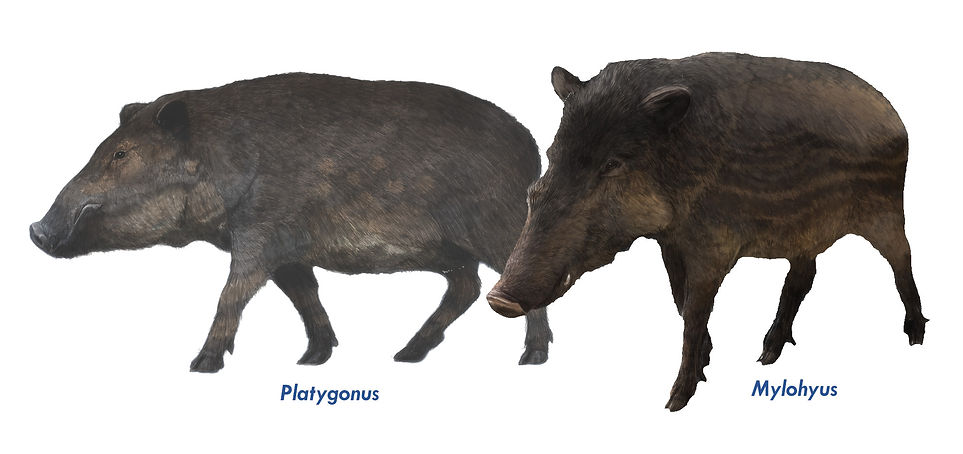
Mylohyus was an extinct genus of peccary found throughout many parts of North America during the Pleistocene. These animals stood slightly taller than today’s peccaries. Their legs were relatively long and their skulls were particularly large for a peccary. Their canine teeth formed a set of sharpened tusks which they could use as defensive weapons or as tools used to dig in search of roots and edible tubers. The spinal processes on the vertebrae near the shoulder were quite long in these animals and would have been held off the ground at a higher position than the pelvis, giving Mylohyus’s back a distinctive sloped posture.
The genus first appears in the fossil record around the start of the Pliocene epoch and quickly spreads across a large part of the southern and eastern areas of the North American continent. Knowledge about their social structure is somewhat murky but they seem to have lived in smaller groups than other Pleistocene peccaries like Platygonus.
Flat-headed peccary
Platygonus compressus
Temporal Range: 10.3 million years ago to approximately 11,000 years ago
Geographic Range: Found throughout North and South America
Species: P. compressus, P. brachirostris, P. chapadmalensis, P. cinctus,
P. kraglievichi, P. marplatensis, P. narinoensis, P. oregonensis, P. pearcei, P. pollenae,
P. scagliae, P. setiger, P. striatus, P. texanus, P. vetus
Diet: Omnivorous, roots, tubers, leaves, invertebrates, carrion
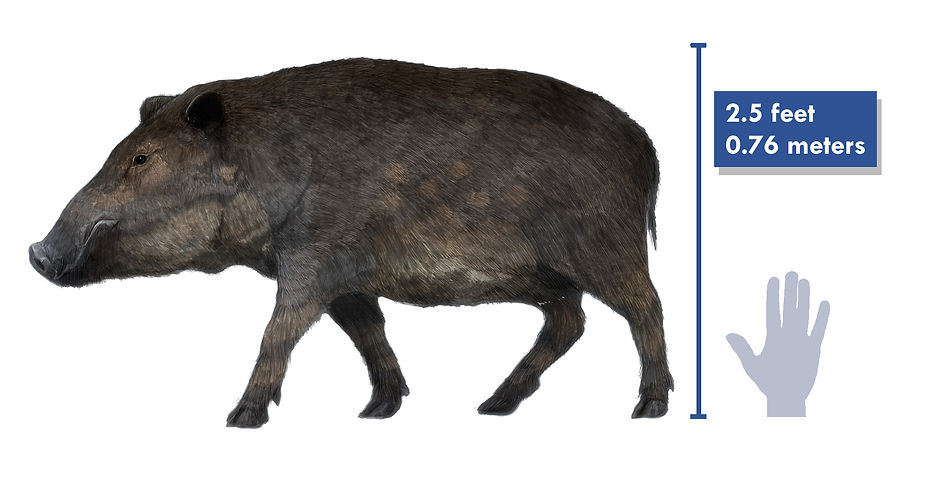
Platygonus was the most widespread genus of North American peccaries from the Pleistocene epoch. In terms of its general appearance, it was similar in size and shape to today’s collared peccaries. The name “flat-headed peccary” refers to the shape of the animal’s forehead, which was smooth with no sharp differences in the angles between the slope of the bones of the forehead and the slope of the nasal bones. Relative to their body sizes, Platygonus peccaries had smaller skulls than their contemporaries like Mylohyus. Fossil assemblages of the remains of large groups of Platygonus are often found in caves, suggesting that they may have used these areas as a source of shelter. They also seem to have been very social animals, with perhaps dozens of animals living together in herds.
Peccaries in the genus Platygonus were particularly common in eastern North America, but ranged much further south as well, with other species of Platygonus known from fossils found as far away as Argentina.
Deer (Cervidae)
Horse-Sized Behemoths and Agile Runners
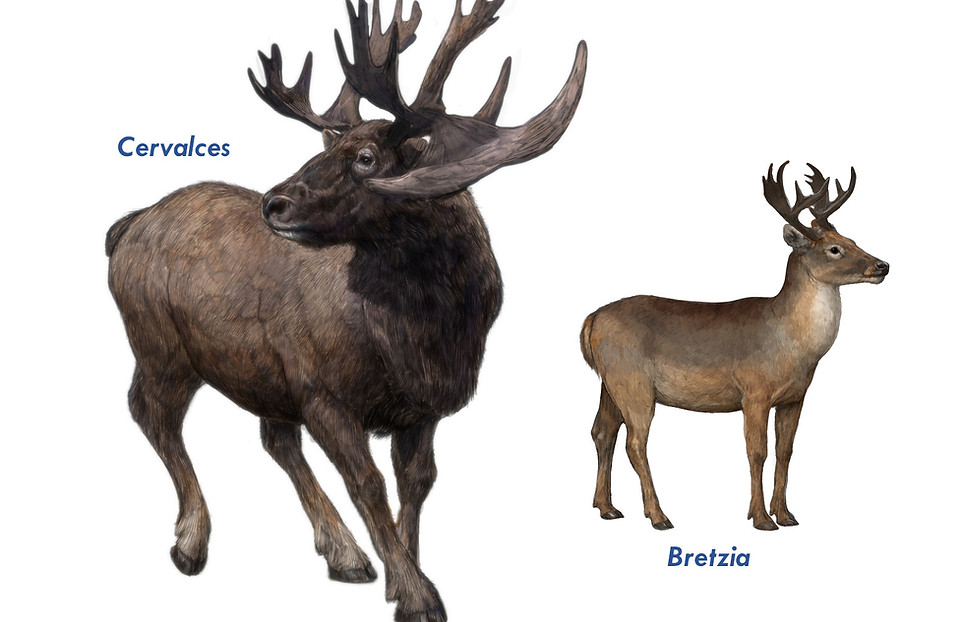
Deer are a group of artiodactyls best known for their unique antlers. Unlike the true horns possessed by other groups of animals, deer grow a new set of antlers every year and shed them during the fall. The largest type of deer found in North America today is the moose, which spread across the continent during the Pleistocene epoch. Some extinct deer species from the Pleistocene like the Stag-moose Cervalces rivaled today’s largest moose in terms of size, growing to be nearly as large as a draft horse. Other extinct deer genera from the Pleistocene, like the smaller genus Bretzia, more closely resembled today’s white-tailed deer and mule deer, with a smaller body size than today’s moose and elk, narrower snouts and thinner legs. Some of these extinct animals preferred to live in wetland habitats, while others tended to live in forests.

Stag-moose
Cervalces scotti
Temporal Range (C. scotti): Middle Pleistocene to approximately 11,500 years ago
Geographic Range: Genus found in North America, Europe, Asia
Species: C. scotti, C. latifrons, C. carnutorum
Diet: Herbivorous, leaves, sedges, aquatic plants
The Stag moose, Cervalces, was a close relative to today’s moose. The genus Cervalces contains three species, two of which are only found in Eurasia, as well as the species C. scotti, the only species found in North America. Unlike today’s moose whose antlers each form a single palmate frond-like shape, Cervalces scotti had antlers with a flattened lower palmated section and an upper palmate area with sharper tines. The North American population of Cervalces seems to be descended from a group of Eurasian Cervalces, most likely Cervalces latifrons, which moved across the Bering land bridge into Alaska at some point during the Pleistocene. It seems to have preferred living in woodlands with a high level of rainfall, perhaps wading through shallow water in search of aquatic plants, a behavior often seen in today’s moose.
Cervalces had a skull with a large nasal opening. In living moose, the rear parts of the nasal openings are positioned further back on their skulls, leaving room for a large fleshy nose which they can seal off when grazing underwater. In Cervalces, the nasal openings are positioned further forward than in moose but further back than in most other types of deer. This suggests that they may have had a less specialized nasal structure than today’s moose.
Bretzia nebrascensis
Temporal Range: 4.9 million years ago to approximately 10,000 years ago
Geographic Range: Central North America, Nebraska, South Dakota
Species: B. nebrascensis, B pseudalces
Diet: Herbivorous, leaves, twigs, soft buds
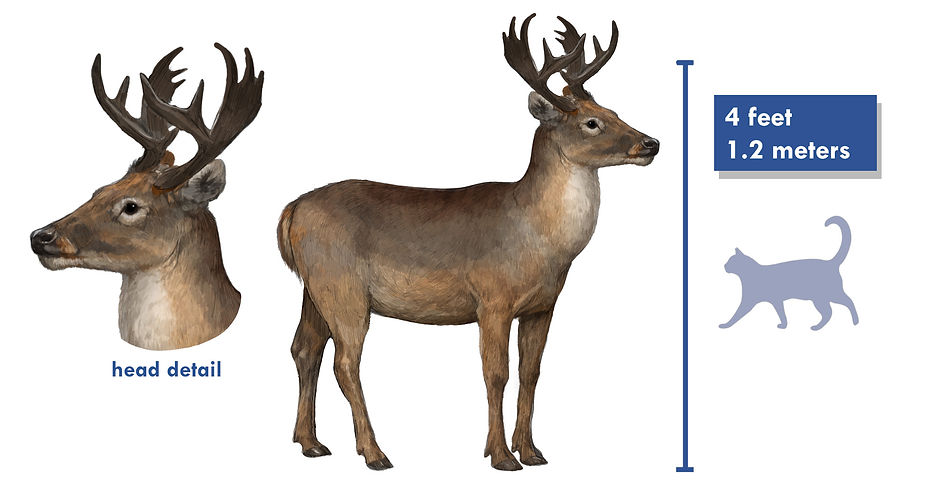
Bretzia is a genus of deer with two recognized species, Bretzia nebrascensis and Bretzia pseudalces. Bretzia pseudalces is known from fossils found in deposits from Washington state and has broad antlers similar to those of moose. Bretzia nebrascensis is known from fossils found in deposits from the Great Plains and had thinner tines on its antlers, more similar to those seen in the living white-tailed deer. The exact relationship between these two species of Bretzia is somewhat unclear and they may in fact be more distinct from one another than previously thought.
Bretzia is classified as a member of the subfamily Capriolinae, along with animals like Caribou, mule deer, white-tailed deer, Cervalces and moose. They are more closely related to these types of deer than they are to members of the “old world deer” subfamily such as elk. The genus includes some of the oldest types of deer known from the Americas. Bretzia likely had a long thin snout, thin legs and a gracile body plan. Like most of today’s species of deer, the females of this genus are thought to have lacked antlers.
Camels (Camelidae)

Giant Camels and Llama Relatives
Camels from the family Camelidae form a group of hoofed mammals which includes all living old world camels, llamas, alpacas, vicunas, guanacos and all their closest extinct relatives. Although there are no living camels native to the Midwest, for most of their evolutionary history camels were most abundant in North America, only spreading to other continents within the last few million years. Camels are part of the suborder Tylopoda, named after the padded feet often seen in living camelids. Unlike true ruminant animals who have four stomach chambers, camels only have three-chambered stomachs making them less efficient at digesting tough plant material like grass. Most camels feed on a mixture of grasses and softer leaves. During the Pleistocene epoch, the Midwest was home to a wide variety of camel genera, including some very large animals like the elephant-sized Titanotylopus as well as smaller relatives of today’s South American camelids.

Giant Camel
Titanotylopus nebraskensis
Temporal Range: 10.3 million years ago to approximately 300,000 years ago
Geographic Range: Central and western North America, California, Nebraska
Species: T. nebraskensis
Diet: Herbivorous, grasses, twigs, leaves
Titanotylopus was by far the largest camel found in Ice Age North America. Standing as tall as a small elephant, these animals filled ecological roles similar to those occupied by giraffes on other continents. Thanks to their height and their extremely long necks, they were able to browse for leafy vegetation which was off limits to nearly every other type of Ice Age herbivore. Titanotylopus did not survive long enough to reach the end of the Pleistocene epoch. This genus first appeared during the Miocene epoch and lived up until around 300,000 years ago. In its habitat throughout much of what would one day become the Great Plains it would have been one of the largest hoofed mammals around at the time.
Like many of today’s camelids, Titanotylopus camels had very long canine teeth which they may have used as defensive weapons when fighting against potential predators and/or against other Titanotylopus in fights over mates, food or territory. Some paleontologists consider the camels once classified as a separate genus, Gigantocamelus, to be part of the genus Titanotylopus, while others consider these to be two separate genera.

Palaeolama mirifica
Temporal Range: 1.9 million years ago to approximately 3,400 years ago
Geographic Range: Found throughout North and South America
Species: P. aequatorialis, P. brevirostris, P. crassa, P. crequii, P. hoffstetteri,
P. leptognata, P. major, P. niedae, P. paradoxa, P. promesolithica, P. reissi,
P. weddeli, P. mirifica
Diet: Herbivorous, grasses, twigs, leaves
Palaeolama, also known as the Stout-Legged Llama, was a lamine camel related to today’s South American camelids as well as the extinct genus Hemiauchenia. Its remains are found in parts of both North and South America. Unlike most of the other hoofed animals included in this section, Palaeolama did not go extinct at the end of the Pleistocene epoch. The most recent remains of these animals seem to be around 4,200 years old. The genus Palaeolama first appeared in Florida during the middle Pleistocene but these animals would soon move to new habitats, eventually reaching far away Chile and Argentina.
In terms of their anatomy and proportions they were roughly similar in appearance to today’s llamas, albeit with slightly shorter legs and a larger maximum body size. Their remains are found in areas which would have been open grasslands, forests and mountainous regions. They seem to have fed on a mixture of grasses, sedges, leaves and softer leaf buds.

Hemiauchenia macrocephala
Temporal Range: 10.3 million years ago to approximately 12,000 years ago
Geographic Range: Found in parts of North and South America
Species: H. macrocephala, H. minima, H. blancoensis, H. vera, H. paradoxa,
H. seymourensis, H. edensis, H. mirim
Diet: Herbivorous, grasses, twigs, leaves
Hemiauchenia is a genus of camels in the tribe lamini which seems to have been the direct ancestor of today’s South American camelids like llamas and alpacas. The genus first appeared during the Miocene in North America with fossils of these early animals uncovered in Texas, Kansas, Nebraska and Florida as well as parts of Central America. The genus further expanded into South America once the isthmus of Panama joined the Americas around 2-2.5 million years ago. Species like Hemiauchenia paradoxa appear in South America during the middle Pleistocene. Like many other lamine camelids, Hemiauchenia had a long neck habitually held in a posture which would have positioned most of the cervical vertebrae above the shoulder blades. Their torsos were relatively narrow and they would have lacked the tall spinous processes which could have anchored fleshy humps like those seen in dromedary and bactrian camels. Some species of Hemiauchenia had proportionally larger heads than their living relatives.
Hemiauchenia was widespread in North America for much of the Pleistocene but disappeared in North America at the very end of the epoch around 12,000 years ago. The descendants of Hemiauchenia paradoxa diversified in South America during the later part of the Pleistocene.
Camelops hesternus
Temporal Range: 3.2 million years ago to approximately 13,000 years ago
Geographic Range: Western North America , Central America
Species: C. hesternus
Diet: Herbivorous, grasses, twigs, leaves
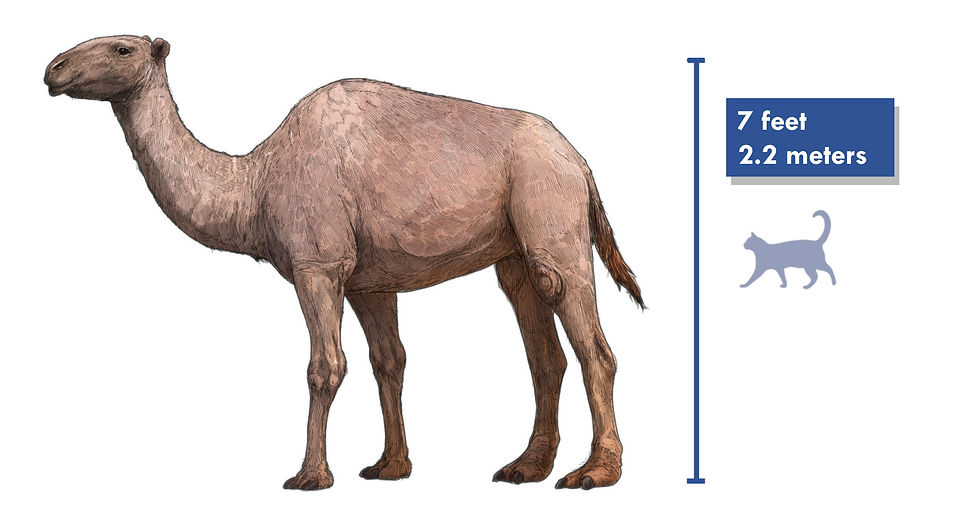
Camelops, also known as the Western Camel or Yesterday’s Camel, was a Pleistocene camel which somewhat resembled today’s dromedary camels. The shape of the spinous processes over the vertebrae along this camel’s back might indicate that it had a low hump similar to those seen in living camels, although the shape and extent of this soft tissue structure has not yet been determined. These animals seem to be closely related to animals like Paracamelus who crossed over into Eurasia and were the direct ancestors of the camels found in parts of Asia and Africa today. Fossils of Camelops are found from southern Canada all the way to Honduras, indicating that these animals once had a very broad geographical range spreading across most of North America.
Standing around 7 feet tall, Camelops would have been similar in size to today’s dromedary camels. It is assumed to have had a flexible lip split into two halves like modern camelids, an adaptation which would have allowed it to easily browse for vegetation and to pull leaves off of branches. Fossils showing many sets of Camelops footprints laid down in the same area show us that these camels were animals who preferred to live in herds. Based on the discovery of Camelops remains found in association with stone tools and showing signs of cut marks on their bones, it seems as though these camels were also hunted by humans who had crossed over into the Americas
Bison and Muskoxen (Bovidae)
Ancient Relatives of Cattle and Goats
Bovids are a family of mammals with four-chambered stomachs and cloven hooves which includes today’s cows, goats, sheep, muskoxen and antelopes. These animals first appeared in Eurasia and by the Pleistocene, North American bovids were still fairly recent arrivals on the continent. During the Pleistocene, the bovid family was represented in North America by members of the Bovinae subfamily (Bison, cattle) as well as members of the subfamily Caprinae (Muskoxen, sheep, etc.). Some of these ancient species seem to have been the direct ancestors of species still found in North America today, while others became extinct towards the end of the Pleistocene or the start of the Holocene. One species from the Pleistocene, the Giant Bison, may have been the largest bovid ever to live in North America.
Giant bison
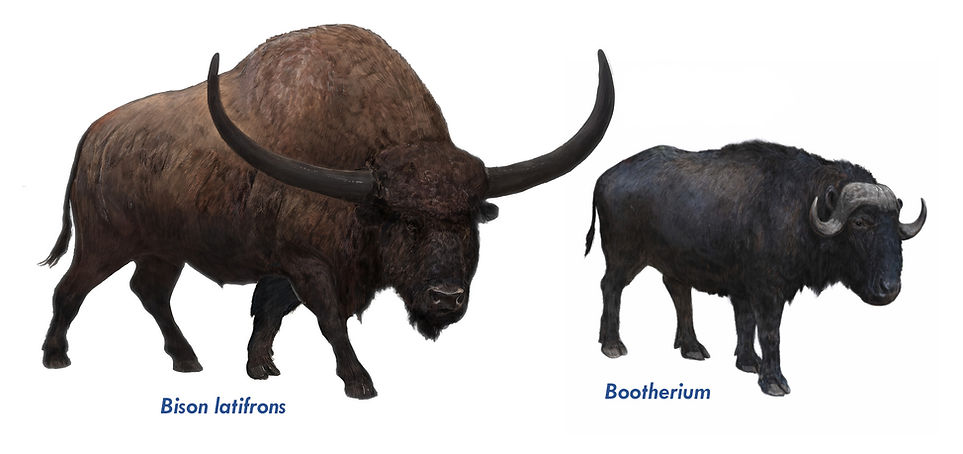
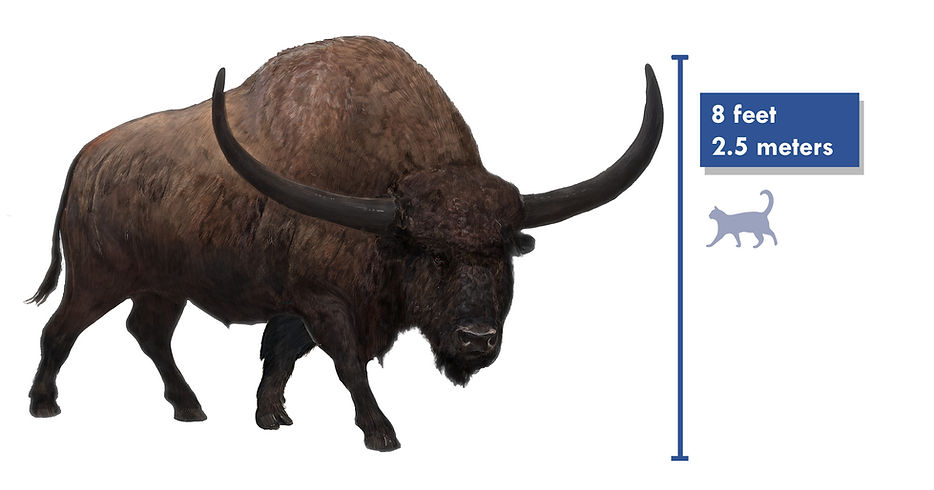
Bison latifrons
Temporal Range: 120,000 years ago to approximately 13,000 years ago
Geographic Range: Found across North America, from Canada to Mexico
Species: B. latifrons
Diet: Herbivorous, grasses, twigs, leaves
Bison latifrons was the largest bison species to appear in North America during the Pleistocene epoch. It is best known for its gigantic horns which could span 7 feet from tip to tip, much larger than the horn spans of today’s bison. The shape of the rest of the body of Bison latifrons remains something of a mystery as most material known from this animal is composed of fragmentary skulls and horns, but if scaled based on other bison species, these animals would have been truly enormous, reaching masses comparable to those of adult white rhinos.
Like all North American bison species, Bison latifrons is thought to have descended from a population of steppe bison who crossed over the Bering land bridge into Alaska and from there spread throughout the rest of North America, diversifying as they entered new habitats. There is some evidence to suggest that Bison latifrons may have given rise to Bison antiquus which was the ancestor of today’s American bison.
As a side note, animals of the genus “Bison” are sometimes considered to be part of the same genus as cattle, the genus “Bos”. This would make the giant bison Bos latifrons but since this group is more commonly known by the genus name “Bison” we will continue to use this genus name for our entries about prehistoric bison species.
Ancient bison
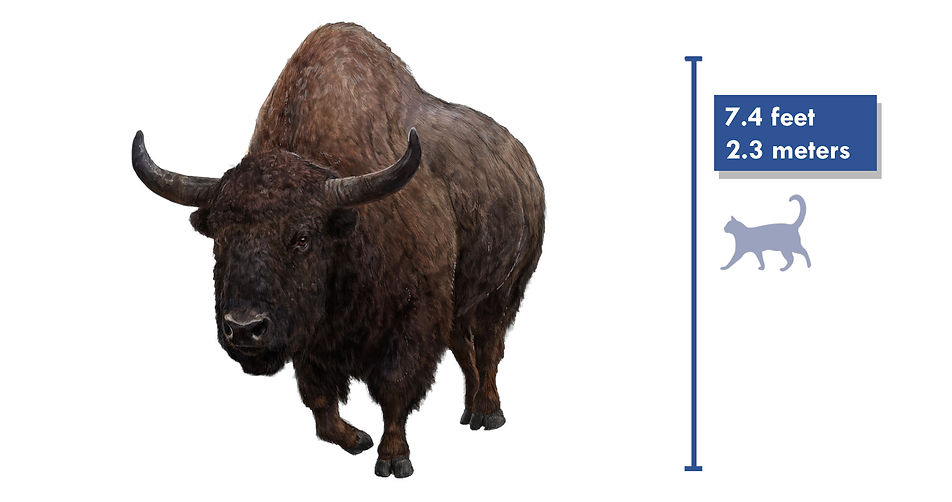
Bison antiquus
Temporal Range: 60,000 years ago to approximately 10,000 years ago
Geographic Range: Found throughout North America
Species: B. antiquus, desendents of this species evolved into B. bison
Diet: Herbivorous, grasses, twigs, leaves
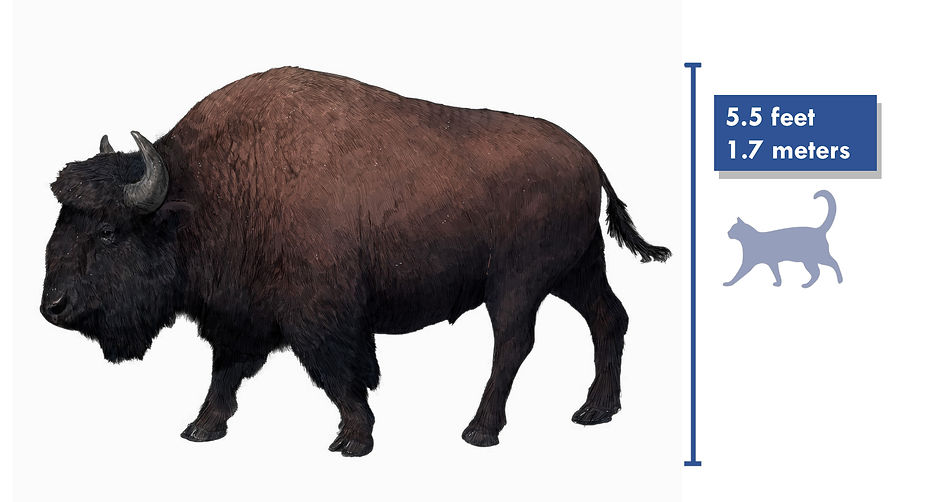
Bison antiquus, also known as the ancient bison, was a large extinct species of bison which is thought to be the ancestor of the western bison and the species of bison found in North America today. Compared with today’s bison, Bison antiquus was considerably larger and had a taller hump over its shoulder. The presence of this hump is determined based on the presence of extremely long spinous processes on vertebrae near the animal’s shoulders.
Patterns of wear on their teeth suggest that they were better suited for feeding on a mixture of soft leaves and tough grasses, spending their lives living in mixed forest-grassland habitats, instead of being grassland specialists. Like today’s bison, these animals are presumed to have lived in large herds, offering them protection from animals like saber-toothed cats, pantherines and large canids which are known from fossil evidence of kill sites to have preyed upon ancient bison fairly regularly. Humans also seem to have hunted these bison, as they were still present when the first people arrived in North America.
Western bison
Bison occidentalis
Temporal Range: 13,000 years ago to approximately 1,700 years ago
Geographic Range: Found in Alaska and central North America
Species: B. occidentalis, possibly intermediate between B. antiquus and B. bison
Diet: Herbivorous, grasses, twigs, leaves
Bison occidentalis, also known as the western bison is a type of bison which is sometimes considered its own species or alternatively considered to be a subspecies of American bison. These animals managed to survive up until very recently, with the youngest Bison occidentalis remains having been found at a site dated to be less than 2,000 years old.
In terms of their appearance, they were roughly similar to today’s American bison, smaller than their possible ancestor, the much larger Bison antiquus. They had medium-sized horns which pointed up and slightly forwards. Fossils of these animals are found far to the north where they likely would have needed very thick fur in order to survive frigid arctic winters. At various times, different authors have suggested these animals to have constituted their own genus, or to have formed a subspecies of either Bison priscus, Bison antiquus or Bison bison.

Woodland muskox
Bootherium bombifrons
Temporal Range: 780,000 years ago to approximately 12,000 years ago
Geographic Range: Found throughout North America
Species: B. bombifrons
Diet: Herbivorous, grasses, twigs, leaves
Bootherium bombifrons, the woodland muskox, was an extinct species of muskox adapted for life in forested habitats. These animals are sometimes called helmeted muskoxen, since their horns are fused together over their foreheads instead of being separated by a small gap as in living muskoxen. Bootherium remains are found in sites which represent temperate environments, suggesting that these ancient animals preferred to live in dense woodlands instead of the open tundras where their living relatives can be found today. In order to remain comfortable while living in these warmer habitats, they may have been covered in a lighter coat of fur, especially during the summer months.
Although muskoxen superficially resemble cows, they are actually part of the subfamily Caprinae, which also includes today’s sheep and goats. The name for the genus of the living muskox, “Ovibos”, translates to “sheep-cow” because of this resemblance. Like their living kin, the woodland muskox would have had wide feet well adapted for walking over muddy, snowy or otherwise unstable ground.

Shrub ox
Euceratherium collinum
Temporal Range: 1.1 million years ago to approximately 13,000 years ago
Geographic Range: Genus is found in Asia and North America
Species: E. collinum, E. bizzelli
Diet: Herbivorous, soft buds, twigs, leaves
Euceratherium, the shrub-ox, was a genus of muskox whose remains are found in parts of Central America, the southern and western parts of the US and parts of China. Fossils of Euceratherium have been found as far south as Guatemala, giving it one of the southern-most ranges of any muskox species. The remains in eastern Asia seem to be the oldest remains of Euceratherium and these animals most likely first appeared in Eurasia before later moving over to North America at some point during the middle Pleistocene.
Euceratherium seems to have preferred living in hilly areas where these animals would have fed upon leafy vegetation instead of grass. They are thought to have filled an ecological role similar to that of the living takin, another species of caprine bovid found today in parts of the Himalayas. Like other muskox species, Euceratherium had large horns, although their horns tended to curve sharply forwards instead of upwards as is seen in those of living muskoxen and those of the extinct woodland muskox Bootherium.
Pronghorns (Antilocapridae)
North America's Endemic Ruminants
Antilocaprids are a group of hoofed ruminant mammals native to North America. Although they are often called “antelopes” their closest relatives are giraffes and okapis. Many types of prehistoric antilocaprids can be distinguished from one another based on the shapes of their horns. These horns possess some features unique to this group. Although they superficially resemble the true horns found in bovids, antilocaprids are able to shed their horns similarly to the way that deer shed their antlers. Extinct antilocaprids, like today’s pronghorns, were typically grassland specialists and fed on a diet primarily composed of grass, although some ancient antilocaprid varieties may have had a greater preference for browsing on leaves.
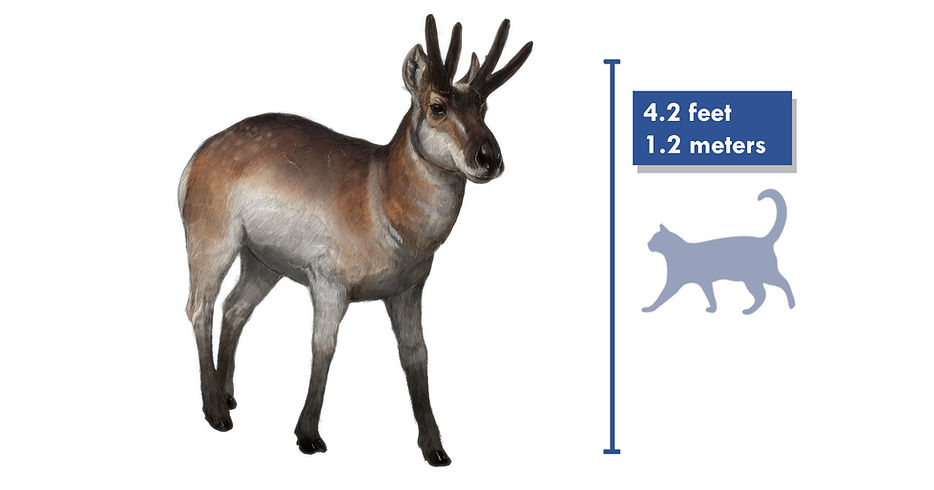
Stockoceros conklingi
Temporal Range: 1.8 million years ago to approximately 12,000 years ago
Geographic Range: Southern North America, as far as central Mexico
Species: S. conklingi, S. onusrosagris
Diet: Herbivorous, grasses, twigs, leaves
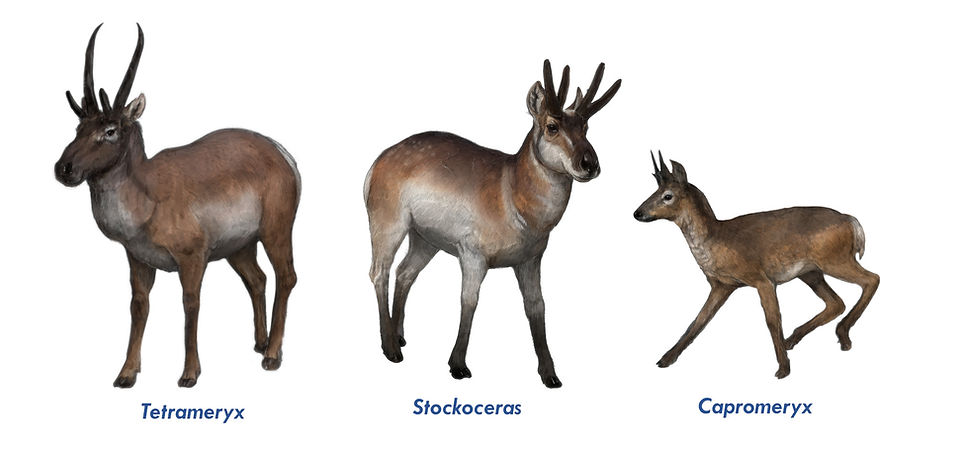
Stockoceros was a genus of extinct pronghorns whose fossils are found in the southern parts of North America. Their fossils are found as far North as Texas and as far south as central Mexico, with populations also reaching the Pacific coast in parts of California. Stockoceros had two horns on top of its head and each of these horns was split into two halves of roughly equal length and size. The tips of the horn cores from these animals are slightly rounded instead of pointed, but keratin horn extensions may have meant that their horns grew into a different shape in life in some individuals.
Stockoceros was initially considered to be part of the genus Tetrameryx, another larger pronghorn found in Pleistocene deposits, however most workers currently consider it to be a valid separate genus. Most remains of Stockoceros represent animals who are slightly smaller than today’s pronghorns but larger than the dwarf pronghorn Capromeryx.
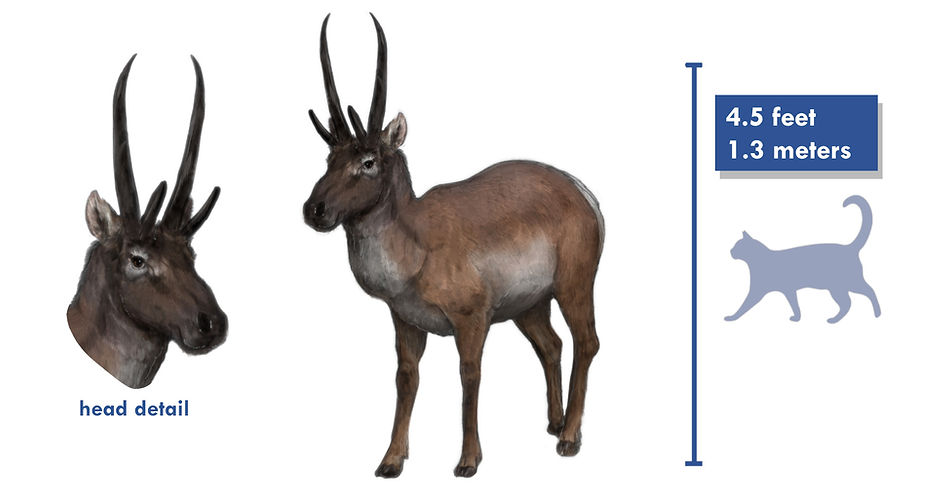
Tetrameryx shuleri
Temporal Range: 1.8 million years ago to approximately 12,000 years ago
Geographic Range: Found throughout western North America
Species: T. irvingtonensis, T. knoxensis, T. mooseri, T. shuleri, T. tacubayensis
Diet: Herbivorous, grasses, twigs, leaves
Tetrameryx is an extinct genus of pronghorns known from fossils found in the southern and western parts of North America. Many species are classified within this genus, distinguished from one another based on subtle differences in the shapes of their horns. In the best represented species, Tetrameryx shuleri, there is a considerable difference between the sizes of the front and rear horns. In this species, a shorter set of anterior horns sits at the front of the skull with two larger horns behind them. These rear horns could extend to lengths of over 2 feet, making them far larger than the horns of living pronghorns.
Tetrameryx appears to have been a more heavily built animal than many of its relatives. As with other antilocaprids, the structure of its leg bones are unique, with the lower legs composed of only the cannon bones without any additional lateral toes. The most recent Tetrameryx populations seem to have died out around 12,000 years ago
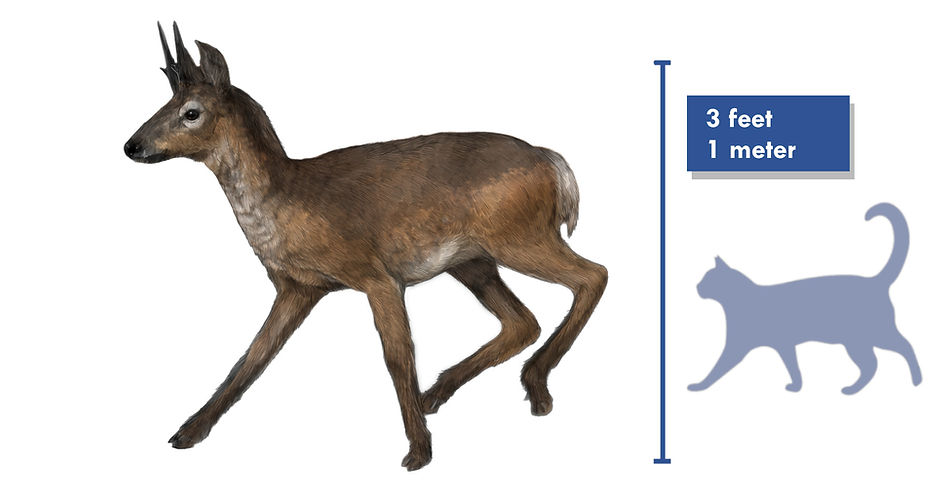
Capromeryx furcifer
Temporal Range: 5 million years ago to approximately 11,000 years ago
Geographic Range: Found throughout North and South America
Species: C. arizonensis, C. furcifer, C. gidleyi, C. mexicanus, C. minor
Diet: Herbivorous, grasses, twigs, leaves
Capromeryx, also known as the dwarf pronghorn, was the smallest known antilocaprid genus. It lived in North America from the start of the Pliocene to the late Pleistocene epoch, with its fossils having been found from Nebraska to as far south as central Mexico. The smallest species of Capromeryx had estimated adult body weights in the area of around 25 pounds, making them much smaller that today’s pronghorns.
The horns of Capromeryx were arranged into four points. Unlike in Stockoceros or Tetrameryx where their horns point in opposite directions, forwards and backwards, in Capromeryx the horn cores seem to be positioned parallel to one another on each side of the skull. In the remains of some individuals the front and rear horns are of roughly equal length while in others the front horns are considerably shorter than the rear horns. In general it seems as though later species of Capromeryx had smaller horns than their relatives in the Pliocene.
Media Gallery


