
Carnivora

Bears, Dogs, Cats and their Relatives
Carnivora is a diverse order of mammals which includes all of today’s cats, dogs, bears, weasels, skunks, otters, raccoons, coatis, seals and sea lions, along with their closest relatives. The name carnivora refers to the meat eating diets common amongst the members of this group, but it should be noted that not all carnivorous animals are carnivorans and not all carnivorans are carnivorous. Although many carnivorans almost exclusively eat meat, some members of this group, like raccoons and grizzly bears, eat a mixed diet of meat and plant matter. Furthermore other carnivorans, like the olinguito and kinkajou, almost exclusively eat fruit. During the Pleistocene epoch the Midwest was home to several types of large carnivorans which have since disappeared. The most famous of these extinct carnivorans are without a doubt the large saber-toothed cats like Smilodon and Homotherium, but other animals like short-faced bears, American lions and giant jaguars were also found in this region at the time.
Bears (Ursidae)

Short-faced bears
By the end of the Pleistocene, North America was already home to the brown, black and polar bears we associate with the continent today, but a few other types of now extinct bears would have also made their home in this area at that time. These were the short-faced bears which are known from two main species found in Pleistocene deposits. The largest of these was the Giant short-faced bear Arctodus simus, while a smaller species, Arctodus pristinus, lived in parts of Florida and the area which would one day become the southeastern US.

Giant short-faced bear
Arctodus simus
Temporal Range: 2 million years ago to approximately 12,800 years ago
Geographic Range: Found across North America, Alaska to Mexico
Species: A. simus, A pristinus
Diet: Omnivorous, fish, meat, roots, invertebrates, carrion
The giant short-faced bear, Arctodus simus, was the largest bear found in North America during the Pleistocene epoch. These animals would have been larger than today’s polar bears. They were well over five feet tall at the shoulder and would have easily stood over 10 feet tall standing on their hind legs. Arctodus was part of a subfamily of bears called Tremarctinae, a group whose only living member is the spectacled bear found in parts of the Andes mountains in South America. The tremarctine subfamily first appears in the fossil record at the end of the Miocene epoch with remains of animals like Plionarctos found in parts of central North America. Many of the larger tremarctine bears like Arctodus simus and the South American Arctotherium angustidens appeared later on in the Pleistocene.
Although it is often called the “short faced” bear, Arctodus’s face was not as flattened as is seen in older paleoart. Although its snout was shorter than that of a living grizzly bear, Arctodus’s nasal tissues would have extended the length of their noses further forward than the shape of the animal’s skull would initially suggest.

Lesser short-faced bear
Arctodus pristinus
Temporal Range: 2.5 million years ago to approximately 500,000 years ago
Geographic Range: Southern and eastern North America
Species: A. simus, A pristinus
Diet: Omnivorous, fish, meat, roots, invertebrates, carrion
Arctodus pristinus was a smaller species of short-faced bear whose fossils are found in the southeastern US in deposits from the early Pleistocene. In the parts of its range which extended into Florida, it would have lived alongside yet another species of short-faced bear, Tremarctos floridanus, as well as saber-toothed cats like Xenosmilus and large canids. Although it was smaller than Arctodus simus, Arctodus pristinus would still have grown to larger sizes than many types of bears still found in North America today. Like all other short-faced tremarctine bears, Arctodus pristinus had a tall shoulder, long legs and a somewhat shortened snout.
Arctodus pristinus is thought to have had an omnivorous diet, feeding on carrion, fruits, tubers, fish and possibly occasionally hunting for live prey. They may have used their large body sizes to frighten other carnivores away from their kill sites. This behavior involving opportunistically stealing food from other animals is sometimes seen in living grizzly bears in western North America so it is not unreasonable to think that short-faced bears may have engaged in similar behaviors.

Cats (Felidae)
Sabertooths and ancient felines
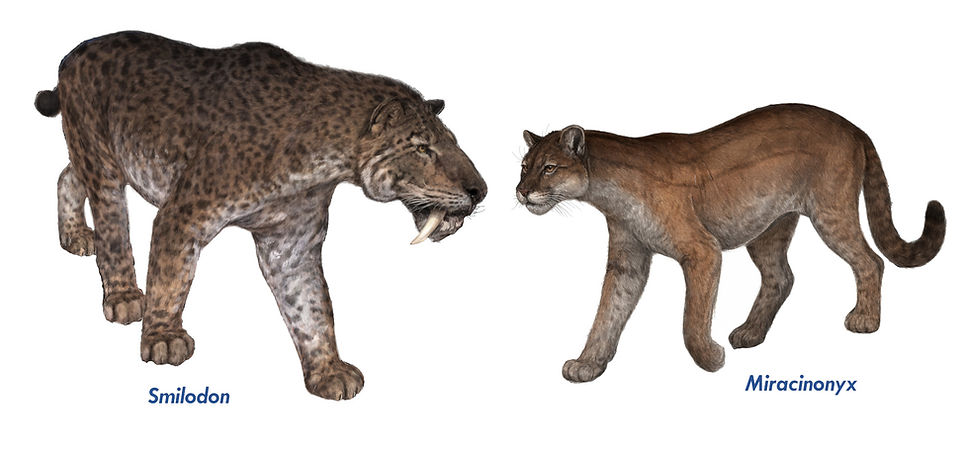
Cats form a family of carnivorous mammals with short snouts who typically have retractable claws. All members of the cat family are hypercarnivorous, almost exclusively eating meat. The ancestors of cats crossed into North America from Eurasia sometime during the Miocene epoch and by the start of the Pleistocene, the Midwest was home to several types of large cats, many of which were endemic to the North American continent. The best known prehistoric cats from this time period are saber-toothed cats like Smilodon and Homotherium. Extinct relatives of the pantherine cats, like American lions and giant jaguars, could also be found in this region, living alongside relatives of today’s mountain lions who had independently developed long legs adapted for chasing down fast moving prey

Smilodon fatalis
Temporal Range: 700,000 years ago to approximately 11,000 years ago
Geographic Range: Found across North America, possible South American material
Species: S. fatalis, S. gracilis, S. populator
Diet: Carnivorous, large mammalian prey
Smilodon is the best known genus of saber-toothed cats. Smilodon fatalis was the dominant species in North America, descended from its smaller ancestor, the earlier Smilodon gracilis. Some Smilodon populations even managed to cross the Isthmus of Panama and reached South America, becoming their own separate species, Smilodon populator. The North America Smilodon found in the Midwest at the end of the Pleistocene epoch were slightly smaller than their relatives in South America but would still have been some of the largest cats found on the continent at that time. Their characteristic sabers seem to have been surprisingly fragile. Some fossils of Smilodon are occasionally found with broken saber teeth showing signs of wear indicating that they broke while the animal was still alive. Their exact purpose as part of Smilodon’s hunting strategy remains a matter of debate with some suggesting that they may have been used in order to quickly sever blood flow in the necks of their prey.
Although they are often colloquially referred to as “saber-toothed tigers”, Smilodon and other sabertooths were not particularly closely related to today’s lions and tigers. Sabertoothed cats are now classified within their own separate subfamily, Machairodontinae, which has no living members. Many of the later members of this group had very short tails.


Scimitar-toothed cat
Homotherium serum
Temporal Range: 4 million years ago to approximately 12,000 years ago
Geographic Range: Genus found in the Americas, Eurasia, Africa
Species: H. serum, H. latidens, H, ischyrus, H. venezuelensis
Diet: Carnivorous, large mammalian prey
The scimitar-toothed cat, Homotherium, was one of the most widely distributed genera of saber- toothed cats. Its fossils have been found in Europe, Asia, Africa, North America and South America, a range comparable to the historic distribution of the genus Panthera. Like most of its relatives it had a short tail and longer limbs than many of today’s cats. Compared with animals like Smilodon, Homotherium had shorter saber teeth and a longer skull.
Homotherium is special since it is not only known from fossils of its bones. A recently discovered mummy of a Homotherium latidens cub from Siberia tells us that this species had reddish-brown fur as cubs. This information may not carry over to the North American species of Homotherium, Homotherium serum, but it nevertheless gives us a surprisingly detailed insight into the appearances of at least some of these ancient cats.
Homotherium’s short sabers may not have been visible when these cats had their mouths closed in life. Like many of today’s cats, it’s likely that they kept their canine teeth sheathed inside of fleshy pockets lining the outside edges of their gum tissues of the lower jaw.

American lion
Panthera atrox
Temporal Range: 129,000 years ago to approximately 13,000 years ago
Geographic Range: North America as far south as Guatemala
Species: P. atrox
Diet: Carnivorous, large mammalian prey
One of the largest cats found in Pleistocene North America was not a saber-toothed cat at all, but rather a member of the same genus as today’s leopards, tigers and lions. This was the American Lion, Panthera atrox, possibly one of the largest cats ever to exist. These giants were around 25-30% larger than today’s lions, standing nearly four feet tall at the shoulder. American lions are thought to have descended from a population of Eurasian cave lions who crossed over into North America during the late Pleistocene. They may also be known from fossil material found in South America. Since Eurasian cave lions are known from cave art to have been maneless cats, it’s likely that even male American lions also lacked this feature.
Given their large size, American lions would have been able to hunt many of the larger herbivorous mammals found in North America during the Pleistocene, bringing down bison, pronghorns, large deer, muskoxen and possibly even mammoths and mastodons. We know very little about their social structures but they may have lived and/or hunted together in prides like today’s lions. There is some evidence from cave paintings to suggest that their cave lion ancestors also lived in groups which may lend further credence to the idea that these American lions also spent time living together.

Giant jaguar
Panthera onca augusta
Temporal Range: 1.8 million years ago to approximately 11,000 years ago
Geographic Range: Found throughout North America
Species: P. onca augusta
Diet: Carnivorous, large mammalian prey
The Giant Jaguar, Panthera onca augusta, was a large subspecies of jaguar once found as far north as Oregon. These animals are known from some fairly fragmentary remains but by scaling these fossils using the bones of living jaguars, it seems as though the largest members of this subspecies were up to 20% larger than their modern relatives, possibly as an adaptation for hunting larger prey in open habitats. Their legs are considerably longer than those of living jaguars, making them taller as well as more massive than their possible descendents. There are also trackways suggested to have been made by a giant jaguar in Tennessee at Blue Spring Cave.
It is possible that the giant jaguar may be the direct ancestor of the living jaguar species found in parts of North and South America today. Today’s jaguars seem to have a preference for living in dense forests but they are also found in more open semi-arid environments. Some jaguars are even found today within the southernmost parts of the continental US.

American cheetah
Miracinonyx inexpectatus, M. trumani
Temporal Range: 2.5 million years ago to approximately 16,000 years ago
Geographic Range: Genus is found across North America
Species: M. inexpectatus, M. trumani
Diet: Carnivorous, large mammalian prey
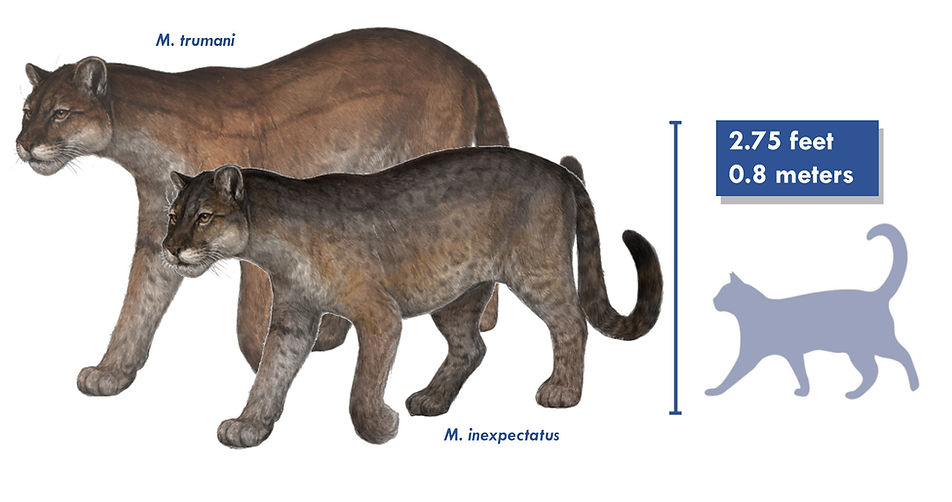
Despite its name, the American cheetah, Miracinonyx, was not a close relative of today’s cheetahs. These long-legged cats were instead distant relatives of today’s mountain lions. Two species of Miracinonyx are currently recognized; Miracinonyx inexpectatus and Miracinonyx trumani. Miracinonyx trumani is the most cheetah-like of the two species, with a narrow body and longer legs than most cats.
The purpose of these long legs is unclear, with some studies suggesting that they would have filled a similar ecological role to the living cheetah, using bursts of speed to chase down pronghorns or deer. Other studies point out that these animals did not have the same foot structure seen in living cheetahs, possibly indicating that these animals were not as well suited to running down prey as we may have once thought. Miracinonyx inexpectatus had a body shape much more similar to that of today’s mountain lions. These animals may have been the ancestors of Miracinonyx trumani, in which case the latter only later developed their unique leg and body proportions.

Dogs and Wolves (Canidae)
Canids in the Midwest
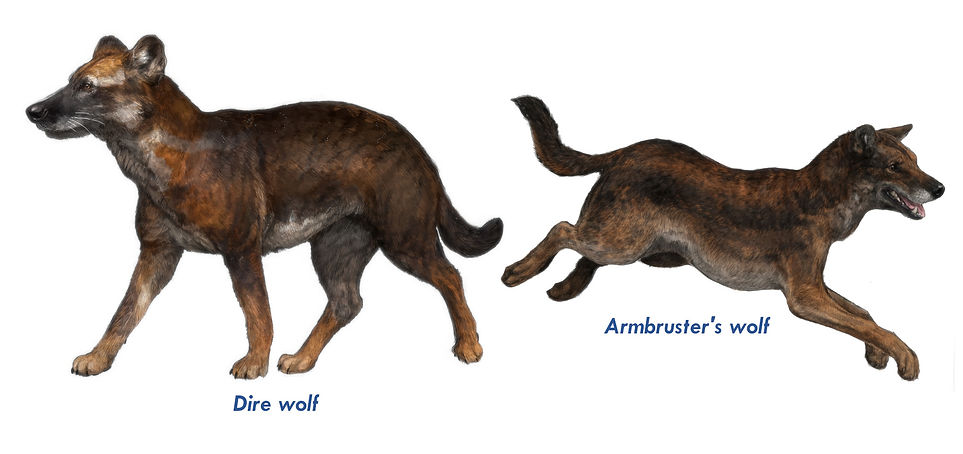
Canidae is the family of carnivoran mammals which includes today’s dogs, wolves, jackals, raccoon dogs and dholes. They are part of the caniform group of carnivorans meaning that they are more closely related to bears, weasels and otters than they are to cats or hyaenas. Most members of the canid family have long narrow snouts. They also have a set of large upper fourth premolars and a pair of specialized lower first molar used to cut through meat. During the Pleistocene epoch, the midwest was home to some of the ancestors of today’s gray wolves and red wolves, as well as a variety of other extinct canids, most famously the dire wolf, Aenocyon dirus.
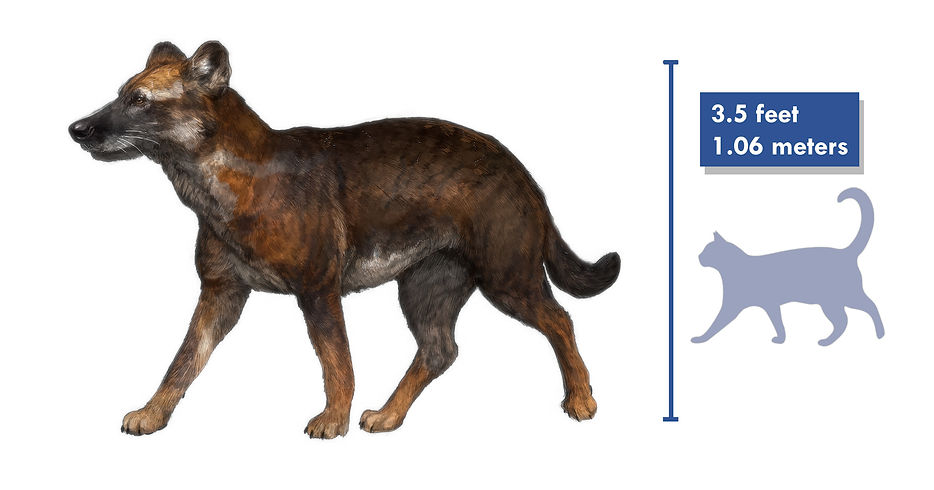
Aenocyon dirus
Temporal Range: 125,000 years ago to approximately 10,000 years ago
Geographic Range: Found in parts of North and South America
Subspecies: A. dirus dirus, A. dirus guildayi
Diet: Carnivorous, large mammalian prey
The dire wolf, Aenocyon dirus, was originally considered to be a close relative of the gray wolf, placed alongside it within the genus Canis. More recent analyses of their bones have suggested that dire wolves may have actually been part of a more distantly related lineage which diversified and spread throughout the Americas. This research led the dire wolf to be placed in a different genus, Aenocyon. In popular culture, dire wolves are usually represented as much larger versions of gray wolves. In reality, these animals were around the same size as the largest living gray wolves, although they were generally more heavily built than living wolves.
Dire wolf remains are some of the most common mammal remains found at the La Brea Tar Pits in Los Angeles. Thousands of dire wolf bones have been found at this site, most likely drawn to the pits by the sounds of other animals who had already become trapped in the thick pools of tar. The sheer number of dire wolf remains found at these sites is considered evidence that these animals would have lived together in large packs, possibly using their numbers to bring down very large prey.
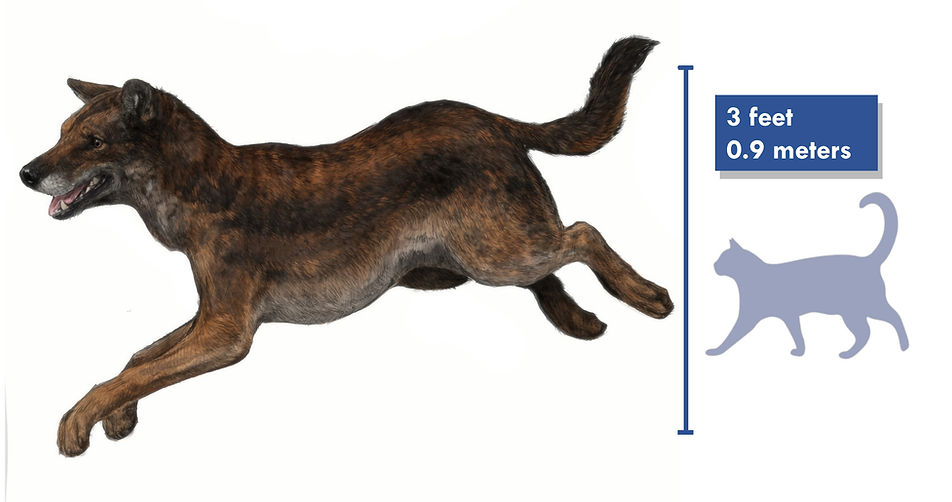
Aenocyon armbrusteri
Temporal Range: 850,000 years ago to approximately 13,000 years ago
Geographic Range: Found across North America
Species: A. armbrusteri
Diet: Carnivorous, large mammalian prey
Armbruster’s wolf was a species of canid found throughout North America during the Pleistocene epoch. Much like the dire wolf, these animals were originally placed within the genus Canis along with living dogs and wolves, but have since been placed within a separate genus; Aenocyon. Armbruster’s wolf shared many skeletal features in common with dire wolves and may in fact be the direct ancestor of Aenocyon dirus. Its fossils were first found in Maryland but remains belonging to Armbruster’s wolves have since been found throughout the US. It seems to have been most abundant during the early and middle Pleistocene epoch.
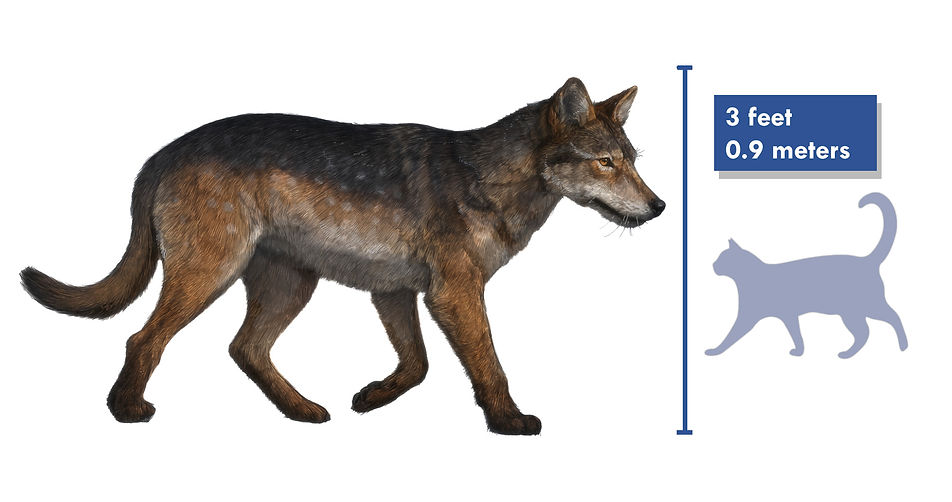
Canis edwardii
Temporal Range: 2.3 million years ago to approximately 300,000 years ago
Geographic Range: Found throughout most of North America
Species: C. edwardii
Diet: Carnivorous, meat, invertebrates
Edward’s wolf, Canis edwardii, is a canid with uncertain evolutionary relationships with other Pleistocene canids from North America. These animals are currently considered to be the ancestors of today’s coyotes. In terms of their size, Edward’s wolves were smaller than gray wolves but still quite a bit larger than living coyotes. Their snouts were long and thin and they seem to have been well adapted for hunting larger prey, unlike today’s coyotes which have a more generalist diet and feed primarily on smaller mammals and birds. Little is known about the social structures or possible pack sizes for Edward’s wolf.
Media Gallery


